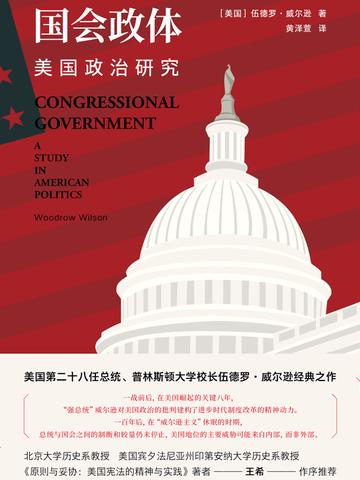
"Congressional Government: A Study of American Politics" provides a detailed introduction to the central nervous system of American federalism - the unique attributes and real operation picture of Congress, including its organizational structure that is different from other representative institutions, its complex activity rules, and its actual relationship with the executive agencies. The U. S. Constitution has designed a complex and exquisite system of checks and balances, but it is nothing more than a written theory. In reality, the U. S. Federal system is dominated by Congress, and the power of Congress is dispersed in the hands of various standing committees. This "parliamentary system of government" has complicated rules of procedure, decentralized powers, unclear responsibilities, and the absence of leaders, which is far from the ideal of the Constitution. In the book, Wilson reviewed the U. S. House of Representatives, Senate, and executive agencies one by one. In order to overcome this fundamental flaw in the U. S. Federal system, he believed that a concise government system with simple channels, single and complete powers, and clear responsibilities should be established to get closer to the political ideal that the 1787 Constitution attempted to achieve.
Reader comments
Detailed and comprehensive, professional book with reading threshold









Detailed and comprehensive, professional book with reading threshold