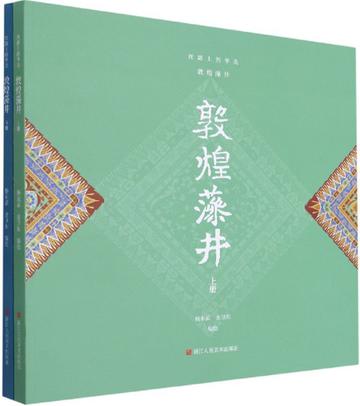
A professional reference book containing Dunhuang caisson restoration patterns.
Editor's recommendation
⭐Comprehensive organization and detailed restoration. This book collects the representative works of Caojing and Pingqi in Dunhuang patterns from various historical periods from the Southern and Northern Dynasties to the Yuan Dynasty. There are complete patterns and partial enlargements to facilitate readers' reading and reference.
⭐Professional explanation and authoritative interpretation. An authoritative expert on Dunhuang studies explains and introduces the restoration of Dunhuang caissons, with professional illustrations and illustrations, which serves as a reference book for many industries such as arts and crafts and graphic design.
⭐With pictures and texts, the language is simple. It contains the Dunhuang caisson patterns from the Northern and Southern Dynasties to the Yuan Dynasty, including the overall picture and local details, and is accompanied by text explanations. The language is clear and concise, which plays a very good supplementary role.
Introduction
This book is a collection of restored patterns of caissons in Dunhuang dynasties, divided into two volumes. The caisson is a concentrated and comprehensive expression of Dunhuang patterns. The caisson is a well made of crossed trees and decorated with algae inscriptions. It is located on the top of a traditional Chinese wooden building. In the Five Elements Theory of traditional Chinese culture, there is a saying that fire overcomes wood and water overcomes fire. Painting deformed patterns of aquatic plants on wooden components that are extremely vulnerable to fire is not only beautiful but also has the meaning of fire prevention.
Dunhuang pattern painting and Dunhuang figure painting began and ended in the same era. They both experienced a thousand-year painting period from the Sixteenth Kingdom of the Eastern Jin Dynasty to the end of the Yuan Dynasty. The creation and drawing of patterns has never stopped. Their origins are the same, but the styles of each era are different. They have gone through the entire process of Dunhuang art creation. What is commendable is that this process is in a spontaneous and conscious natural state, and is a concrete expression of the human state of mind. The following discussion will be made on its contemporary context and artistic expression style.
[About the author]
Yang Dongmiao was born in a Dunhuang art family in the ancient city of Xi'an in November 1969. He has been passionate about painting since he was a child. Later, he learned fine brushwork and heavy-color figure painting from his fathers. During this period, he was influenced by the art of Dunhuang murals, and he determined to devote his whole life to restoring the Dunhuang murals so that more people could witness the essence of Chinese civilization. He successively studied at the Xi'an Academy of Fine Arts, the People's Liberation Army Art Institute, and the Central Academy of Arts and Crafts, where he improved his theory and painting skills.
Since 1992, it has spent millions to restore and copy more than 300 Dunhuang murals. Large-scale Dunhuang mural restoration exhibitions have been held in Xi'an, Beijing, Foshan, Shunde, Chengdu, Hangzhou, Shanghai, Nantong, Taipei and other places, and are deeply loved by the audience. He designed all the caisson patterns and some murals for the nine-story pagoda of the Western Temple of the Hong Kong Bodhi Society. From 2012 to 2015, it took three years to restore Cave 220 of the Early Tang Dynasty and Cave 45 of the High Tang Dynasty in the Dunhuang Mogao Grottoes at the Tang West Market, the starting point of the Silk Road in Xi'an. In 2015, he designed and created a 400-square-meter giant mural "Huayan Sutra" in the Huayan Hall of Fufeng Peacock Temple in Shaanxi Province. In 2016, he created and painted an imitation Tang caisson for Xi'an Guangyao Cultural Communication Center, and designed and produced a 10-meter-high auspicious four-sided Buddha statue for Liquan, Shaanxi.
From 2002 to the present, he has published monographs such as "Recreating Dunhuang - Collection of Large-Scale Dunhuang Mural Restorations", "Dunhuang Flying Apsaras", "Dunhuang Mural Line Drawing Collection", "Dunhuang Fine Border Decorations·Yuanguang Collection", "100 Pictures of Dunhuang Fine Caissons from Past Dynasties", "Dunhuang Dance Fine Line Drawings", etc.
Reader comments
I think it is like an art treasure, which opened my eyes! I have read some books about art before, but this book gave me a very different feeling. It makes me feel like I am in the art world of Dunhuang and feel the charm of thousands of years of culture. I think this book is a very valuable reference book for people who like art and history!
I think it is like an art treasure, which opened my eyes! I have read some books about art before, but this book gave me a very different feeling. It makes me feel like I am in the art world of Dunhuang and feel the charm of thousands of years of culture. I think this book is a very valuable reference book for people who like art and history!