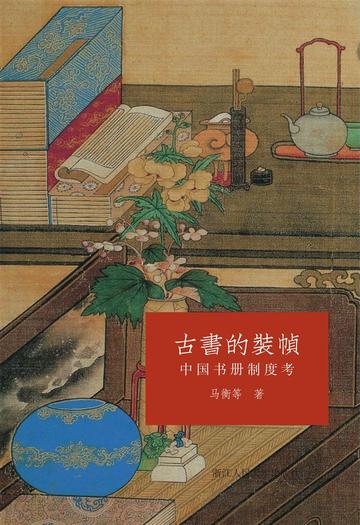
A collection of papers discussing the book system in ancient China!
Editor's recommendation
⭐Master of Chinese Studies, authoritative discussion. Representative works by famous scholars. This book selects representative papers by Ma Heng, Yu Jiaxi and other Chinese masters discussing the book system. Representative papers from authoritative experts, rigorous and highly readable.
⭐Standardized and organized with pictures and texts. The better final draft of the paper is selected, organized according to modern publishing standards, and pictures are inserted to facilitate readers' intuitive understanding. Reproduce high-definition pictures of the real thing, combined with text explanations, for easy understanding.
⭐The system is accurate and supported by physical objects. Many of the articles are difficult to write, the writing is fluent, and the points raised are quite insightful. There are not a large number of documents handed down from ancient times that record the decoration methods of books, so the evidence of physical data is particularly important, and the exquisite illustrations in this book play a good role in supplementing the explanation.
Introduction
This book contains several papers discussing the book binding system in ancient China, such as "Research on Book Decoration", "Research on the Changes of Chinese Book System", etc. It is very useful for understanding the binding of ancient books. Related pictures are inserted along with the text to make it easier for readers to understand. The whole book is written by Ma Heng, Yu Jiaxi and others.
[About the author]
① Jin E (1771-1819), courtesy name Fengjian and nickname Chengzhai, was born in Linhai, Zhejiang. Yougongsheng, Gongci Zhang, is particularly proficient in the study of the three rites. Ruan Yuan built a scripture exegesis monastery, where Jin, Hong Yixuan and others gave lectures. They made great progress in their studies and became famous for a while. His treatment of classics deduced and expounded the theories of the Confucian scholars of the Han and Song dynasties, and supplemented the classics with others. At that time, people such as Wang Yinzhi, Hao Yixing and Chen Huan were all convinced by him.
②Shimada Han (1879-1915), courtesy name Yanzhen, was born in a family of sinologists in Tokyo, Japan. His father, Shigere Shimada, was a famous sinologist in Japan during the Bakumatsu and Meiji periods, and trained a large number of well-known sinology researchers. Shimada Kanyou was trained by the court, and later studied under the famous scholars Ii Fuzi, Takezo Mitsuhiro and others. He has profound research on the study of Chinese version and collation. At the beginning of the 20th century, Shimada Han went to China to visit books and helped Lu Xinyuan's Songlou classics be collected in Jingjia Hall.
③Ma Heng (1881-1955), also known as Shuping, was born in Yin County, Zhejiang Province (now Ningbo). He studied at Nanyang Public School in his early years, and later worked at Peking University, where he also served as president of Xiling Seal Society and director of the Palace Museum. Ma devoted his life to the study of classics, history, and epigraphy, paying particular attention to the combination of documentary records and on-the-ground physical investigation. He played a positive role in promoting the development of Chinese archeology from traditional epigraphic research to field excavation in the modern sense.
④Yu Jiaxi (1884-1955), courtesy name Jiyu, was born in Changde, Hunan. In the 28th year of Guangxu's reign in the Qing Dynasty (1902), he was elected as the head of the Literary and Selection Department of the Ministry of Civil Affairs. Later he taught at Changde Normal School. After 1927, he taught in many universities such as Fu Jen Catholic University, Peking University, China University and Beijing Women's Normal University, focusing on bibliography. He was elected as an academician of Academia Sinica. Yu has a profound academic background and profound knowledge, and has extremely high attainments in philology, history and other fields.
Reader comments
This book compiles research papers on the ancient Chinese book system by many masters of Chinese studies. The content is systematic and accurate, and it is also equipped with real pictures, allowing us to understand ancient book binding more intuitively. Moreover, the authors' writing style is fluent and the exposition is rigorous. It is not boring to read at all, and it is very helpful for us to understand traditional Chinese culture.
This book compiles research papers on the ancient Chinese book system by many masters of Chinese studies. The content is systematic and accurate, and it is also equipped with real pictures, allowing us to understand ancient book binding more intuitively. Moreover, the authors' writing style is fluent and the exposition is rigorous. It is not boring to read at all, and it is very helpful for us to understand traditional Chinese culture.