On March 23, 2018, U. S. President Trump announced the "301 Investigation" report on China and ordered the imposition of large-scale tariffs on approximately US$60 billion of goods imported from China. A new round of trade war between China and the United States broke out. The U. S. Tax increase list directly refers to "Made in China 2025", and the manufacturing industry has become the focus of competition and friction among major countries.
In fact, after the economic crisis ten years ago, countries have begun to reflect on the economic development model and have regarded manufacturing reform and development as an important means to boost the economy. Especially with the accelerated development of the new generation of information technology represented by big data, the Internet of Things, and artificial intelligence in recent years, national strategies such as advanced manufacturing in the United States, Industry 4.0 In Germany, and the robot revolution in Japan have been successively launched, all reflecting the major powers' renewed emphasis on manufacturing and their ambition to use technology to drive the upgrading and development of manufacturing.
As we all know, China's manufacturing has achieved rapid development and progress in recent years, and our country has long been known as the "world's factory." However, our manufacturing industry still faces the problem of non-independence of a large number of core production technologies and equipment, and still cannot get rid of its position at the relatively low end of the value chain in the international division of labor. In this new round of high-tech + manufacturing competition, where will my country's manufacturing industry go?
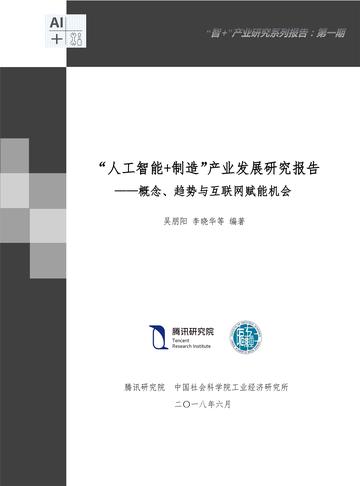
The accumulation of new technologies and business experience gained from my country's great development of the Internet, especially with the development of emerging technologies such as artificial intelligence, is likely to provide our manufacturing industry with an opportunity to "catch up around the corner." This report aims to define the relevant concepts of "artificial intelligence + manufacturing", analyze its development and the practical problems faced by China, study the special value that my country's Internet can play in it, and propose suggestions for the future development of "artificial intelligence + manufacturing" in my country based on a summary of relevant policies and development characteristics of major countries, with a view to promoting the joint progress of manufacturing and the Internet.
Directory
Report introduction
1. The concept of "artificial intelligence + manufacturing"
(1) What is artificial intelligence
(2) What is "artificial intelligence + manufacturing"
(3) How artificial intelligence "+" manufactures
2. Current status of "artificial intelligence + manufacturing"
(1) Market size
(2) Typical cases
(3) Facing challenges
3. The impact of "artificial intelligence + manufacturing"
(1) Overall industry impact
(2) Impact on classified industries
4. The Internet supports "artificial intelligence + manufacturing"
(1) The basis of Internet assistance
(2) Objects assisted by the Internet
(3) Internet-assisted model
5. "Artificial Intelligence + Manufacturing" Policy Reference
(1) Top-level design and strategic guidance
(2) Building an intelligent manufacturing platform
(3) Promote the formulation of technical standards
(4) Support research and development of common technologies
(5) Pay attention to the development of small and medium-sized enterprises
(6) Improve the talent security system
6. Countermeasures and suggestions for accelerating the promotion of "artificial intelligence + manufacturing" in my country
(1) Establish a multi-channel investment and financing mechanism
(2) Focus on breakthroughs in key common technologies
(3) Layout of major scientific and technological projects
(4) Build a multi-party collaboration service platform
(5) Establishing a pilot base for integrated innovation
(6) Improve the training mechanism for comprehensive talents
(7) Strengthen the construction of technical standards system
(8) Establishing an information security assurance system
Reader comments
This book mentioned the Sino-US trade war and made me realize the importance of manufacturing. The book also introduces relevant policies and development characteristics of various countries, which I think is of great reference value. I particularly like the part about the Internet assisting "artificial intelligence + manufacturing", which is very interesting. However, some places are too professional and I have to digest them slowly. Overall, this book is good and worth reading.



This book mentioned the Sino-US trade war and made me realize the importance of manufacturing. The book also introduces relevant policies and development characteristics of various countries, which I think is of great reference value. I particularly like the part about the Internet assisting "artificial intelligence + manufacturing", which is very interesting. However, some places are too professional and I have to digest them slowly. Overall, this book is good and worth reading.