Stats
Tags
Synopsis
Reader comments
In booklists 202
Explore more →
A High-Quality Book with a Score of 9.5 or Above
High-quality books other than Dali and Zhanshen
Completed Version of the Book of God (9.0 or Above)
Books with a Score of 9.8 or Above
Complete and High Scores
As long as you finish the novel with high scores
Check Out Books with a Tomato Score of 9.8 or Above
If there is more, please add
9.9, 9.8 Treasure Book
High-end book waste area, novices are allowed to enter
It Seems Like 9.9, 9.8 Points Are All Articles from the Entertainment Industry.
Are there no other high-scoring essays on internal types?
Looking for (Completed) Articles That I Will Never Tire of Reading! ! !
I'm already out of books, and I don't want to wait for updates that would be too painful😭. There is no limit to the type of completed articles, and the subject matter should be as novel as possible. I don't want to read the same articles.
TV Series Original Novel
Looking for original novels for TV series
Recommend a Good Book for Middle-Aged and Elderly People!
"The Troubled Life of Mountain Village Youth" is a good book with realistic themes, which is very suitable for older people to read.
9.8 Points or Above, Good-Looking and Funny New Movie
Novel, good-looking and funny, scores high
Complete the Masterpiece with a Score of 9 or Above
Novels Suitable for the Elderly
Books suitable for middle-aged and elderly people
A Book Where You Can Learn Real Skills
Any book will do
High Quality Finished Copy
Tomato Bought the Copyright, but You Don't Know About the Book
All kinds of good-looking classics are here
The Book with a Score of 9.9 Is Here
What Are the Four Sacred Books of Tomato?

9.9 Points Masterpiece
I have a 9.9-Rated masterpiece called Crazy Amway (ღ˘⌣˘ღ)
A Very Good Fantasy Novel with a Score of 9.8 or Above
Tomato's Four Funny Articles
Let Me Share with You a Few Fengshen Novels with a Score of 9.8
Jade Stone Gambling Novel
Looking for Stone Gambling Novels
Nobel Prize for Literature, Mao Dun Literature Prize, Lu Xun Literature Prize and Other Literary Works
I want to read a book similar to "One Sentence is Worth Ten Thousand Sentences: Collector's Edition".
The beginning is about the daily life of a middle-aged middle-level leader, which makes people laugh and feel helpless. The combination of the gods and the secular is very clever, and it doesn't feel inconsistent at all. The various catastrophes in the middle are true and false, and the big catastrophes are surrounded by small catastrophes. The suspense is endless, the philosophy is profound, and the reading is hearty and full of meaning. In the end, the Golden Immortal was realized, the true scriptures were obtained, and the mystery was solved. People from all walks of life achieved righteousness and returned to the right path of heaven and earth.
It uses Journey to the West as the background to allude to the workplace. The writing is humorous and the plot is clever. I laughed out loud at first, but the more I watched it, the sadder it became, because I saw the helplessness of ordinary people at the bottom. From a high-spirited and flesh-and-blood appearance, the edges were gradually smoothed by reality, and I had no choice but to restrain my sharp edges, and became the person I hated at the beginning: a refined egoist. I don't know whether this choice is right or wrong, but I prefer to believe that if you are poor, you can be alone, and if you are prosperous, you can help the world. The superiors are considerate of the inferiors. A little effort may be able to save many people at the bottom and avoid many irreversible consequences. Only by never forgetting the original intention can you always succeed.
This is a piece of workplace literature, social literature, and realistic literature wrapped in myth. The Nine-Nine-Eighty-One Dilemma is a performance by the Lingshan Buddha to support the Golden Chanzi to check and balance the Buddhas. Each force will have selfish motives in this performance. Just like many xxx recruiting people now, there are many restrictions on recruitment conditions, such as professional qualifications, etc. This is the problem of having carrots first and then pits, and posts are set up based on people. The one who touched me the most was Liu Er. He represents many disadvantaged groups who have no foundation. When they suffer injustice, unless they have deep inner obsessions, they will be crushed by social reality and have no chance to stand up. Those in power hold power, and every decision may have a butterfly effect. Just like every case in the hands of a prosecutor, for the prosecutor, it may be one case among countless files, and for the parties involved in the case, it is their life. After Wukong became a Buddha, the body carrying the six ears can be regarded as a compensation for the six ears, and it can also be regarded as a compensation for reality. Otherwise, it feels really suffocating. Jin Chanzi did not choose to become a Buddha in his true body, stay away from the cause and effect of the mortal world, and be aloof, but to save all sentient beings in the mortal world. Looking back at the past, Li Changgeng has never been able to attain the Golden Immortal Realm. He was trapped in transcendent cause and effect, and was too obsessed with love. I always think that I am entangled in trivial matters and tainted with cause and effect. Now that he has witnessed Sun Wukong abandoning his mortal body and thinking through the intentions of the Jade Emperor and the Buddha, Li Changgeng has finally figured out the true meaning of that point: transcending cause and effect does not mean not being attached to cause and effect, but only keeping one's own thoughts; being too forgetful of love does not mean being ruthless and desireless, but only cultivating oneself. After Li Changgeng obtained the Golden Immortal Ceremony, he left a trace of his thoughts to experience the world of mortals. Whether to be transcendent or not, to forget about love or not, are all choices. Just like you and me in this world, no matter how helpless we are, we still hope to respect our true heart.
After reading in depth, I deeply realized that this work is the result of the author's excitement and inspiration. The author's talent and enthusiasm flow between the lines. It is written in one go and makes people feel extremely comfortable and happy when reading it. As everyone knows, in the process of savoring it carefully, we are deeply attracted by this hearty writing style, as if we have experienced the spiritual feast with the author. Such a talented author is rare in the world and is admirable.
He is really a genius. He writes Journey to the West from another perspective, and everything is so reasonable and logically consistent. It has added another layer of confusion to Journey to the West. I am going to review Journey to the West [Thinking] If I think about it carefully, there are indeed many unreasonable things in Journey to the West. Sun Wukong is so powerful that he causes trouble in the Heavenly Palace and beats all the gods without any problems, but he repeatedly makes trouble in the mortal world.
This book can be regarded as a modified version of Journey to the West. However, when analyzing the Nine-Nine-Eighty-One Difficulties from the perspective of the Platinum Star, once the perspective changes, the magical modification of the content makes people feel more natural. It is interspersed with the rules and regulations of Vanity Fair. While Venus is at home in it, she is also troubled by the common thoughts that she will be with her since she ascends from the mortal world. I want to further enlighten myself to the Golden Immortal, but I am also worried about the cause and effect of the chaos in the Heavenly Palace five hundred years ago. But who said that to achieve enlightenment, one must not be tainted by cause and effect? So when it ascended, Venus entrusted Guanyin with its worldly thoughts and gave the Buddhist scriptures team a final explanation. The four masters and apprentices finally became Buddhas, which was the closing ceremony of the first reality show in the three realms. Xuanzang and Monkey each have their own back tricks and plans, which is pretty good.
The author is so talented and imaginative. It is really novel to read Journey to the West from this perspective. Moreover, in humorous language, it shows the complexity among "gods" and the injustice that exists between Lingshan and Heaven. It turns out that even if you become a god or golden immortal, you cannot "transcend cause and effect, and be too supreme to forget love." Full of satirical effect. There were some parts that I didn't understand and I read it over and over again. I also looked up the meanings of some words, and I learned a lot. It is worth mentioning that Sun Wukong's purity and the six-eared macaque's stubbornness are pitiful. When I was a kid, I really hated Liu Er when I watched the show, but I feel sorry for it when I see it from this angle. It is just a microcosm of countless ordinary people whose fate has been changed.
Journey to the West can be written like this. It is a refreshing and refined account of the workplace of a human resources manager. There are all the classic elements, such as the leader's children's work arrangements, taking the blame, senior management talking about Tai Chi, factional fighting, stupid young people who accept death, gossipy colleagues, difficulty in reimbursement, false reimbursement, cross-company cooperation, business outsourcing, etc. The teaching of human nature and sophistication is amazing.
I started reading it in the morning on May 4, 2024, and finished it in one sitting in one day. I was amazed! I originally thought it was about gods, demons, and monsters, but later I found out that it was about the officialdom and the workplace. Finally, I realized that it was about the refining of human nature, the simplicity of the Tao, and the return to nature. The text is quoted from classics, each sentence has its origin, the human feelings are sophisticated, echoes before and after, the details are rich, and the writing is humorous and interesting. It is the second masterpiece of Journey to the West!
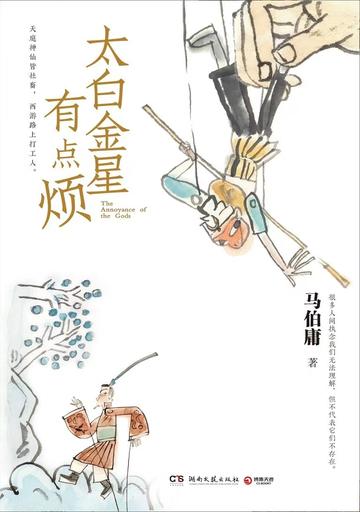
Ma Boyong's "Taibai Jinxing is a Little Annoying" is like a fantasy mirror, reflecting the "workplace world" behind a unique world of Journey to the West. It is both hilarious and deeply thought-provoking. The story unfolds from the perspective of Taibaijin Li Changgeng, bringing us into a wonderful world where myth and reality are intertwined. In the seemingly sacred and solemn workplace environment of Heaven, it is actually full of undercurrents, full of trivial affairs, complex interpersonal relationships and delicate balance of power. As a senior employee of Tianting, Li Changgeng's daily work is not just to sit in the Immortal Class at ease, but to handle various difficult documents, coordinate the interests of all parties, and deal with overt and covert struggles in the officialdom. From arranging the seats for the Peach Blossom Party to dealing with various emergencies in the Buddhist scripture-seeking plan, every task is like a carefully laid out chess game, and one careless move can lead to the whole game being lost. The most outstanding thing in the book is undoubtedly the creation of characters. Taibaijinxing Li Changgeng is no longer the aloof and unreachable god, but a flesh-and-blood "worker" full of troubles and anxieties. He is smart, capable and good at dealing with others, but he is often bound by various rules and interpersonal relationships. His inner monologue and way of dealing with things make us seem to see ourselves struggling in the workplace. The other characters are equally vivid and three-dimensional. Guanyin Bodhisattva is no longer just a symbol of compassion. She has a careful mind and superb political skills. She cleverly arranges the scripture collection project, which not only promotes the spread of Buddhism eastward, but also quietly consolidates her position in heaven and the Buddhist world. Monkey King, the Monkey King, is no longer just the hero who is omnipotent and fearless. In the book, his image is fuller, with his own helplessness and growth. From the initial misunderstanding and conflict to the later mutual understanding and cooperation between him and Taibai Jinxing, the transformation of this character relationship is delicate and touching, showing the complex multi-faceted nature of human nature. In terms of narrative style, Ma Boyong uses humorous writing to integrate serious official struggles and profound discussions on human nature into relaxed and interesting stories. The book is full of clever homophones, innovative interpretations of mythological allusions, and bitter satire on workplace phenomena. For example, the various red tapes and formalisms of heaven are vividly depicted in the author's writing, making people laugh and feel deeply familiar at the same time. Ridicule such as "Golden immortals must also know how to report, otherwise credit will turn into hard work" accurately hits the pain points in the workplace, making readers resonate strongly with laughter. From the perspective of thematic depth, "Taibaijinxing is a bit annoying" is not just a simple fairy tale comedy novel. Through the depiction of the heavenly workplace, it deeply explores the conflicts between human nature, rules, ideals and reality. In the pursuit of justice and truth, Taibaijinxing is constantly faced with the squeeze of officialdom rules and the interests of all parties. He tried to maintain order in heaven while sticking to his inner bottom line, but things often backfired. This portrayal of the struggle and compromise of human nature in a complex environment gives the work a depth of thought that goes beyond ordinary fantasy novels. It makes us think about how, in real life, we are struggling to move forward in the whirlpool of various rules and interests, how to find a balance between ideals and reality, and become a person who can not only stick to himself but also adapt to the environment. Overall, "Taibaijinxing is a bit annoying" is a masterpiece that is both entertaining and thoughtful. With its unique perspective, wonderful characterization, humorous narrative style and profound theme connotation, it presents readers with a brand new world of Journey to the West. Whether readers are interested in fairy tales and fantasy themes or are struggling in the workplace, they can gain a rich reading experience and profound life enlightenment from this book. It makes us understand that even gods have their own troubles and helplessness. When we face various challenges in life, we may be like Taibai Venus, using wisdom and humor to resolve difficulties and find our own "magic path" in the ordinary world.
This book is much more interesting than 99% of the second edition of Journey to the West on the market. The world of Journey to the West is also written in a straightforward and easy-to-understand manner. The conspiracy theories are also briefly touched upon, and the logical chain is fairly complete and followable, leaving plenty of leeway. Unlike the popular books on the market, this book is much more interesting. Those conspiracy theories for the sake of conspiracy theories, and judging from the rhythm of the writing, the author's original intention is not to write too deeply, but it seems that he still retains the good wishes in his heart when he writes. The reality is not full, but the darkness is not the end.
A different story, using Journey to the West as the background to reflect the real workplace and human nature. Every character in it is very vivid. The Great Sage is still the same Great Sage and has never changed. The character and image of Guanyin Bodhisattva are also very prominent. In Baihuaxi, the image reflects what Guanyin Bodhisattva means to save suffering. The protagonist, Taibai Jinxing Li Changgeng, is like an old man in the workplace who wants to get the Golden Immortal, but in the end he still has a trace of ambition left to fulfill his hobby of reciting poems. The final summary is as Wu Gang said, no trace can be left after cutting down the tree so many times, so why do it? Isn't it the same for Keren? The key is not to leave behind cause and effect and not to be influenced by emotions.
I read it a few months ago, so I'm going to write a review now. Teacher Ma has a great imagination and is able to connect Journey to the West with the real officialdom and rewrite Journey to the West, which is very admirable. The stories are diverse, many are hilarious, and some are depressing. Most of the plots allude to problems in modern officialdom and even the current status of society. This must be the main reason why Teacher Ma writes. Although it is only a partial excerpt of the plot of Journey to the West for rewriting, coupled with Teacher Ma's huge imagination, it is enough to write a book. Every character has a distinct, thoughtful, and enjoyable character. It just feels like the ending is a bit rushed. I was still looking forward to the whole plot of Journey to the West ending quickly. At the end, the section about Taibai Jinxing's own breakthrough was very touching, and I liked it very much.
It's very interesting. It narrates Journey to the West from another perspective, and describes the overt and secret struggles behind the composition of the four masters and apprentices. In fact, here is not a detailed description of all the tribulations, but a few are selected. The tribulations are not tribulations, but gold-plated arrangements. It describes the relationship between the characters and the officialdom struggle in the heaven. It is very interesting and well-written. There is a sense of eloquence in reading the words. It may be a bit hard to read at first, because it has a feeling of ancient culture, but the more you read, the better it becomes. The final chapter of Taishang Wangqing also points out that he became a Buddha immediately, but separated his body, and then continued to complete the following things. It is really beautiful. I think the ending is quite good.
Comment on "Taibai Jinxing is a bit annoying": the subtleties of human nature and philosophy behind the workplace in the fairy world "Taibaijinxing is a bit annoying" shows a fairyland full of fireworks from a unique perspective. The story revolves around Li Changgeng, the star of Taibai, who is responsible for arranging various trivial affairs in the heaven, from the preparation of the Peach Blossom Club to the planning of Buddhist scripture learning projects, he has to worry about everything. In terms of narrative techniques, the author Ma Boyong uses humorous writing to vividly depict the complex interpersonal relationships and work processes in the fairy world. Taibai Jinxing in the article is like an "old fritter" who is well versed in the ways of the workplace. When faced with various difficulties and emergencies, his inner monologue and coping methods make readers feel the shadow of real life while laughing. For example, when coordinating the interests of the gods of all parties, he not only has to take care of the face and privileges of the established gods in heaven, but also arranges appropriate positions for the emerging forces. The trade-offs and helplessness during this process vividly demonstrate the rules of survival in the officialdom and the workplace, making people laugh and reflect on various phenomena in society. In terms of character creation, the image of Taibaijinxing is full and three-dimensional. He is not an immortal in the traditional sense, but he is entangled in all kinds of worldly affairs and has his own little thoughts and calculations, but he has not lost his good heart. His image represents those people in life who strive to stick to the right path in complex environments, but also have to compromise with reality. Other characters, such as Guanyin Bodhisattva and Sun Wukong, have also been given new levels of character in the author's writing, breaking past stereotypes and making all living beings in the fairy world vividly appear on the page. This work is not just a simple fairy novel, but also a reflection and ridicule of real life. Through the story of the fairy world, it reveals issues such as power structure, interpersonal relationships, work pressure, etc., Allowing readers to gain detachment and reflection on the difficulties of real life in a fantasy reading experience, and understand the difficulty and preciousness of maintaining one's original intention in the complicated world. It can be said to be a masterpiece with profound connotations in light words, and it is worth savoring it again and again.
"Beyond cause and effect, too supreme to forget love." Before entering the Buddha Hall, he became the real Buddha! Praise! The true spirit of Xuanzang returned to the Tang Dynasty to translate and fax Buddhism. Good monkey brother, turn around for Liu Er and enter reincarnation again! Really sublimated! Nice! Like
This book didn't remind me to rate it, but in order to express my surprise, I searched for a long time and finally found the place to rate it, and then I had to give it an all-round and no-nonsense review. First of all, as people born in the 1980s, it can satisfy our obsession and feelings about Journey to the West, especially the TV series. I have never read the original novel. This novel is actually more like a spin-off of the TV series Journey to the West. The important thing is that the author is very rigorous and has no logical flaws. It perfectly blends with the Journey to the West in my memory. It is very enjoyable after two days. Secondly, I like the writing style very much. It is not deliberately sensationalistic, but it has a touch of humor and is very interesting. It is not frivolous or dull. The overall writing style is relaxed and full of goodwill. The last one, hiss, is very realistic. From gods fighting to gods taking the blame, there is no difference between them and mortals. How can there be so many people who stand at the top of the food chain and live a wanton and arrogant life. Even the great sage takes the blame. Is there anything else we can't think about? We are all NPCs being rubbed on the ground by the powerful. But then again, what about the NPCs, every one of them is great.
If you want to read something cheesy and like Sun Wukong, you should read this book. In this era when conspiracy theories and dark science have infected the four major classics, and were even the mainstream thought many years ago, this Journey to the West short story, which seems to be full of darkness and conspiracy theories, is actually like a firefly in the dark, and still contains hints of hope. It is really valuable. The details are closely related to the original work, and it is cleverly dark and delicate. The core of the popular characters are still there, and the roots of the original work have not changed, but they are all perfectly integrated with the new story. The difficulty and change are the background. After reading this book, before Taibai Jinxing attained the Golden Immortality, I understood the motto "Being detached from cause and effect, being too supreme to forget love" four times. It can be said that it was full of twists and turns. At first, I thought that the author was falling into conspiracy theories, and the writing was as smooth as official rules. Later, I felt that it was really wrong. Wukong's sentence "Being detached from cause and effect does not mean being free of cause and effect; being too supreme to forget love, does not mean being without desire and ruthlessness." Lieque's thunderbolt , suddenly opened, the light also fell from Yunque; in the end, in just a moment, Taibai Jinxing realized the truth of Jinxian, and the truth he understood, his heart fell to the bottom again, he was still too happy, but fortunately, there was only half a chapter, and the ending was happy. Now that I am writing these thoughts after reading, I have also sorted out some ideas, and found that Taibai Jinxing's way of attaining the enlightenment of Jinxian actually also alludes to today's refined egoism, which is really a wonderful stroke. Finally, I want to record my interest in reading this book. From the beginning, I saw that Taibai Venus loved to write poetry, but struggled with his roots and nature. Suddenly, I remembered that Li Taibai also had the legend of Venus descending to earth. I did not expect that it coincided with the author, or that I got this foreshadowing hint very early. When I saw the ending, I was really surprised.
The gods in heaven are all social animals, working as workers on the journey to the west. Ma Boyong cleverly used the story structure of the four-person group of Buddhist scriptures in Journey to the West, and from the perspective of Li Changgeng, a middle-level migrant worker in Tianting, as a "catastrophe scriptwriter". The nine-nine and eighty-one disasters were deliberately designed according to the script. Each disaster is a struggle between various forces. Everyone wants to profit from the journey of seeking scriptures, mixed with private goods... It describes the bitterness and helplessness of little people in the workplace who have no background and power and are at the mercy of others, as well as the intrigues, calculations and battles of wits of those in positions of power. The novel undoubtedly corresponds to Mr. Lu Xun's evaluation of "Journey to the West" that "gods and demons are all humane, charming and sophisticated". Based on the secular tendency of the world of gods and demons, it is more workplace-oriented and resorts to the observation of ordinary people and small people. As the saying goes, "To be detached from cause and effect does not mean to be independent of cause and effect, but to only keep one's own thoughts; to be too forgetful of emotion does not mean to be heartless and desireless, but to maintain oneself."
"Gatha of Sighing the Sky" I want to sigh that I have nowhere to go, The chaos of the world causes pain in the heart. Prosperity is like a dream that eventually becomes an illusion, How can fame and fortune last long like mist? The sea of suffering is surging and it is difficult for a boat to cross, Delusions float around. Now let's turn it into an illusion, No place to return is a place to return to. This novel is completely an authentic extra of Journey to the West! Hearing Thunder in a Silent Place not only writes about the many helplessness in reality, but also sublimates a higher spiritual pursuit in the helplessness. It is fully worthy of this high score! Thanks to the book friends who recommended it! [Love] This is a shocking and philosophical novel. The book profoundly reveals the complexity of human nature, allowing readers to understand that the meaning of living lies in enduring the responsibilities given by life. It reflects the various difficulties and challenges that people face in real life, allowing us to have a deeper understanding and appreciation of life. It is a classic that is worth savoring again and again.
It's very interesting to read and very logical. It reflects many characteristics of the modern workplace. It's very interesting to read! I cried later when I saw the ending of the six-eared macaque, it was really good (≧∇≦*)
Absolutely! Superb! Wonderful! Wonderful! The most amazing thing about this book is that it has a very correct foundation for the three views! Means are important, but only character can go a long way... What's even more amazing is that the characters of Monkey King and Xuanzang have never collapsed! Sun Wukong actually attained the Golden Immortal status as early as the 500 years since he was suppressed! That's why he could say to Mr. Jin Xing that "Transcendent Karma" does not mean that he is not attached to the cause and effect, he is too forgetful of love, nor is he ruthless and desireless. He only keeps his own thoughts and cultivates himself. Isn't this a great wisdom for readers... At the beginning of the book, it was said through the mouth of Jin Xing that if you don't take the initiative to do things, you will not be contaminated by the cause and effect. When cause and effect can be touched but not stained, and lust can be attached but not hindered, it is complete! It's all round! And it's so complete! Thank you, Prince! This book is worth reading again and again! ! PS. The mountains of manufacturing and marketing have stirred the DNA of the professionals in the system...😂
From the perspective of Taibaijinxing, it tells the story of the Journey to the West team "within the system". It describes Taibaijinxing's psychological activities very tastefully, and explains the context of everything to us through his psychological activities. The most amazing thing is that the key points mentioned by the author explain many of the illogical but interesting places in Journey to the West. I can't help but admire the author's open-minded and perfectly logical at the same time, and at the same time, it contains some realistic truths but is not too dark. It is really a wonderful article.
"Taibaijinxing is a bit annoying" describes a different kind of fairyland full of human fireworks and humor! The book uses a unique perspective to portray the majestic Taibai Jinxing into a flesh-and-blood character with joys and sorrows. He traveled through the heavens, facing the complicated affairs of the fairy world and all kinds of fairy families. Sometimes he was involved in the whirlpool of power, and sometimes he was troubled by trivial matters. The author uses humorous writing to describe life in the fairyland, which was originally out of reach, vividly, vividly and interestingly. Here, you can not only appreciate the majesty and mystery of heaven, but also feel the familiar light of humanity in the immortals. Follow the steps of Taibaijinxing and start this fantastic journey to the fairyland with laughter and thinking, giving you a new understanding and appreciation of traditional mythology.
"Taibaijinxing is a bit annoying" combines classical literature with the real workplace extremely cleverly, with natural connection and short and concise description. Taking the heavenly workplace behind Journey to the West as a starting point, the fairy tales are written in a splendid way, focusing on the "project coordination & full-process management" Taibai Jinxing. Li Laoxian's "Trouble" accurately resonates with the workplace of contemporary migrant workers, turning the journey into a game of multi-interests between heaven, the Buddhist world, and the demon clan, giving the familiar Journey to the West story a new reality. Li Laoxian's tact and helplessness in mediating between various factions take the metaphor of the workplace to the extreme, just like a worker who strives for perfection in every crack. The laughter is hidden in the details, and the jokes are heart-wrenching, expressing the truth that "you can't help yourself in the workplace."
Teacher Ma Boyong's writing is so good. The plot is smooth, the plot rhythm is smooth, not procrastinating, and it fits the original work of "Journey to the West" very well. Each character is fully fleshed out and three-dimensional, and the original characters are not discredited. Moreover, it truly reflects the contemporary officialdom phenomenon. It is both popular and reasonable, and it is very comfortable to read.
How should I put it? I read it very carefully, switching chapters repeatedly for fear of missing details. I haven't known Ma Boyong for a long time, but it was so shocking. I bought almost all of his books in one go, thinking about reading them on paper. I hope that after many years, I can learn Prince Twenty-Third. This book focuses on the perspective of Chang Geng. Chang Geng is also called Jin Xing. Of course, when I finally checked, it was also Li Bai's small print, which is very interesting. There is no need to elaborate on the content. Anyone who reads it carefully can appreciate the awesomeness and ingenuity of various settings and causal relationships in this book. Perhaps it is precisely because it does not carry any ideological baggage that this book can be seen in the world. I hope I can rest a lot in the future. This book is awesome! So fun! Tribute to Ma Boyong! ! !
This is the first time I saw a high score of 9.9. This is the first time I saw "Journey to the West" from this perspective. For the first time, I feel that readers' paragraph comments are sometimes more exciting than the author's main text. The first time I learned Ma Boyong's name was "The Twelve Hours of Chang'an". The first book I read was the author's "Antique Game". I thought the book was better than the TV movie [laughing]. I turned around and wanted to read something relaxing, so I chose this book "Taibai Jinxing is a Little Busy". Unexpectedly, it was surprisingly good👍🏻. This book reflects the author's perception and understanding of certain things, which is very accurate and true. In addition, the author's logic has gone a step further and is more rigorous than when he wrote "The Middle Game of the Antique Game". This is the best derivative work of "Journey to the West" I have ever read, and I really want to recommend it to my readers. It is really worth reading by people of today's era. I recommend the listening and speaking mode, which does not delay the work at hand or the reading of masterpieces. 2025.3.28
2025.3.7.4.30 Writer Ma's books are always excellent. Whether it's the lychees from Chang'an or Taibai's troubles. Every sentence does not talk about the human world, but every sentence is about the people in the book. Logic genius. A genius at angles, the content is sensitive yet realistic. It seems like I'm watching Journey to the West, but I'm actually watching all the workers in the system. It seems to have nothing to do with us, but this novel is actually related to everything. It writes about things around us. Summary: If you want to do well in the system, this book is a must-read. If you want to gain a good job title, you must read this book over and over again. How to balance the snobbery of all parties, how to profit from it, how to wipe the butt, and how to justify oneself. Very worth reading and learning.
It's been a long time since I read a book completely. This book is unfolded from the perspective of little old man Taibai, describing the different 81 difficulties, the exchange of favors, and the game between the two sides from the perspective of officialdom. Fairyland workplace, fairyland version of office politics. Disputes between Tianting KPI, Lingshan budget and the learning team. Black humor dispels the nobility of myth, the heavenly reimbursement process hides bureaucracy, monster disasters are reduced to performance indicators, and the game between immortals and Buddhas reflects the unspoken rules of the workplace. The dual-line narrative jumps repeatedly between the Eighty-One Incident and the Heavenly Meeting, using joking touches to expose the dilemma of human nature under the veil of divinity - even if the gods bow down for five buckets of rice, how can mortals escape the secular gravity field? The absurdity after the dissolution of divinity is the most authentic allegory of mid-life crisis.