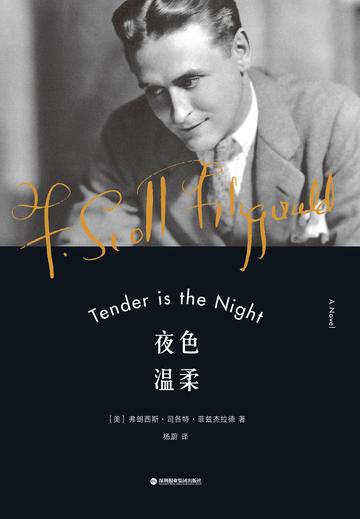
Dick and Nico are a charming couple living in a villa in the south of France, surrounded by a group of friends. Everyone wants to be friends with them and join the upper class. Dick is a psychiatrist with a promising future, and his wife Nirko is her patient. They fell in love with each other, and Dick quickly entered the upper class by taking advantage of Nico's wealthy family background. Driven by desire, Dick fell in love with the young actress Rosemary and even became addicted to alcohol. And his wife, Nilko, suffered from recurring mental illnesses, and in the end, because she and Dick drifted apart, the marriage came to an end...
"Tender Is the Night" is Fitzgerald's last novel. The last stage of his life was the darkest and most difficult period, with a serious financial crisis in his life and his wife Zelda also suffering from mental illness. Through this work, Fitzgerald explores his inner journey and depicts the disillusionment of the American dream in the "Great Depression Era". Everything came and disappeared so quickly, like a short-lived dream.
Reader comments
The night is gentle, the flowers are misty, the blush is golden, the darkness is dark, the appearance is inexplicable... What a beautiful translation! The charm of Fitzgerald's language has been well restored by the translator. During the reading process, I gradually understood why he was highly respected by Haruki Murakami - both of them were very good at using images, and their imaginations were amazingly rich. Personally, I still prefer Fitzgerald. The images he chose are closely related to the characters, environment, and era, and the emotions conveyed are more delicate, richer in levels, and deeper in connotation.
As for our protagonist, Dick Diver, he, like Don Quixote, is a hopelessly romantic lunatic. "Dick Diver was Don Quixote in a Brooks Brothers suit at the beginning of the 20th century." Will the naive idealist eventually be crushed by the tide of the times? But I like this innocence and love this purity. To see the complete collapse of an idealist (corresponding to the third part of the book) is tantamount to mental retardation for me and I can't bear to finish reading. The friendly, gentle and considerate Dick who was always admired and respected by those around him and regarded as a role model is gone forever... When the signs of collapse first appeared, he used this sentence to judge his miserable second half of life: "I guess I am the Black Death virus. I will probably never be able to bring happiness to others." Dick, who always brings happiness to others, why can't he take a closer look at himself?
This book touched me very much. Dick's experience in the book reminded me of my own married life. His struggle between desire and reality, as well as his confusion and confusion about marriage, made me empathize with him. At the same time, I also appreciate the author's depiction of the disillusionment of the "American Dream", which makes me cherish everything I have now. Overall, this is a very in-depth novel and worth reading.







The night is gentle, the flowers are misty, the blush is golden, the darkness is dark, the appearance is inexplicable... What a beautiful translation! The charm of Fitzgerald's language has been well restored by the translator. During the reading process, I gradually understood why he was highly respected by Haruki Murakami - both of them were very good at using images, and their imaginations were amazingly rich. Personally, I still prefer Fitzgerald. The images he chose are closely related to the characters, environment, and era, and the emotions conveyed are more delicate, richer in levels, and deeper in connotation. As for our protagonist, Dick Diver, he, like Don Quixote, is a hopelessly romantic lunatic. "Dick Diver was Don Quixote in a Brooks Brothers suit at the beginning of the 20th century." Will the naive idealist eventually be crushed by the tide of the times? But I like this innocence and love this purity. To see the complete collapse of an idealist (corresponding to the third part of the book) is tantamount to mental retardation for me and I can't bear to finish reading. The friendly, gentle and considerate Dick who was always admired and respected by those around him and regarded as a role model is gone forever... When the signs of collapse first appeared, he used this sentence to judge his miserable second half of life: "I guess I am the Black Death virus. I will probably never be able to bring happiness to others." Dick, who always brings happiness to others, why can't he take a closer look at himself?
This book touched me very much. Dick's experience in the book reminded me of my own married life. His struggle between desire and reality, as well as his confusion and confusion about marriage, made me empathize with him. At the same time, I also appreciate the author's depiction of the disillusionment of the "American Dream", which makes me cherish everything I have now. Overall, this is a very in-depth novel and worth reading.