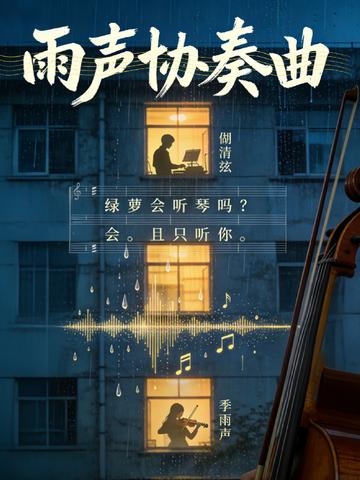
In the campus where the autumn rain was getting thicker that year, there were two souls that were contrary to the sound.
Gu Qingxian, a radio station technical genius who wears a dark gray hearing aid in his right ear, can repair all equipment, but cannot repair the broken memory of the rainy night seven years ago - the sound of his mother's piano and the crash of the car accident mixed into an eternal traumatic noise in his deaf left ear.
Ji Yusheng, a transfer student with the aura of being an outstanding cellist, can only practice alone in an empty classroom at midnight. The stage lights were suffocatingly white to her, and the crowd's gaze was like a rope—the trophy she received when she was twelve years old and her father's last words locked her possibility of being on stage.
Until one rainy night, Gu Qingxian's spectrum analyzer captured an 8.7KHz frequency from the classroom downstairs. The pure, lonely, trembling sound of the cello was like a ray of light splitting through the torrential rain in his memory.
He began to use data tracking: voiceprint analysis, coordinate positioning, anonymous notes. She began to experiment with the sound of the piano: deliberately out of tune, improvised passages, and code words in the music score.
A "midnight voiceprint game" that started with technical analysis and psychological defense quietly turned into a two-way redemption experiment: he built a "safe box" for her piano sound - visual spectrum fireworks, a one-way glass stage that isolates eyes, and a hearing aid channel that belongs only to her. She rewrote his definition of the sound of rain - using the piano left by her father, she played a "Concerto for the Sound of Rain" that transformed trauma into warmth.
"If the stage is destined to suffocate me, then I will only play for you."
"If the world is destined to be noisy and blurry, then I will only listen to your voice."