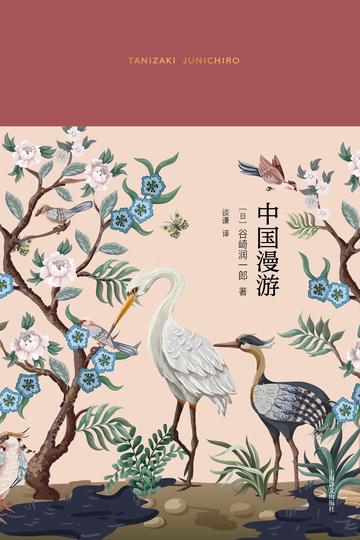
"Wandering in China" is a collection of articles written by Japanese writer Junichiro Tanizaki about China from 1918 to 1942. The ten articles mainly chronicle his journey to China, and also include stories based on Chinese culture.
The six collected articles, including "Lushan Diary", "Qinhuai Night", "Suzhou Journey", "Moon over the West Lake", "Chinese Cuisine" and "Wanderer's Face", were written from the author's first trip to China. From October to December 1918, Tanizaki traveled from North Korea to Shenyang, China, from north to south to Tianjin, Beijing, Hankou, Jiujiang, Nanjing, Suzhou, Shanghai and other places. He wrote about his experiences along the way. "Chinese Cuisine" is his experience of tasting food in several places while "The Face of a Wanderer" is a close-up of a person he met by chance during the journey. "Crane" is somewhere between an essay and a story, with its longing for China clearly visible. The protagonist Yasinosuke is devoted to the company of Chinese cranes and Chinese women. It can be called the Japanese version of the Chinese Song Dynasty allusion "Plum Wife and Crane Son".
In January 1926, Tanizaki took a sea ship and arrived in Shanghai from the opened Nagasaki-Shanghai route, starting his second trip to China. Through the introduction of Uchiyama Wanzo, the owner of Uchiyama Bookstore, he met and communicated with dozens of Chinese literati and artists, such as Tian Han, Ouyang Yuqian, Guo Moruo, Ren Jinping, etc. The details of the encounters were compiled into two notes, "Shanghai Scenery" and "Shanghai Travels". "Talk about Yesterday and Today" is also a recollection of Tanizaki's friendship with famous Chinese people during his stay in Shanghai, as well as his interactions after returning to China. For example, Tian Han took him to Ouyang Yuqian's house to celebrate the New Year, for example, he fell in love with Cantonese breed puppies and specially brought two of them as gifts from Chinese friends back to Japan from China, etc. Based on these interactions, Tanizaki evaluated modern Chinese literature and wrote about his feelings after reading the works of Hu Shi, Feng Zikai, Zhou Zuoren, Lin Yutang and others. He also discussed the works written by American writer Pearl Buck about China and the films adapted from them.
Reader comments
This book is really good! Junichiro Tanizaki's writing style is very delicate. He is able to integrate his emotions and thoughts into the text, allowing readers to feel his love and exploration of Chinese culture. In this book, Junichiro Tanizaki not only records what he saw and heard while traveling in China, but also presents his unique understanding of Eastern aesthetics through in-depth research on Chinese culture. His writing is concise and clear, and it reads very smoothly.


This book is really good! Junichiro Tanizaki's writing style is very delicate. He is able to integrate his emotions and thoughts into the text, allowing readers to feel his love and exploration of Chinese culture. In this book, Junichiro Tanizaki not only records what he saw and heard while traveling in China, but also presents his unique understanding of Eastern aesthetics through in-depth research on Chinese culture. His writing is concise and clear, and it reads very smoothly.