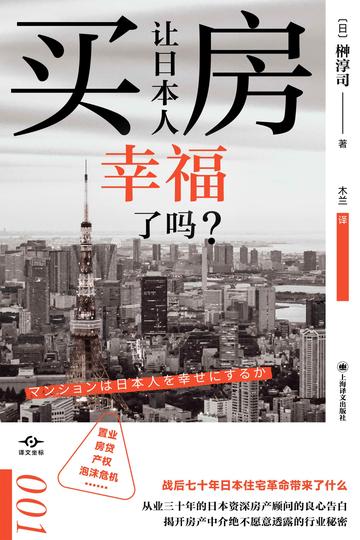
★Home ownership, mortgages, property rights, bubble crisis... What did the Japanese housing revolution bring about in the 70 years after the war?
★Experts with thirty years of experience unlock the secrets of the real estate ecosystem
★Break the "land myth" and change your "common sense" about housing
[About the author] Junji Sakaki, real estate columnist. Born in Kyoto in 1962, graduated from the Faculty of Law of Doshisha University and the Faculty of Letters of Keio University. He started to get involved in real estate advertising planning and sales in the second half of the 1980s. He has been engaged in real estate advertising planning and sales for more than 20 years, and later engaged in real estate consulting and column writing. His books include "Tokyo Real Estate Plunge in 2025" (east new book), "Does Buying a House Make Japanese People Happy?" " (Shueisha's new book), "You can buy a house with an annual income of 3 million yen! "(Business & Money), "Housing Quality Difference" (Kodansha Hyundai New Book) and many other books.
[Introduction] "Does buying a house make Japanese people happy?"
"Will buying a house make Japanese people happy in the future?"
The answer is of course "Yes". Must be "Yes". And it must always be "Yes."
Population decline, economic downturn, market bubble, national housing price decline... Even if this reality is before their eyes, many people are still bound by an impulse and obsession that cannot be explained by theory: "I want to buy a house."
However, what is the reality?
The "average service life of residential buildings after construction" is thirty years in Japan, fifty-five years in the United States, and seventy-seven years in the United Kingdom.
In other words, after a salaryman spends his life savings and pays off the mortgage over many years, your house is likely to have aged, depreciated, or even become a ruin as the years go by.
In addition, there are neighborhood disputes due to housing quality issues, the unexpected real estate bubble, safety risks caused by high-rise buildings to the elderly and children, and the lack of democratic management leading to the failure of the owners' committee...
A house that is supposed to bring happiness to its residents may also become a burden or even a nightmare for you.
Can these problems be avoided? What can we do?
A confession of conscience from a senior Japanese real estate consultant who has been in the industry for 30 years reveals industry secrets that real estate agencies are never willing to reveal.
Reader comments
This book is very real and I have encountered many of the problems it mentions. For example, when buying a house, we are always swayed by impulses and obsessions that cannot be explained theoretically. And the service life of the house also touched me deeply. I thought of the old house I lived in when I was a child, which has now been demolished. This book gave me a deeper understanding of real estate, and I also understood that I should not just look at the immediate future, but also consider longer-term issues. I think this book is of great reference value for people who want to buy a house.
Regarding the investment risks and management risks of buying a house, a lot has been written in "The Age of Negative Real Estate". What is special about this book is the impact of living in high-rise buildings on health. I have heard that living in high-rise buildings lacks magnets. I don't know if it is pseudoscience, but the impact of various houses on the body should still be studied.
At the end of the article, I wrote about two well-managed buildings. One is a rental apartment and the other is managed by the owner. They are both interesting. I hope I can live in a place like that.





This book is very real and I have encountered many of the problems it mentions. For example, when buying a house, we are always swayed by impulses and obsessions that cannot be explained theoretically. And the service life of the house also touched me deeply. I thought of the old house I lived in when I was a child, which has now been demolished. This book gave me a deeper understanding of real estate, and I also understood that I should not just look at the immediate future, but also consider longer-term issues. I think this book is of great reference value for people who want to buy a house.
Regarding the investment risks and management risks of buying a house, a lot has been written in "The Age of Negative Real Estate". What is special about this book is the impact of living in high-rise buildings on health. I have heard that living in high-rise buildings lacks magnets. I don't know if it is pseudoscience, but the impact of various houses on the body should still be studied. At the end of the article, I wrote about two well-managed buildings. One is a rental apartment and the other is managed by the owner. They are both interesting. I hope I can live in a place like that.