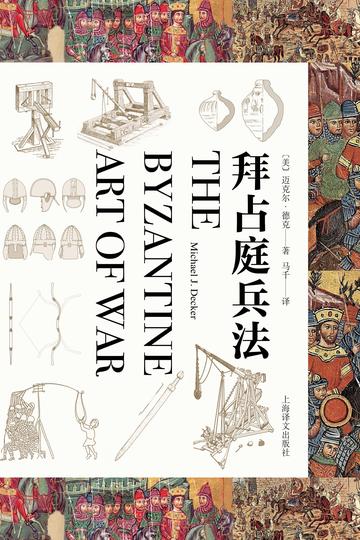
★ Surrounded by powerful enemies, an empire on the brink of collapse: how did a thousand-year empire endure? The Byzantine Art of War: A Thousand-Year History of Survival Against the Odds
★ Combines grand strategy with specific case studies, drawing on the finest classical sources and modern scholarship
★ Translated by Ma Qian, translator of 1453: The Fall of Constantinople, author of A Complete History of the Knights Hospitaller, and well-known military history podcaster
★ Eleven detailed, high-resolution historical maps chart a thousand years of change across the Eastern Roman Empire, from its lands and provinces to its military districts and urban road networks
★ More than twenty carefully crafted strategic maps dynamically analyze the empire's famous battles
[About the Author] Michael J. Decker is a professor of Byzantine history at the University of South Florida. He has conducted extensive archaeological and historical research on Byzantium in the Middle East and North Africa.
[About the Book] From Constantine I's relocation of the Roman Empire's capital to the new city named after him, Constantinople, in 330 CE, to the city's final fall in 1453, the Byzantine Empire endured for a thousand years, spanning classical antiquity and the Middle Ages. Situated on the Bosporus, Constantinople bridged Europe and Asia. Its location brought it immense wealth from trade routes, but also made it a crossroads of conflict. Enemies came from every direction, and the threat never ceased. War was the eternal theme of this thousand-year empire. For the Roman Empire of the Middle Ages, however, war was no longer about conquest and glory. It had just one purpose: survival.
With clear arguments and lively prose, this book recounts how the empire weathered a thousand years of military upheaval. It learned, adapted, and evolved through repeated catastrophes capable of destroying most civilizations, developing new tactics to counter each new enemy and rising again and again. The author, Byzantine history expert Dr. Michael Decker, draws on his solid scholarly expertise to explain the historical background, the organization and leadership of the imperial army, its training and equipment, and the main enemies the empire faced in each period. By combining grand strategy with specific case studies, he ultimately distills the principles of warfare that enabled Byzantium to survive. Surprisingly, many of the lessons in this Byzantine art of war echo The Art of War, written by Sun Tzu two and a half millennia ago. They might even be seen as expressions of the same ideas in different contexts. This shows that even in the most extreme and brutal arena of war, human wisdom remains universal.























The author of this book, Michael Decker, is an expert on Byzantine history. With solid professional knowledge, he tells how the Byzantine Empire survived thousands of years of military ups and downs. The book is rich in content, combining macro strategies and specific battle examples, and is also equipped with a large number of maps to give people a more intuitive understanding of history. Dirk's writing was clear and flying, which gave me a deeper understanding of this mysterious empire and new thoughts on the philosophy of war. As the book says: "The purpose of war is only one: survival." This is not only the Byzantine art of war, but also the way for humans to survive in extreme environments.
Good! A detailed and obvious account of the historical changes in the Eastern Roman military and military structure.
I just realized that Tomato has so many good books!