[About the author]
Marguerite Duras (1914-1996) was a French novelist, playwright, and film director with an international reputation. Her real name was Margaret Donadieu. Her works cover novels, essays, scripts, films, and other forms. She won the French Prix Goncourt for "The Lover" and won international reputation for "Hiroshima Am Amour" and "Song of India". His early works were classical in form, but later they gradually broke away from traditional narrative methods and endowed them with psychological analysis connotations, bringing innovation to art.
Introduction
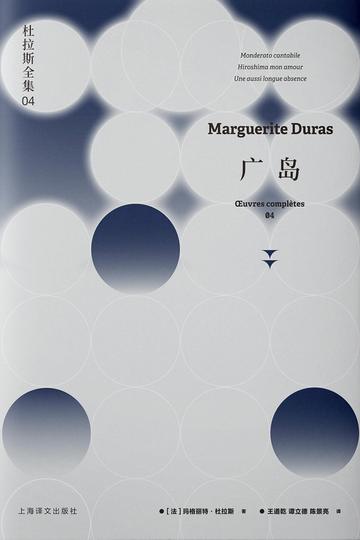
"Hiroshima: The Complete Works of Duras 4" is the fourth volume of "The Complete Works of Duras". It includes the novella "The Sound of Music" published by French writer Duras in 1958 and the movie scripts "Hiroshima Mon Amour" and "The Long Separation" published in 1960 and 1961 respectively. The three texts abandon the traditional linear narrative and elaborate description. Most of the pages are concise dialogues with obvious characteristics. The influence of the three texts is directly related to the film.
"The Sound of Music" is an important basis for literary critics to classify Duras as a "new novel school". The novel describes an impossible love. One is the victim who cannot escape from love, and the other is the murderer who kills because of love. The bystanders of the love murder are involved step by step. This novel established Duras's status as an important modern French writer. The famous British director Peter Brook made it into a French feature film of the same name in 1960 (English title "Seven Days... Seven Nights"). Duras co-wrote it with the writer Gérard Jarlot. The heroine, French actor Jeanne Moreau, won the Best Actress Award at the Cannes Film Festival that year for this film. The film was also included as a masterpiece of the "New Wave" films.
"Hiroshima Mon Amour" is a script written by Duras for the film of French director Alain Resnais. It uses the atomic bombed Hiroshima as the background and opens a dialogue between French women and Japanese men. It is about the theme of memory and forgetting. The film was released in 1959 and was nominated for the Palme d'Or at the Cannes Film Festival in the same year. The film became a representative work of "Left Bank" films (or "writer's films"), and the script text was published in 1960.
"The Long Separation" is a script written by Duras and writer Gérard Jarlot for the first film directed by French film editor and director Henri Colby. It tells the story of the dramatic reunion of the female cafe owner Therese and her husband who was arrested and disappeared during World War II after sixteen years of separation. It shows the theme of war's alienation of human nature. The film was released in 1961 and won the Palme d'Or at the Cannes Film Festival in the same year. It is also a masterpiece of "Left Bank" films. The script was published by Gallimard Publishing House in the same year. The text content is different from the movie, and the content of unfilmed scenes is retained.
Reader comments
This book is very good! The characters in the book are all very delicately drawn. I particularly disliked the child. He always didn't answer the teacher's questions and acted very stubborn. However, this also reflects the personality characteristics of some children in reality. I thought the dialogue in this book was wonderful and gave me a deeper understanding of the inner world of the characters. Overall, this is a book well worth reading.


This book is very good! The characters in the book are all very delicately drawn. I particularly disliked the child. He always didn't answer the teacher's questions and acted very stubborn. However, this also reflects the personality characteristics of some children in reality. I thought the dialogue in this book was wonderful and gave me a deeper understanding of the inner world of the characters. Overall, this is a book well worth reading.