★Focus on the evolution and characteristics of the Argentine language
★Discuss the relationship between language and culture, language and city
★Discover the unique poetry in everyday language
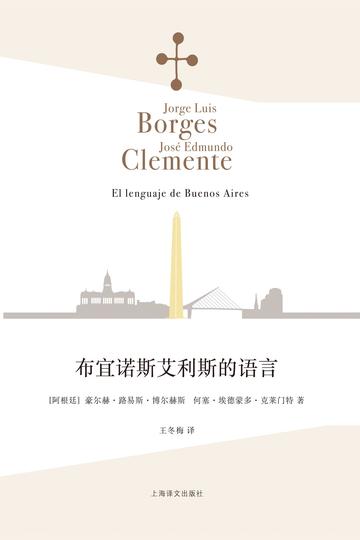
[About the author] Jorge Luis Borges (1899-1986) Argentine poet, novelist, critic, translator, and master of Spanish literature. Born in Buenos Aires on August 24, 1899, he lived in Europe with his family when he was a boy.
In 1923, he published his first collection of poems, "The Passion of Buenos Aires", in 1925, his first collection of essays, "Collection of Explorations", and in 1935, his first collection of short stories, "Biographies of Villains", gradually establishing his position in the Argentine literary world. His representative poetry collections "Notes of Saint Martin" and "The Goldenness of the Tiger", novel collections "The Garden of Forking Paths" and "Aleph", essay collections "Eternal History" and "Discussions" have won him international reputation. Translated works by Wilde, Woolf, Faulkner and other writers.
He once served as Director of the National Library of Argentina and Professor of Literature at the University of Buenos Aires. He has won many literary awards such as the Argentine National Literary Award, the Formento International Publishing Award, the Jerusalem Award, the Barzan Award, the Chino del Duca Award, and the Cervantes Award. He died of illness in Geneva, Switzerland on June 14, 1986.
José Edmundo Clemente (1918-2013) was an Argentine writer and librarian.
Born in Salta, Argentina, in 1918. In 1957, the School of Librarians of the National Library of Argentina was founded. In 1993, he was elected as an academician of the Argentine Academy of Letters.
He once served as Chairman of the National Art Foundation of Argentina, Director of the Department of Culture of the Province of Buenos Aires, Dean of the National Library of Argentina, and Foreign Corresponding Academician of the Royal Academy of Languages in Spain. He worked with Jorge Luis Borges at the National Library of Argentina, both of whom served as director of the National Library of Argentina.
In 1950, he won the "Ribbon of Honor Award" and the Writers' Committee Award of the Argentine Writers Association for "The Aesthetics of the Reader". In 1959, he won the Buenos Aires Municipal Prize for "The Basic Theme of Literature".
[Introduction] "The Language of Buenos Aires" is a collaborative work between Borges and José Edmundo Clemente. It contains a series of articles written by the two of them that explore the characteristics of the Argentinian language. From the fresh and natural market language to the poet's moving words and phrases, from Yangchun Baixue's articles to the slang and jargon of the Lower Riba people. There is a common spirit between them: the emotional projection of the market. Local language is the root, which goes deep into the soil, absorbs the juice and nourishes the mother tongue. The author opposes the rigid and inflexible discussion of language institutes and emphasizes that language is action and life. It rings in our ears every day and is our emotion, our home, our trust and the friendship that comes from conversation.
Reader comments
This book reminded me of my first conversation with my baby. Although he couldn't speak yet, I could feel his expressions in his eyes and babbling. As the book says, language is not just words, it is also a part of our emotions and life. I like the discussion of market language in the book, which allows me to better understand and appreciate the beauty in daily life. This book made me think more deeply about language and culture, and also made me cherish every communication with my children more.
Language has a long-lasting significance. If people want to communicate, language is indispensable, and language has many distinctions.
Orthodox is just like Mandarin, people can understand it, but it has less characteristics because it is straightforward and has no environmental impact. Ordinarily, just like dialects, the way of speaking that is familiar to fellow villagers differs from place to place.
No matter how you define language, it has its own meaning in a specific context. Without the context, it becomes strange. Language cannot be separated from the environment, and the environment shapes people.
From the language of Buenos Aires, people can also see the charm of English, and even more so, the charm of Chinese.




This book reminded me of my first conversation with my baby. Although he couldn't speak yet, I could feel his expressions in his eyes and babbling. As the book says, language is not just words, it is also a part of our emotions and life. I like the discussion of market language in the book, which allows me to better understand and appreciate the beauty in daily life. This book made me think more deeply about language and culture, and also made me cherish every communication with my children more.
Language has a long-lasting significance. If people want to communicate, language is indispensable, and language has many distinctions. Orthodox is just like Mandarin, people can understand it, but it has less characteristics because it is straightforward and has no environmental impact. Ordinarily, just like dialects, the way of speaking that is familiar to fellow villagers differs from place to place. No matter how you define language, it has its own meaning in a specific context. Without the context, it becomes strange. Language cannot be separated from the environment, and the environment shapes people.
From the language of Buenos Aires, people can also see the charm of English, and even more so, the charm of Chinese.