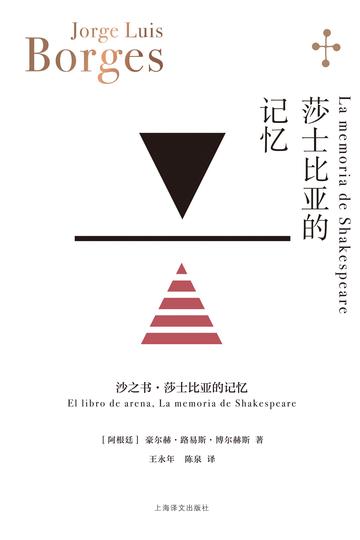
★Book of Sand·Shakespeare's Memory
★The final work of Borges's novels
★"I take the risk, I accept the memory of Shakespeare."
[About the author] Jorge Luis Borges (1899-1986) was an Argentine poet, novelist, critic, translator, and master of Spanish literature. Born in Buenos Aires on August 24, 1899, he lived in Europe with his family when he was a boy.
In 1923, he published his first collection of poems, "The Passion of Buenos Aires", in 1925, his first collection of essays, "Collection of Explorations", and in 1935, his first collection of short stories, "Biographies of Villains", gradually establishing his position in the Argentine literary world. His representative poetry collections "Notes of Saint Martin" and "The Tiger's Gold", novel collections "The Garden of Forking Paths" and "Aleph", essay collections "Eternal History" and "Discussions" have won him international reputation. Translated works by Wilde, Woolf, Faulkner and other writers.
He once served as Director of the National Library of Argentina and Professor of Literature at the University of Buenos Aires. He has won many literary awards such as the Argentine National Literary Award, the Formento International Publishing Award, the Jerusalem Award, the Barzan Award, the Chino del Duca Award, and the Cervantes Award.
He died of illness in Geneva, Switzerland on June 14, 1986.
[Introduction] This book is a collection of novels by Borges, the Argentine poet, novelist, critic, translator, and master of Spanish literature. It includes Borges' short story collection "The Book of Sand" published in 1975 and "The Memory of Shakespeare" in 1983. They are the writer's last two consecutive novels.
Among them, "The Book of Sand" contains thirteen chapters and is Borges's top work in his later writing period. Facing a "book of sand" with endless pages, at first it was a sense of happiness that we took for ourselves, and finally we realized that it was a terrible monster and the source of all troubles. This book is the embodiment of Borges's book worship complex and symbolizes the infinite universe and world. People try their best to break through the unknown, but in the end they experience the infinite and confirm their own insignificance and powerlessness.
"Shakespeare's Memory" contains four chapters, including "August 25, 1983", "The Blue Tiger", "The Rose of Paracelsus" and "Shakespeare's Memory". In each chapter, there appears another "I" coexisting with "I", the blue "pebble" that can be derived, the "rose" that is reborn after destruction, and the "memory of Shakespeare" that appears in each chapter. The "memory of Shakespeare" that a person remembers seems to be the presentation of dreams. In fact, Borges uses dreams to explore the relationship between the three human abilities-memory, understanding, and fantasy. Memory is like a cave. It is not a superposition of the past, but a mixture of various possibilities with unclear meanings.
Reader comments
Four pieces of "Shakespeare's Memories":
The past me and the future me do not understand each other, the past is ignorant, and the future is nothing; the mysterious stones and unknown things bring endless fear; the rebirth of the rose depends on whether people believe that it has been reborn; I have the memory of Shakespeare, but I cannot become Shakespeare. The memory of Shakespeare has occupied my memory, so who am I?
This book is so wonderful! Borges' imagination opened my eyes, especially the book with infinite pages in "The Book of Sand", which made me feel the infinite possibilities of the universe. As a father of two children, I think this book can also help children feel the charm of literature. Just like the sentence in the book, "Memory is like a cave. It is not a superposition of the past, but a mixture of various possibilities with unclear meaning." The same is true for our lives, full of various uncertainties and possibilities.
Four pieces of "Shakespeare's Memories": The past me and the future me do not understand each other, the past is ignorant, and the future is nothing; the mysterious stones and unknown things bring endless fear; the rebirth of the rose depends on whether people believe that it has been reborn; I have the memory of Shakespeare, but I cannot become Shakespeare. The memory of Shakespeare has occupied my memory, so who am I?
This book is so wonderful! Borges' imagination opened my eyes, especially the book with infinite pages in "The Book of Sand", which made me feel the infinite possibilities of the universe. As a father of two children, I think this book can also help children feel the charm of literature. Just like the sentence in the book, "Memory is like a cave. It is not a superposition of the past, but a mixture of various possibilities with unclear meaning." The same is true for our lives, full of various uncertainties and possibilities.