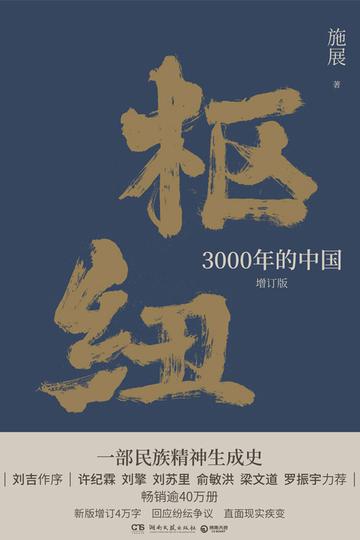
The core of "Pivot: China in 3000 Years" is to answer a question: "What is China?"
In this book, Shi is problem-oriented, transcends the limitations of specific disciplines, and uses knowledge from various disciplines such as geography, history, philosophy, economics, finance, currency, military, population, society, law, and international politics to provide a unified explanatory framework for China's thousands of years of complex history and its successes and failures over the past century.
In the elaboration of ancient history, Shi Zhan broke through the common Central Plains-oriented perspective and also broke through the grassland-oriented perspective. In the process of interaction, interdependence, and mutual shaping of multiple sub-regions such as the Central Plains, grasslands, Western Regions, plateaus, and oceans, he discovered a unified historical process that transcended each sub-region, thus reducing Chinese history to a systematic evolutionary history.
Shi Shi restrained any value preference in any direction and used the clue of China's super-large scale to coherently explain the reasons why China was able to maintain a unified empire and the reasons why China fell into backwardness in modern times. The great history of the Chinese revolution in the 20th century also gained a new meaning.
In the process of China's encounter with the West, some internal dynamics of Chinese history were activated. Against this background, China's economic growth and its profound shaping of the world order received in-depth discussions on a new model. On this basis, the author also started a series of very constructive thinking about the future.
Reader comments
This book is really interesting! It is not as boring as ordinary history books, but uses a very novel perspective to explain Chinese history. I especially like the description of the interaction between various sub-regions in the book, which gave me a deeper understanding of Chinese history. But I kind of hate those characters who only know how to fight for power. They are really selfish. As the book says, "History is a complex system, not a simple linear process." This book gave me a lot to think about, and I recommend you read it too!
It is extremely difficult for a cultural empire to maintain efficiency, flexibility, and stability in an environment full of variables. A civilization, especially a civilization with a long history, will inevitably have the instinct to reproduce and continue like the animals in Darwin's theory of evolution, which will eventually lead to a cultural empire that is constantly changing and reorganizing.
This book is not about Chinese history, but about showing readers a Western perspective through Chinese history. The core point here is: China cannot develop without Western intervention and help.
A lot of the information accumulated is useful. The argument is rather idealistic, empty-handed, and not convincing enough. Some arguments, such as that China is a maritime and land hub and a nation in world history, are enlightening, but the conclusions and proposed response methods are wrong, especially the views on technological innovation, new technological revolution, and the U. S. Trade war with China, and many of them have been proven wrong by practice. The mind is in a semi-liberated state, and there are many legacy of rigid ideas from the last century. In short, there are still merits.
The logic of historical evolution. (What happened in the Six Dynasties, it was just a private plan)
It is enlightening and worthy of our study.
By reading this book, readers can gain profound insights into the logic of China's historical evolution, the reasons for the persistence of China's miracle, and China's role in the world.
A very structured and nutritious book, worth recommending
Wide to wide to wide to wide
Big world view, big historical view, big pattern view
Very professional, in-depth and interesting!
Very professional, insightful and in-depth!
Deconstructing ancient Chinese history with a novel perspective and a grand pattern.


This book is really interesting! It is not as boring as ordinary history books, but uses a very novel perspective to explain Chinese history. I especially like the description of the interaction between various sub-regions in the book, which gave me a deeper understanding of Chinese history. But I kind of hate those characters who only know how to fight for power. They are really selfish. As the book says, "History is a complex system, not a simple linear process." This book gave me a lot to think about, and I recommend you read it too!
It is extremely difficult for a cultural empire to maintain efficiency, flexibility, and stability in an environment full of variables. A civilization, especially a civilization with a long history, will inevitably have the instinct to reproduce and continue like the animals in Darwin's theory of evolution, which will eventually lead to a cultural empire that is constantly changing and reorganizing.
This book is not about Chinese history, but about showing readers a Western perspective through Chinese history. The core point here is: China cannot develop without Western intervention and help.
A lot of the information accumulated is useful. The argument is rather idealistic, empty-handed, and not convincing enough. Some arguments, such as that China is a maritime and land hub and a nation in world history, are enlightening, but the conclusions and proposed response methods are wrong, especially the views on technological innovation, new technological revolution, and the U. S. Trade war with China, and many of them have been proven wrong by practice. The mind is in a semi-liberated state, and there are many legacy of rigid ideas from the last century. In short, there are still merits.
The logic of historical evolution. (What happened in the Six Dynasties, it was just a private plan)
It is enlightening and worthy of our study.
By reading this book, readers can gain profound insights into the logic of China's historical evolution, the reasons for the persistence of China's miracle, and China's role in the world.
A very structured and nutritious book, worth recommending
Wide to wide to wide to wide
Big world view, big historical view, big pattern view
Very professional, in-depth and interesting! Very professional, insightful and in-depth!
Deconstructing ancient Chinese history with a novel perspective and a grand pattern.