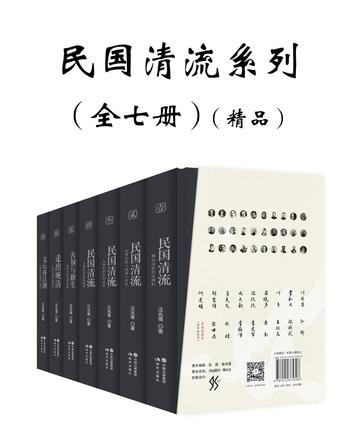
◇ The Clear Stream of the Republican Era: The Great Masters Who Have Passed On
With their learning and integrity, the clear stream of the Republican era wrote the brief yet brilliant story of China's "scholars."
This is a sweeping collective biography and epic account of a generation of great masters who formed the clear stream of the Republican era.
From 1917 to 1927, China witnessed a flourishing of ideas and culture comparable to the "Hundred Schools of Thought Contending" during the Spring and Autumn and Warring States periods. Carrying forward the traditional sense of responsibility of the scholar class, a generation of clear-stream intellectuals in the Republican era took "the world as their responsibility." They championed national and academic dignity, playing a vanguard role amid turbulent times. Their learning was extraordinary, their characters proud and unconventional. They challenged one another in learning and principle, yet the tides of their time continually drove them apart. For a while, they roared like dragons and tigers, each commanding their own field, reflecting the rise and fall, storms and sunshine of a great age.
For the first time, this book systematically recounts the friendships, grievances, disagreements, ties, and partings among these independent-minded cultural masters of the Republican era, as they exchanged ideas, clashed, and crossed swords across thought, scholarship, political views, work, and private life. It vividly recreates their lives during a major turning point in modern China, portraying each one's distinctive character and cultural sensibility. It faithfully recounts their greatness and humility, their nobility and flaws, painting a dazzling portrait of the cultural stars of the Republican era.
◇ The Clear Stream of the Republican Era: The Warring States Era of the Great Masters
The historical truth behind the divisions and clashes among the masters of the Republican era
The Clear Stream of the Republican Era 2 follows the period covered in the first volume, from 1917 to 1927, and depicts the "Warring States" landscape of the cultural battleground from 1927 to 1930. The domestic political situation was undergoing a dramatic change. Cooperation between the Kuomintang and the Communist Party had broken down, and political struggles were fierce and brutal. The cultural leaders who had raised the banner during the May Fourth New Culture Movement became deeply divided. Cai Yuanpei, Lu Xun, Mao Dun, Qu Qiubai, Ding Ling, Ye Shengtao, Rou Shi, Hu Shi, Shen Congwen, Lin Yutang, Yu Dafu, Liang Shiqiu, Bao Tianxiao, Zhou Shoujuan, and others all converged on Shanghai, as the cultural center temporarily shifted from Beijing to Shanghai. For a time, the world of Republican-era culture and thought was swept up in turmoil. Cultural movements flew their colors and clashed head-on: the Creation Society, the Sun Society, the Crescent Moon School, the Yusi School, the New Sensationists, the Mandarin Ducks and Butterflies School, the Aesthetic Decadents, and many others. "Feudal remnants," "revolutionary fighters," and "fellow travelers" all stepped into the spotlight, giving rise to polemics, clashes, old grudges, and tangled relationships in the cultural and intellectual world of the Republican era.
◇ The Clear Stream of the Republican Era: The Masters' Era of Revival
Would they retreat to the mountains or step forward to save the nation? See the extraordinary choices made by the masters of the Republican era!
In the style of The Clear Stream of the Republican Era 1: The Great Masters Who Have Passed On and The Clear Stream of the Republican Era 2: The Warring States Era of the Great Masters, this book continues the history covered in the previous two volumes, from 1917 to 1930. It describes the revival of Beiping as the cultural battleground from 1931 to 1936. In the wake of the breakdown in cooperation between the Kuomintang and the Communist Party, political struggles were fierce and brutal, while Japanese forces gradually expanded their invasion of China. At this critical moment, with the nation beset by internal and external threats, what choices would Chinese intellectuals make?
This book reminded me of my uncle, who was also very interested in history. I deeply admire the thoughts and behaviors of the masters described in the book. In such turbulent times, they still persisted in their beliefs and made great contributions to the development of the country and culture. This reminds me of "The Journey to the South and Return to the North", which are all stories about the masters of that special period. I think this kind of book is very meaningful and allows us to see the other side of history.