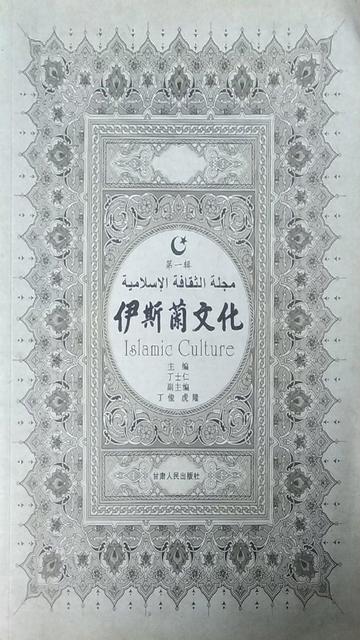
"Islamic Culture" is a book published by Gansu People's Publishing House, written by Ding Shiren , the content covers a wide range of topics. As shown in the catalog, it is divided into five sections. It includes both a macroscopic view and overall grasp of Islamic civilization, as well as some microscopic observations and case studies. It includes both historical review and realistic analysis. It is informal and focuses on discussion. Some are very academic and have been published or reprinted in high-level academic journals. For example, "On the Harmonious Concept of Arab-Islamic Culture" was included in the People's Daily's "Internal Reference", Issue 36, 2006, and "New Trends in Contemporary Islamic Civilization". The core content was reprinted in the 2010 issue 4 of "Xinhua Digest", and "Comparison of the Sovereignty Concepts of Islamic Civilization and Western Civilization" was included in the "2004 Chinese Academic Yearbook". Some are simple and unpretentious, only published in general publications and circulated in a small area. Biographies, such as "On Scholars", "Muslim Concepts of Physiological Hygiene and Mental Hygiene", "Professional Spirit and the Rise and Fall of the Muslim Nation", etc. "Everyone has their own preference for carrots and cabbage", readers can selectively read according to their own interests, and do not have to read from beginning to end.
Reader comments
This rich book explores Islamic culture from multiple perspectives. The "translation movement" in the book reminded me of those friends and relatives who learn foreign languages. They learn about other cultures through translation. This kind of communication and integration is really meaningful. I think this book is not only suitable for professionals, but also for general readers who are interested in Islamic culture.
I just finished reading the History of Islam and established a large, complete but rough framework. Reading this book again will add more vivid and rich details.

This rich book explores Islamic culture from multiple perspectives. The "translation movement" in the book reminded me of those friends and relatives who learn foreign languages. They learn about other cultures through translation. This kind of communication and integration is really meaningful. I think this book is not only suitable for professionals, but also for general readers who are interested in Islamic culture.
I just finished reading the History of Islam and established a large, complete but rough framework. Reading this book again will add more vivid and rich details.