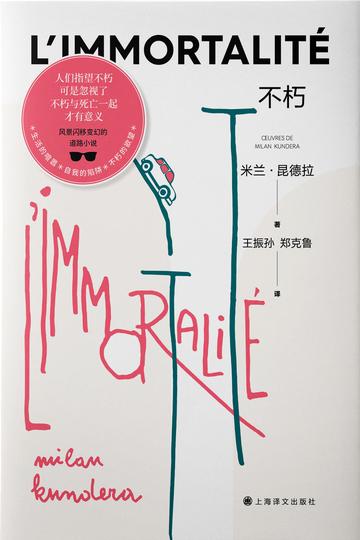
People hope for immortality, but they ignore that immortality is meaningful together with death.
The hustle and bustle of life, the trap of oneself, the immortal desire - a road novel with shifting scenery.
"Immortality" is Milan Kundera's masterpiece novel and a model of Kundera's musical novel art. The novel alternately tells three stories: the first story is about Agnès, a middle-aged woman living in Paris and her hometown in Switzerland, who decides to withdraw from the trivial daily life and the tortuous entanglement with the past, and prepares to live alone; the second story is about the relationship between the elderly poet Goethe and his young lover Bettina; the third story is about the dissolute life of a man nicknamed Rubens. The three stories proceed alternately and connect one proposition after another: self, hometown, happiness, freedom, inevitability and contingency, big immortality and small immortality, romance and debauchery, image, youth, eternal female worship, etc.
Reader comments
The author's plain narrative tone can naturally draw readers into the book, making it very comfortable to read.
The plot is very simple, but the author inserts long paragraphs of thinking, and even sets the purpose of each character's appearance to elicit discussion. The information density is very high. The author rarely gives conclusions and uses metaphors and examples to express a lot of things, which needs to be summarized by himself.
The writing style of this book is very unique, the writing style is concise and poetic. The book explores profound topics such as immortality and death, self and freedom, which made me think more about life. Especially the view on "immortality" made me realize that pursuing the meaning of eternity may be a kind of illusion. I really like a sentence in the book: "Immortality is a fantasy worth mentioning, an empty word, a trace of wind that people chase with butterfly nets..." This sentence is really inspiring!
Read it again if you have a chance
I read it as recommended by A Zhan, but I couldn't understand it. It took half a month to read such a complicated narrative from a great writer, so I'm checking in here to commemorate it.
To be honest, I didn't understand "Immortal". Why is it immortal? What is it for?
The author's plain narrative tone can naturally draw readers into the book, making it very comfortable to read. The plot is very simple, but the author inserts long paragraphs of thinking, and even sets the purpose of each character's appearance to elicit discussion. The information density is very high. The author rarely gives conclusions and uses metaphors and examples to express a lot of things, which needs to be summarized by himself.
The writing style of this book is very unique, the writing style is concise and poetic. The book explores profound topics such as immortality and death, self and freedom, which made me think more about life. Especially the view on "immortality" made me realize that pursuing the meaning of eternity may be a kind of illusion. I really like a sentence in the book: "Immortality is a fantasy worth mentioning, an empty word, a trace of wind that people chase with butterfly nets..." This sentence is really inspiring!
Read it again if you have a chance
I read it as recommended by A Zhan, but I couldn't understand it. It took half a month to read such a complicated narrative from a great writer, so I'm checking in here to commemorate it.
To be honest, I didn't understand "Immortal". Why is it immortal? What is it for?