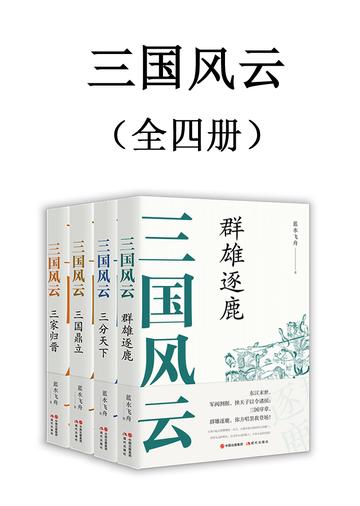
"Three Kingdoms" is a popular historical work that tells the history of the Three Kingdoms. This book covers nearly 100 years of historical stories from AD 184 to AD 280, and is divided into four volumes - "The Heroes Struggle", "Three Parts of the World", "Three Kingdoms" and "Three Families Return to Jin". It is based on historical materials, with characters and events as the main line, and time as the order. It uses the lively language that modern people like to read, and uses the writing style of novels and humorous style to write a wonderful and informative story of the Three Kingdoms.
"Heroes Chasing the Deer" begins with the Yellow Turban Uprising that broke out during the reign of Emperor Ling of the Han Dynasty, and ends with Cao Cao's victory in the Battle of Guandu and his unification of the north. Although this period belongs to the end of the Eastern Han Dynasty, the Eastern Han Dynasty regime existed in name only, and the prelude to the history of the Three Kingdoms had begun. The princes from various places were separatist, and the heroes came together to compete in the Central Plains. At the same time, a large number of heroes in the history of the Three Kingdoms successively stepped onto the stage of history. They plunged into the torrent of the times and competed fiercely, with swords and swords shining, and blood dripping with blood.
"Three Triparts of the World" starts from the Battle of Chibi, when Sun and Liu unite to fight against Cao, and ends with Sun Quan's capture of Jingzhou to unify the middle and lower reaches of the Yangtze River. This period was the formation period of the Three Kingdoms. Cao Cao's group was defeated in the Battle of Chibi and retreated to the north. The coalition forces of Sun and Liu won and divided Jingzhou. The situation of dividing the world into three parts began to be established. In the following ten years, all parties continued to compete and attack each other, and gradually formed three large groups headed by Cao, Liu, and Sun - the embryonic form of the Wei, Shu, and Wu regimes. At the same time, the history of the Three Kingdoms is still turbulent and wars are frequent. Heroes appear in turns, superb strategies show their magical powers, and famous battles continue to be staged, magnificent and exciting.
"Three Kingdoms" was written from the time Cao Pi became emperor to Sun Quan's death in Jianye. This period was the mature period of the Three Kingdoms. The three regimes of Wei, Shu, and Wu were successively established, officially opening the three kingdoms' tripartite ruling pattern. In the following decades, the three regimes of Wei, Shu, and Wu went from domestic affairs to diplomacy, from war to peace, from overt disputes to secret plots, and every step was shocking: whether it was a magnificent war scene or a diplomatic occasion of battle of wits and courage, conspiracies and plots were hidden and permeated everywhere, and those involved were both heroic figures who could turn the tide, as well as cunning and despicable villains. The game of nations, the struggles of individuals, the collision of wars and intrigues are dizzying and dangerous.
"Three Families Return to Jin" was written from the time Zhuge Ke assisted the government to Sima Yan's unification of the country. This period was the end of the Three Kingdoms, and the unification of the world had become an irreversible trend. However, the change of political power and the struggle for power were even more thrilling and bloody. In 263 AD, Sima Zhao launched a war between Wei and Shu, which marked the beginning of the unification of the Three Kingdoms era. The Sima family monopolized the power of the Cao Wei royal family, and finally the Wei, Jin and Zen dynasties completed the transfer of power. After years of internal strife, the Soochow regime across the river has greatly weakened its national power and is in decline. In 280 AD, Emperor Wu of Jin Dynasty Sima Yan launched a war to destroy Wu and wiped out the Soochow regime in one fell swoop. At this point, the three families returned to Jin, officially ending the Three Kingdoms era of nearly a hundred years.
Reader comments
This book is like a time machine, taking me back to the Three Kingdoms era when heroes arose in large numbers. The author Lan Shui Feizhou uses relaxed and humorous language to tell historical stories vividly, just like the friends around me are chatting with me. The characters in the book seemed to come alive, and their stories moved me and amazed me. Thinking of my uncle who loves reading "The Romance of the Three Kingdoms", I decided to recommend this book to him. I believe he will like it!
This book is like a time machine, taking me back to the Three Kingdoms era when heroes arose in large numbers. The author Lan Shui Feizhou uses relaxed and humorous language to tell historical stories vividly, just like the friends around me are chatting with me. The characters in the book seemed to come alive, and their stories moved me and amazed me. Thinking of my uncle who loves reading "The Romance of the Three Kingdoms", I decided to recommend this book to him. I believe he will like it!
Second brush, a very good book