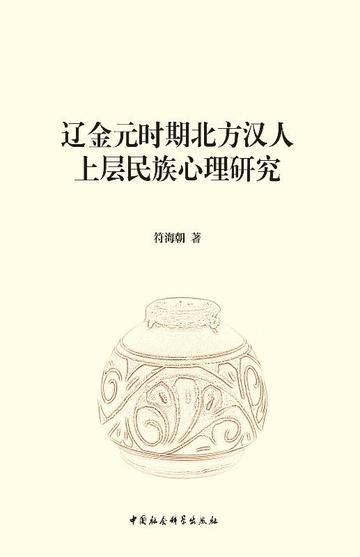
This book mainly uses the research method of psychological history to explore the national psychology of the upper class of the northern Han people in the Liao, Jin and Yuan Dynasties. The reason why we use the national psychology of the upper class of the northern Han people as a research perspective is because during the period of dynasty change, "the reason why people's hearts are for Chu and Han, they all rely on it", especially some of the most influential bureaucrats, religious leaders and scholars. Their mentality and choices during critical periods in history often have a huge leading role in society, because in agricultural societies, the collective unconscious mentality of blindly following the trend is very marketable. Moreover, in dynasties established under the leadership of ethnic minorities, those who have substantial contact opportunities with ethnic minority emperors and powerful figures at all levels, that is, these upper-class Han figures who appear as bureaucrats, religious leaders, and scholars, although their feelings cannot represent the feelings of all Han people, are still very representative. During the Liao, Jin, and Yuan dynasties, the national psychology of the upper class Han people in the north went through a complex process of change during the nearly five hundred years when ethnic minorities held the core power of the country. During this process, the Liao Kingdom once expanded its power to the Yellow River Basin; the Jin Kingdom pursued the Southern Song Dynasty regime after the demise of the Northern Song Dynasty. During the period of King Hailing, it even attempted to use war to unify China; while the Mongols eventually led the country's new and larger-scale unification, but after the unification, the time to maintain unity was relatively short. If we analyze the national psychology of the upper class of the northern Han people during this period from the perspective of the formation process of a common social psychology required to unify the country, it will be very beneficial to the overall study of this period of history.
Reader comments
This book is very interesting! It studied the national psychology of the upper class Han people in the north during the Liao, Jin and Yuan dynasties, allowing me to understand the history of that period. I especially like the analysis of the mentality and choices of some influential bureaucrats, religious leaders and scholars in the book, which is very interesting. However, I don't like certain historical figures and find their behavior a bit annoying. Overall, this book is well worth reading and provides a deeper understanding of society during that period.


This book is very interesting! It studied the national psychology of the upper class Han people in the north during the Liao, Jin and Yuan dynasties, allowing me to understand the history of that period. I especially like the analysis of the mentality and choices of some influential bureaucrats, religious leaders and scholars in the book, which is very interesting. However, I don't like certain historical figures and find their behavior a bit annoying. Overall, this book is well worth reading and provides a deeper understanding of society during that period.