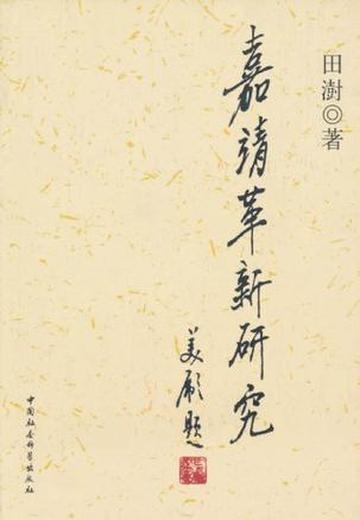
The early Jiajing period was a turning point in the historical development of the Ming Dynasty. The abnormal change of the throne and the dispute over "Dali" gave rise to a new personnel structure in the early years of Jiajing, composed of Shizong and the upstart Dali Zhang Cong and others. This great change in the political arena is itself a major revolutionary phenomenon. In order to correct the chaos, rebuild the new political order of Jiajing and consolidate Sejong's ruling position, comprehensive reforms must be implemented. The Jiajing Reform was a real reform activity in the history of the Ming Dynasty. It focused on updating concepts, rectifying official administration, and replacing personnel. It eliminated the accumulated abuses of the Ming Dynasty for more than a hundred years to the greatest extent, stimulated the vitality of the Ming Dynasty's ruling class, and contained and reversed the declining trend of the country. The Jiajing Reform had a far-reaching impact, and the remaining waves followed the Longqing period and reached the early Wanli period. When Zhang Juzheng served as the chief minister of the cabinet, he imitated him as much as possible. If we do not understand the Jiajing Revolution, it is impossible to objectively understand the characteristics of Zhang Juzheng's political behavior.
Reader comments
Thinking of a relative of mine who faced similar challenges at work and needed to reform and innovate. The concepts and measures in this book gave me a lot of inspiration and made me understand the importance and difficulty of reform. Moreover, the analysis of the characters' behaviors in the book is also very thorough, which gave me a more objective understanding of historical figures. Recommended to friends who are interested in the history of the Ming Dynasty!
Jiajing was really lucky to meet Zhang Cong at the beginning of his political career. Of course, Zhang Cong also met the young monarch who valued him as a Jinshi in his later years.
The Taoist priest had feelings for Zhang Cong, whether it was the memorial written personally or the correspondence over the years (Wang Shizhen also said that Zhang Yongjia (Zhang Cong) was stabbed hundreds of times in the temple, and Xu Yan was only two or three), and Zhang Xunye followed Shen Lian and scolded Yan Song and his son. Shen Lian was demoted and Zhang Xunye was fine. Zhang Xunye tried to save Shen Lian, but was resented and demoted by Yan Shifan. Within two days, the Taoist priest asked Yan Song where Master Zhang's son was, and then he was transferred back to Beijing.
During the Jiajing Dynasty, there was little relationship between emperor and ministers.
There is also this book that can explain why Hai Rui has expectations for Jiajing, because the monarch when he was young was his ideal monarch. He grew up during the Jiajing revolution, but this monarch was already broken after entering the system. As Teacher Hetian said in the article, the Jiajing of the 20th year of Jiajing and the Jiajing after that cannot be the same.



Thinking of a relative of mine who faced similar challenges at work and needed to reform and innovate. The concepts and measures in this book gave me a lot of inspiration and made me understand the importance and difficulty of reform. Moreover, the analysis of the characters' behaviors in the book is also very thorough, which gave me a more objective understanding of historical figures. Recommended to friends who are interested in the history of the Ming Dynasty!
Jiajing was really lucky to meet Zhang Cong at the beginning of his political career. Of course, Zhang Cong also met the young monarch who valued him as a Jinshi in his later years. The Taoist priest had feelings for Zhang Cong, whether it was the memorial written personally or the correspondence over the years (Wang Shizhen also said that Zhang Yongjia (Zhang Cong) was stabbed hundreds of times in the temple, and Xu Yan was only two or three), and Zhang Xunye followed Shen Lian and scolded Yan Song and his son. Shen Lian was demoted and Zhang Xunye was fine. Zhang Xunye tried to save Shen Lian, but was resented and demoted by Yan Shifan. Within two days, the Taoist priest asked Yan Song where Master Zhang's son was, and then he was transferred back to Beijing. During the Jiajing Dynasty, there was little relationship between emperor and ministers. There is also this book that can explain why Hai Rui has expectations for Jiajing, because the monarch when he was young was his ideal monarch. He grew up during the Jiajing revolution, but this monarch was already broken after entering the system. As Teacher Hetian said in the article, the Jiajing of the 20th year of Jiajing and the Jiajing after that cannot be the same.
I am satisfied with two green onions.