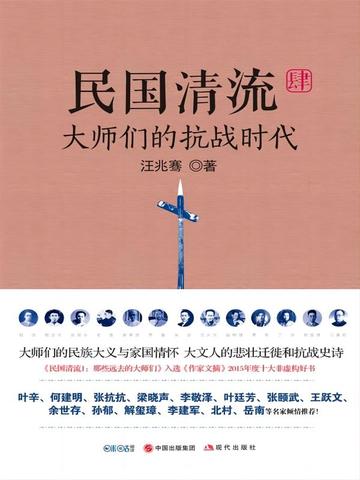
This book is the fourth in a series of collective biographies of masters of the Republic of China.
This book follows the style of "Republic of China 1: The Gone Masters", "Republic of China 2: The "Warring States" Era of the Masters" and "Republic of China 3: The Masters' Renaissance Era", inherits the historical stages of the first three parts (1917 to 1936), and presents the tragic and tragic cultural landscape during the eight-year Anti-Japanese War from 1937 to 1945.
After the July 7th Incident, the national crisis was at the forefront. The intellectuals of the Republic of China consciously stood under the banner of the united front and performed a heroic and fierce epic of the Anti-Japanese War. Whether it was in Kuomintang-controlled areas, liberated areas, occupied areas, or the "isolated island" of Shanghai, the mainstream of "nation" and "national salvation" aroused huge national cohesion and made the cultural and ideological circles during the Anti-Japanese War unprecedentedly unified. Hu Shi, Yu Dafu, Lao She, Shen Congwen, Liang Shuming, Mao Dun, Zhang Henshui, Wen Yiduo, Zheng Zhenduo, Ma Yinchu, Chen Yinke, Wu Mi, Zhao Shuli, Ding Ling, Xiao Jun, etc., Did what they thought literati should do, worked tirelessly on the road to resist Japan and save the country, and in their own ways, demonstrated the integrity, character and responsibility of intellectuals.
The author is not limited by the past and has certain conclusions. Based on detailed historical materials, he writes the obscured history and depicts the true, vivid and rich destiny of the characters. He three-dimensionally demonstrates the unique and complex cultural character and personality of the masters of the Republic of China.
Reader comments
This book gave me a deeper understanding of the masters of that special era. They contributed to the country and nation in their own way during the difficult period of the Anti-Japanese War, which is admirable. Thinking of my grandfather, he was also a man of that era. He had experienced the suffering of the war and could better understand the scenes described in the book. The stories of these masters made me feel the responsibility and responsibility of intellectuals.
This book gave me a deeper understanding of the masters of that special era. They contributed to the country and nation in their own way during the difficult period of the Anti-Japanese War, which is admirable. Thinking of my grandfather, he was also a man of that era. He had experienced the suffering of the war and could better understand the scenes described in the book. The stories of these masters made me feel the responsibility and responsibility of intellectuals.