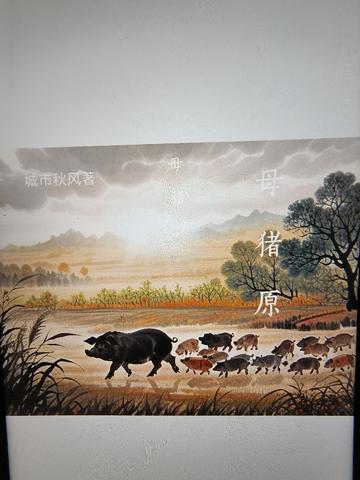
The Pig Sow Plain is an epic, sprawling novel. With its sweeping historical scope, enormous length, and rich cast of characters, it presents readers with a magnificent portrait of human nature. The book runs to more than two million words and offers nuanced, profound depictions of over 460 vivid characters. Each has a distinct personality, fate, and story, together weaving a complex and ever-changing picture of society.
At its heart, the novel is a profound exploration of human nature. Through 87 poignant love stories, the author reveals the truth, goodness, and beauty in humanity, as well as its falsehood, malice, and ugliness. Spanning different eras, social classes, and regional cultures, these romances range from sweet, tender encounters to tragic farewells at death's door, as well as tangled love triangles and more. Each story offers a penetrating examination of human nature, revealing people's vulnerability and strength, kindness and selfishness, loyalty and betrayal when confronted with love.
The Pig Sow Plain spans multiple eras, from mysterious ancient legends to the upheavals of the modern age and the prosperity of the present day. Each era has its own distinctive social landscape and traits of human nature. With delicate prose, the author skillfully links these fragments of history into an epic of human nature that transcends time and space. The author has also devoted immense care to the characters. Whether protagonist or supporting character, kind and upright hero or sinister and treacherous villain, each receives careful attention and vivid portrayal, exposing the truth and complexity of human nature: it has a bright side, but also a dark one.

Nice and a good book
Each article can be an independent chapter, explaining the people and things that happened in the process of historical development from multiple angles and dimensions! In the story, there are hypocrites who were promiscuous before they got rich, there are hard-working, kind-hearted, resourceful and brave long-term workers, and there are women who stick to love for their whole lives. The story makes people cry, laugh, and think deeply! We have all experienced the people and things in the story. The author takes you back to recall the tragic youth! After reading more than 300 chapters, I couldn't help but sigh. There are many characters in the book, and they are not deliberately targeted at any one person. Instead, they appear continuously as the plot develops. I can't help but admire the author's writing skills. This ability comes from personal quality of life and insight into life's body and mind. So many comparisons of human nature are really eye-catching. People's fate is different, their positions are different, and the characters' images will be different.
The last chapter is the most exciting This passage uses delicate writing to show the tense atmosphere in Dongling Village and the anger of the villagers after the secretary was beaten. The author vividly depicts the impact of this incident on the village by describing the investigation at the police station, the discussions and concerns of the villagers, and the lively scene in the Lu family compound. At the same time, it also expresses people's desire for justice and concern and support for Secretary Lu, and reflects the community's determination to unite to fight violence. Overall, this passage is full of tension and thought-provoking.
The author expresses his feelings directly in his writing method, and does not hide the discussion of things or people. A person's character can be seen in a few words, which is a sign of mature writing. In the first chapter, the truth, goodness and beauty of human nature begin to take sides. Bai Yaoting's third son saw other people's gossip and felt that the focus of other people's discussions was related to him. After investigation, he discovered a shocking secret that made him unable to survive and chose to run away from home. This secret was caused by his father, and he couldn't do anything to his father. It was absolutely helpless for him to choose to leave his hometown. After he left, Junjun Kang Rui took his son's hand and walked into Lu Fuwa's ruined courtyard in order to survive and start another life. Tathagata made people heart-wrenching. In order to survive and live, sometimes he even gave up his dignity.
I have read many books, but this one is different. All works describe human nature, using human nature to show the living environment and the complexity of people's hearts, refining the beauty of language, and then expressing the purity of people's hearts. The love between Shijie and Mengyan can be said to be pure love and a model. The author describes the love of dozens of people, but Shijie's love is the last song, which makes people think deeply and sigh with regret! The author cleverly implants ancient mysterious legends into the novel, adding to the mystery and historical depth of the work. It leads readers to explore the true face of Jingcheng Huang. Although the proportion of orange stories in the works is not very large, as a kind of thread, it is a rare creative technique. Comparing ancient legends with current traditions, is it the progress of culture or the stereotype of civilization? It is worthy of people's reflection! Continue to savor, the moral of this book is worthy of scrutiny. The original inhabitants died one by one, even Xia Linquan, who had a strong destiny and was full of wisdom, was no exception. It made people sigh that the laws of nature are a fate that no one can escape. The hero Lu Zhaohong has gone, and Lu Zhaoqian, the model who turned from a bandit to a good man, has gone. These things have to make people feel sorry. They are gone, leaving behind their dependent wives living in the world, and a person is lonely and lonely. How wonderful it would be if life were not like this! One person, one story, and hundreds of stories strung together can vividly express human nature. The economic environment under the constraints of productivity in the 1950s is very different from the economic situation after thirty years of reform and opening up. However, material civilization is unprecedentedly prosperous, but the development of spiritual civilization? I read the author's conscience!
Monotonous and straight houses, restricted by traditional culture, in a place called Sow Plain, people still live in the shadow of the patriarchal system. Every living life has a story, and the story is thought-provoking. In particular, the author pays special attention to the fate of the little characters. The work has a sense of history and is more humane and critical, and is worth appreciating. The content of the novel is too rich. Lu Furong was originally an extremely pure girl. Because of Lu Mengyan's humility, she was able to work at Dahua Food Factory in Dongling Town, where she met veteran Jin Wenqing and began an enviable love. A beautiful woman should have the best fate, but a car accident changed her fate. The storyline is gripping!
Rural life is full of life and flesh and blood.
Real rural works.
The portrayal of Wan Qiaoyun is an epitome of modern people! Whenever a woman loses her virginity, the rest of her life will not be much better. Wan Qiaoyun is a wise person who made two trips to Anfu Town and two pregnancies even though she knew she was not welcome. She made her married life as happy as possible. Compared with ordinary people, it is already commendable! Life may not be perfect, but it is a wise choice to make up for the loopholes. How to behave? This should be a model!
The content is rich and there is a stigma against young people caused by traditional thinking, and Bai Zhili is the victim. The description of human nature is unique and special, such as describing Bai Yaoting's hunched waist like a dog when he went upstairs. This kind of penetrating creative technique generally does not allow the author to have the concreteness of life like poetry. In the year of hunger, there is no food, and everyone is in danger. Xia Sanwa can give up her own screw meat to Lu Fuwa, and her character immediately becomes fuller.