See the history of the Ming dynasty through the lens of social status and legitimacy: an engaging brief history of Ming ritual institutions.
[Editor's Recommendations]
★ A fresh perspective: From the emperor down to the common people, why have Chinese people cared so much about status and legitimacy? Using this as its starting point, the book builds a new narrative framework for the history of Ming ritual institutions.
★ An entertaining interpretation: What “ancestral laws” did the Yongle Emperor leave behind? Why did the Jingtai Emperor enjoy scattering silver beans? Why did the Zhengde Emperor ban pork? Why did the Jiajing Emperor seek to separate Heaven and Earth? Why did the Chongzhen Emperor insist that “a ruler must die for his state”? The book brings seemingly monotonous historical figures and seemingly dry ritual events to life.
★ Thoroughly sourced: Drawing clues from a wealth of historical sources, the book cites more than 1,200 references. It uses individual examples to illuminate the bigger picture, gradually tracing the history of Ming ritual institutions from beginning to end.
[About the Book]
Ritual institutions are the systems that govern ceremonies: their outward form lies in rites and ritual objects, while their inner substance lies in the institutional framework. Through the lens of changing ritual practices, this book explores the theme of “status and legitimacy,” drawing on a solid documentary foundation and using an accessible style to reinterpret Ming history. From the little-known “Edict of Prince Hao,” which opens a different chapter on the founding of the Ming dynasty, to the repeatedly altered rites for worshipping Heaven and Earth; from the widespread worship of City God deities to vassal princes’ seizures of power in the name of the ancestors; from the “two emperors ruling at once” during the Yingzong and Jingtai eras to the farcical imperial campaigns of the Ming Wuzong... The book gathers distinct episodes from history to tell the stories of the rituals of the time, revealing how the state and its people continually struggled and strived to gain recognition for new forms of status and legitimacy.
[About the Author]
Chen Shiyin holds a PhD in history from Tsinghua University and is a lecturer in the Department of History at Yangzhou University. His main research interests include the Three Rites and Ming ritual institutions. He has participated in projects including the National Social Science Fund major project “Restoring the Book of Etiquette and Ceremonial and Rebuilding Everyday Rituals in the Contemporary Era” and the special commissioned National Social Science Fund project “A Comparative Study of Chinese and Foreign Ceremonial Systems.” He has led projects including the National Social Science Fund post-funding project “A Study of Ritual Reform in the Early Ming” and the Jiangsu “Innovation and Entrepreneurship PhD” project “A Study of Ritual Institutions in the Mid-Ming.” He has edited and published The Book of Rites: An Analytical Study and Supplementary Corrections to Chen’s Collected Commentaries on The Book of Rites, and published books including Wisdom Gathered in China: Twelve Peaks of the Chinese Intellectual Landscape.
[Recommendations from Leading Scholars]
① I have read Huang Renyu’s 1587, A Year of No Significance and Dang Nian Ming Yue’s Those Things in the Ming Dynasty. In this book, I see the scholarly expression of Huang Renyu’s work and the artful expression of Dang Nian Ming Yue’s., Bao Hongjun, Chairman of Zhejiang Publishing and Media Co., Ltd.
② Chen Shiyin is a young man with a deep sense of human concern. He feels keenly that traditional academic research, especially the study of ritual, is generally written in a way that ordinary people cannot follow. So he has tried using a lighter, more accessible style to introduce readers to the history of Ming ritual institutions., Peng Lin, Tsinghua University
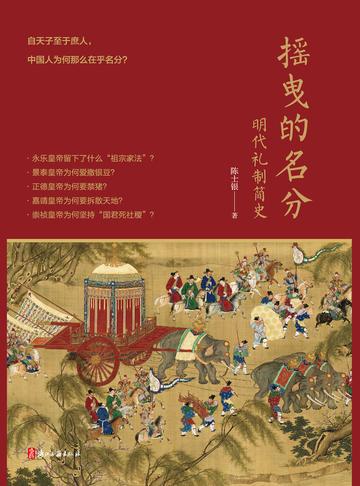








As the book says, "The framework of the etiquette system includes five etiquettes: auspicious etiquette, unlucky etiquette, military etiquette, guest etiquette, and honorable etiquette." It feels so interesting! Moreover, the author's language is also very relaxed and not boring at all. I especially like the narration of different historical fragments in the book, such as "Two Emperors Coexisted", which gave me a deeper understanding of the history of the Ming Dynasty. All in all, this is a great book worth reading!
Serious literature is worth recommending