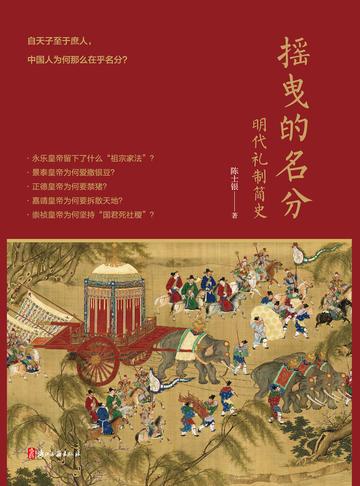
Looking at the history of the Ming Dynasty through "names" is an easy-to-read brief history of the ritual system of the Ming Dynasty.
Editor's recommendation
★Novel entry: From the emperor to the common people, why do Chinese people care so much about their status? Taking the title as the starting point, we re-establish the narrative framework of the history of rituals in the Ming Dynasty.
★Interesting interpretation: What "ancestral family laws" did Emperor Yongle leave behind? Why did Emperor Jingtai like to scatter silver beans? Why did Emperor Zhengde ban pigs? Why did Emperor Jiajing want to break up the world? Why did Emperor Chongzhen insist that "the monarch must die in the country"? Make the seemingly monotonous ritual characters come alive, and make the seemingly boring ritual events come alive.
★Detailed citations: Find clues from numerous historical materials, with more than 1,200 cited materials. From point to point, step by step, we outline the origin and end of the etiquette system of the Ming Dynasty.
Introduction
Ritual system is the abbreviation of etiquette system. Its appearance lies in Yi (ritual rituals and objects), and its inner side lies in system (system system). This book reinterprets the history of the Ming Dynasty through the perspective of changes in ritual systems, focusing on the theme of "name and status", relying on a solid documentary foundation, and adopting a relaxed language style. From the little-known "Edict of King Hao" that opened a different chapter in the establishment of the Ming Dynasty, to the sacrificial system of heaven and earth that has undergone many changes, from the worship of the city god that has become popular, to the frequent use of the name of ancestors to seize power, from the " "Two emperors coexist", to the absurdity of the emperor's conquest (Ming Wuzong)... This book attempts to pick up different historical fragments, tell the story of the ritual system at that time, and reveal the historical process of the country and the people's continuous struggle and struggle to obtain new status and identity.
[About the author]
Chen Shiyin holds a PhD in history from Tsinghua University and is a lecturer in the History Department of Yangzhou University. His main research interests include the Three Rites and the Ming Dynasty etiquette system. Participated in the National Social Science Fund's major project "Research on the Restoration of "Rituals" and the Reconstruction of Contemporary Daily Etiquette", the National Social Science Fund's special commissioned project "Comparative Research on Chinese and Foreign Ceremony Systems", and presided over the National Social Science Fund's later-funded project "The Rites of the Early Ming Dynasty" "Research on Institutional Reform", Jiangsu Province's "Doctoral Entrepreneurship and Entrepreneurship" project, "Research on Rituals in the Mid-Ming Dynasty" and other topics, compiled and published "Analysis of Doubts in the Book of Rites", "Revisions of Chen's Collection of the Book of Rites", and published the monograph "Wisdom Gathering in China: Twelve Peaks of China's Ideological Landscape", etc.
[Recommended by famous experts]
① I have watched "The Fifteen Years of Wanli" by Huang Renyu, and I have also watched "Those Things in the Ming Dynasty" by Ming Yue. From this book, I saw the professional expression of Huang Renyu's work and the artistic expression of Ming Yue's work. ——Bao Hongjun (Chairman of Zhejiang Publishing and Media Co., Ltd.)
② Chen Shiyin is a young man with great humanistic care. He feels that what is written in our traditional academic research, especially the study of rituals, is incomprehensible to most people, so he made an attempt to introduce the history of rituals in the Ming Dynasty to everyone in a relatively relaxed and popular writing style. ——Peng Lin (President of Tsinghua University
Reader comments
As the book says, "The framework of the etiquette system includes five etiquettes: auspicious etiquette, unlucky etiquette, military etiquette, guest etiquette, and honorable etiquette." It feels so interesting! Moreover, the author's language is also very relaxed and not boring at all. I especially like the narration of different historical fragments in the book, such as "Two Emperors Coexisted", which gave me a deeper understanding of the history of the Ming Dynasty. All in all, this is a great book worth reading!

As the book says, "The framework of the etiquette system includes five etiquettes: auspicious etiquette, unlucky etiquette, military etiquette, guest etiquette, and honorable etiquette." It feels so interesting! Moreover, the author's language is also very relaxed and not boring at all. I especially like the narration of different historical fragments in the book, such as "Two Emperors Coexisted", which gave me a deeper understanding of the history of the Ming Dynasty. All in all, this is a great book worth reading!
Serious literature is worth recommending