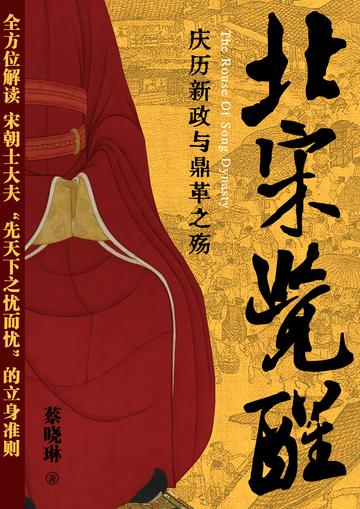
A comprehensive look at the guiding principle by which Song dynasty scholar-officials lived: “Worry about the world’s troubles before anyone else does.”
[Editor’s Recommendations]
⭐ The author seeks to free today’s popular historical narratives from simple palace-intrigue stories, avoiding the portrayal of history as a repetitive cycle of scheming and betrayal.
⭐ The book explores real history, offering a highly detailed account of the finances and official systems during the Qingli Reforms, the character and words and actions of historical figures, and the reforms’ process, gains, and losses.
⭐ Alongside its rigorous historical research, the book has a relaxed, poetic style, drawing on the literary techniques of Zhang Yinlin, Wen Yiduo, and Huang Renyu. It is profound without sacrificing entertainment or artistry.
⭐ With both a broad perspective and an eye for detail, it captures the pulse of real history. Exploring the meaning, triumphs, and sorrows of sweeping change, it is an essential introduction to the history of the Northern Song.
[Synopsis]
The founders of the Song dynasty used their exceptional political wisdom to set society on a better course and change its customs, steering their new era away from the chaotic cycle of shifting warlords that had defined the Five Dynasties and Ten Kingdoms after the Tang. Yet after years of building the Song Empire, flaws in its institutions brought mounting problems, worsening both internal unrest and external threats.
As the empire faced a moment of mortal peril, scholar-officials such as Fan Zhongyan, Han Qi, Ouyang Xiu, and Fu Bi, raised in the culture of reverence for learning that had flourished since the Song’s founding, mounted their horses with the resolve to set the world right. They launched the reform movement of the middle Song, known to history as the Qingli Reforms.
When academic monographs make history seem like perilous terrain to general readers, while popularized retellings sink into cliché, the author of this book draws on extensive reading of original sources, contemporary records, and scholarly research. In poetic language, with a flowing style, rigorous historical analysis, and a distinctive perspective, the author tells the story of the transition from the middle Tang through the Five Dynasties and Ten Kingdoms to the Song, as well as the Qingli Reforms, from beginning to end, including their successes and failures. This book allows readers to grasp the pulse of early and middle Song history in an engaging read, and to glimpse, amid the passion and melancholy of that turbulent age of awakening, the billowing white robes of scholar-officials whose figures have never truly faded into the distance.
[About the Author]
Cai Xiaolin was born in 1977 in Jinjiang, Fujian. He graduated from the navigation program at Jimei Navigation Institute and the law program at Jiangnan University.
He has long been interested in history and literature, and believes that the scholar-officials of the Northern Song are a fascinating group whose stories remain deeply relevant today.
Five years ago, he began reading extensively on the subject. After revising the manuscript with guidance from history professors, he completed Northern Song Awakening: The Qingli Reforms and the Tragedy of Transformation.



This book is very interesting and not boring like most history books. The author tells the history very vividly, making me feel like I have traveled back to the Northern Song Dynasty. I especially like the ambitious scholar-officials in the book who bravely carried out reforms for the sake of the country and the people. But I also hate those conservatives who always hinder the progress of reform. Overall, this book gave me a deeper understanding of the Northern Song Dynasty, and I recommend it to you!