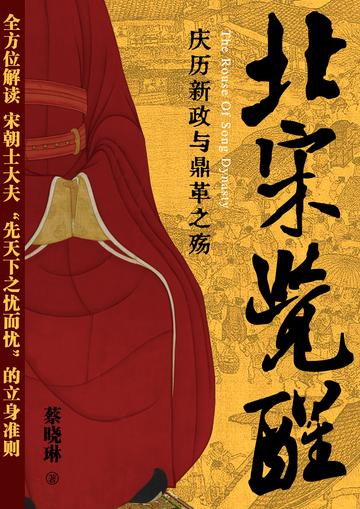
Comprehensive interpretation of the Song Dynasty scholar-bureaucrat's principle of "worrying about the world before it".
Editor's recommendation
⭐The author of this book attempts to liberate the current popular historical narratives from simple stories of palace battles, and avoid depicting history as a repetitive plot full of intrigues.
⭐ Explore the real history, with extremely detailed descriptions of the financial and official systems during the Qingli New Deal period, the personalities, words and deeds of historical figures, as well as the process of reform, gains and losses.
⭐In addition to rigorous historical facts, the narrative style is relaxed and poetic. It inherits and draws on the literary brushwork of Zhang Yinlin, Wen Yiduo, and Huang Renyu. It is deep without losing interest and literary artistry.
⭐Telling the true pulse of history with both overall and nuanced observations. To explore the true meaning and joys and sorrows of Dinggu's innovation is a must-read introductory work to understand the history of the Northern Song Dynasty.
Introduction
The founders of the Song Dynasty used their superb political wisdom to correct customs and make their new era break out of the chaotic cycle of "changing the king's flag on the city wall" during the Five Dynasties and Ten Kingdoms period after the Tang Dynasty. However, after the Song Empire had been operating for a long time, internal and external troubles gradually intensified due to the shortcomings caused by many institutional deficiencies.
So in the autumn when the empire was in critical condition, scholar-bureaucrats such as Fan Zhongyan, Han Qi, Ouyang Xiu, Fu Bi and others who had grown up under the culture-advocating trend after the founding of the Song Dynasty mounted their horses and launched the reform movement in the mid-Song Dynasty with the ambition of rectifying the world, which is known in history as the "Qingli New Deal".
When academic research monographs are regarded as dangerous by the public readers, while historical dramas are stuck in popular conventions, the author of this book, after reading a large number of original documents, contemporary people's notes, and expert research writings, uses poetic language, flowing brushwork, rigorous academic analysis, and unique perspective to tell readers about the transition from the Five Dynasties and Ten Kingdoms to the Song Dynasty in the mid-Tang Dynasty, and the beginning and end of the Qingli New Deal, as well as the gains and losses. This book allows readers to understand the historical pulse of the early and middle Song Dynasty in a relaxed reading, and can also look at the passion and melancholy of the scholar-bureaucrats in that exciting awakening era, and look at their flowing white figures in the distance.
[About the author]
Cai Xiaolin, born in 1977 in Jinjiang, Fujian Province, graduated from the Department of Navigation of Jimei Navigation College and the Department of Law of Jiangnan University.
I have always been interested in history and literature in my life. I believe that the scholar-bureaucrats in the Northern Song Dynasty were a group of people and events that are worth recalling and have a great influence on the present.
So I began to read a large number of relevant documents five years ago, and after revisions under the guidance of history professors, I finally wrote "The Awakening of the Northern Song Dynasty - Qingli New Deal and the Tragedy of the Ding Revolution".
Reader comments
This book is very interesting and not boring like most history books. The author tells the history very vividly, making me feel like I have traveled back to the Northern Song Dynasty. I especially like the ambitious scholar-officials in the book who bravely carried out reforms for the sake of the country and the people. But I also hate those conservatives who always hinder the progress of reform. Overall, this book gave me a deeper understanding of the Northern Song Dynasty, and I recommend it to you!


This book is very interesting and not boring like most history books. The author tells the history very vividly, making me feel like I have traveled back to the Northern Song Dynasty. I especially like the ambitious scholar-officials in the book who bravely carried out reforms for the sake of the country and the people. But I also hate those conservatives who always hinder the progress of reform. Overall, this book gave me a deeper understanding of the Northern Song Dynasty, and I recommend it to you!