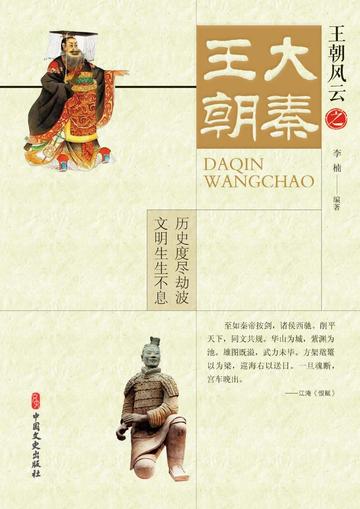
This book tells the historical story of the rise of Qin, to the unification of China by Qin Shihuang in 221 BC, and to the death of Prince Qin as an infant in 206 BC. The first emperor of Qin, Ying Zhengfen, and the remaining heroes of the sixth generation, cut off all the heroes and established the Qin Dynasty. Books share the same text, cars run on the same track, and weights and measures are unified. Qin Shihuang was so satisfied with his ambition that he built the Great Wall, built palaces, built mausoleums, burned books and humiliated Confucian scholars, suppressed the people's ambitions, and caused resentment among the people. After Hu Hai, the second emperor of Qin, came to the throne, he became even more rebellious. Eventually, Chen Sheng and Wu Guang took the initiative, while Liu Bang and Xiang Yu followed behind. "Its rise was rapid, and its demise was sudden." The Qin Dynasty, which had achieved great success, collapsed.
Reader comments
Qin's unification of the six kingdoms lies in the success of reforms. It valued talents, rewarded farming and fighting, and civilians could stand up for their military exploits. The six countries also carried out corresponding reforms, but they were not thorough and ended in failure. The ruling class has always been monopolized by princes and nobles, corrupt and incompetent, and their demise is a historical necessity. Qin paid great attention to the people during its development stage, implemented some policies to promote production enthusiasm, built water conservancy projects to benefit the people, and created fertile farmland and sufficient food. The Qin ruling class was able to accept the suggestions of the ministers, adopt corresponding strategies for the six countries, coupled with a powerful army and rare military generals, unified the world. After Qin Shihuang unified the world, he got carried away and vigorously built civil engineering projects, which wasted money and tax, increased taxes and corvee, and imposed severe punishments. The people were miserable, which eventually led to the death of Qin II.
Especially Qin Shihuang, I was deeply impressed by his ambition and courage to unify the six countries. Moreover, the book also mentioned many interesting historical stories, such as the burning of books and the entrapment of Confucian scholars, which enriched my knowledge. I like this book very much and recommend it to you!
Legalists and military strategists strengthened the country, Taoists and Confucians governed the country, and Mohist farmers made the country prosperous.

Qin's unification of the six kingdoms lies in the success of reforms. It valued talents, rewarded farming and fighting, and civilians could stand up for their military exploits. The six countries also carried out corresponding reforms, but they were not thorough and ended in failure. The ruling class has always been monopolized by princes and nobles, corrupt and incompetent, and their demise is a historical necessity. Qin paid great attention to the people during its development stage, implemented some policies to promote production enthusiasm, built water conservancy projects to benefit the people, and created fertile farmland and sufficient food. The Qin ruling class was able to accept the suggestions of the ministers, adopt corresponding strategies for the six countries, coupled with a powerful army and rare military generals, unified the world. After Qin Shihuang unified the world, he got carried away and vigorously built civil engineering projects, which wasted money and tax, increased taxes and corvee, and imposed severe punishments. The people were miserable, which eventually led to the death of Qin II.
Especially Qin Shihuang, I was deeply impressed by his ambition and courage to unify the six countries. Moreover, the book also mentioned many interesting historical stories, such as the burning of books and the entrapment of Confucian scholars, which enriched my knowledge. I like this book very much and recommend it to you!
Legalists and military strategists strengthened the country, Taoists and Confucians governed the country, and Mohist farmers made the country prosperous.