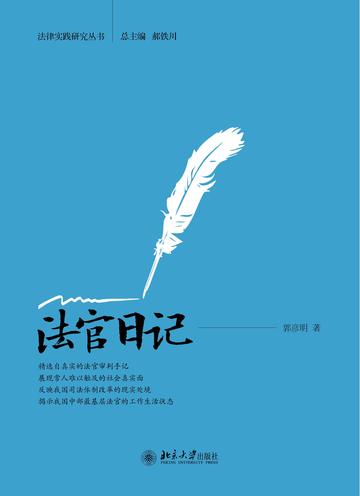
This book is a selected part of the author's real case handling notes recorded in the past three years of trial practice. It is a microcosm of the real work and life of a grassroots judge in central China.
The content covers not only common issues such as the low number of cases under the current judicial system, litigation and litigation, judicial intervention, group disputes, multiple resolution mechanisms for social conflicts, and the urgent need for reforms within the courts, but also individual issues reflecting social reality such as marriage and family, torts, contracts, and labor disputes; it not only describes people's normal It not only reflects the busy, hard, and sometimes helpless life reality of grassroots judges at this stage, but also reflects their wisdom, courage, and responsible inner responsibility, and of course their useful thinking and exploration about work and life. Judges, like ordinary people, face various pressures; but as judges, they bear the solemnity of the law, shoulder the justice of the law, and touch the truest side of society that is difficult for ordinary people to touch. At work, they face more disputes between parents and their parents.
This book contains more narration and less judgment. The words are not false and beautiful, and try not to conceal evil. On the basis of exploring the root causes of legal disputes behind each story, the author also points out the direction on how to improve oneself and perfect human nature. Through this book, we can understand the real situation faced by the judicial system in central my country, understand what the judges in central China do, feel, be confused, think, and love, and see the hope of China's rule of law.
Reader comments
My previous understanding of judges was that they were in the sky, tall, ruthless and selfless. After reading the judge's diary, I suddenly realized that judges are also human beings, with KPIs and tasks. Even if you're not in a legal-related industry, it's worth a look. For example, the author said that new furniture, cabinets, etc. Were distributed, but no one was very active in receiving them. Why? The furniture distributed was not in urgent need. What they needed more was some benches in the corridor to facilitate people waiting in line for court sessions. The machine for ordering files is no longer sewn with hand-made needlework. The author is really careful. There are also the worries of judges. There are too many cases and insufficient manpower. How many cases should be concluded by the end of the year? There are also live broadcast promotion tasks, KPIs, etc. However, there are some professional terms in it that are difficult for laymen to understand. It would be best to have some explanations. The book rarely touches on the results of the cases. There are a few cases where I am still curious about the results. There are many cases in there that are also worth a look.
This book is very real and allowed me to understand the work and life of grassroots judges. By recording his own case handling notes, the author showed various problems and challenges in judicial practice, and also allowed me to see his thinking and efforts. Moreover, there are no characters in the book that I dislike, and every case is very vivid. I think the author is very powerful. His combination of practical experience and theoretical research makes this book both in-depth and practical. I recommend you also read this book, you will definitely gain something.
The author has rich judicial practice experience and profound attainments in Chinese studies. It can be said that all laughter and anger are turned into an article, and it is full of positive energy, and the writing is also very true! There are three hundred poems that describe the past and think about the future. In one sentence, thinking is innocent! Great book! Learn to collect!
This non-fiction book is really nice. Some people think it is a waste of time. But for me, it is an effective way to understand the work and life of judges. I thought judges were all close friends, or the kind of people who are superior. It turns out that the life of grassroots judges is like this. They solve "trivial" things.
Every chapter is sublimated at the end. No wonder people dare to publish books. The writing style is indeed strong, and some modern poems are also very interesting to read.
Recommended reading [laughing]
A good judge based at the grassroots level, dedicated to his duties, kind and sincere to others, Judge Guo has many advantages worth learning from!
It's great. It allows us to have real contact with the daily life of judges, and also allows us to understand how difficult legal work is. It also made me more determined to become a loyal legal worker
It's good-looking, true, and useful. It would be better if you could write down the precautions for court procedures.



My previous understanding of judges was that they were in the sky, tall, ruthless and selfless. After reading the judge's diary, I suddenly realized that judges are also human beings, with KPIs and tasks. Even if you're not in a legal-related industry, it's worth a look. For example, the author said that new furniture, cabinets, etc. Were distributed, but no one was very active in receiving them. Why? The furniture distributed was not in urgent need. What they needed more was some benches in the corridor to facilitate people waiting in line for court sessions. The machine for ordering files is no longer sewn with hand-made needlework. The author is really careful. There are also the worries of judges. There are too many cases and insufficient manpower. How many cases should be concluded by the end of the year? There are also live broadcast promotion tasks, KPIs, etc. However, there are some professional terms in it that are difficult for laymen to understand. It would be best to have some explanations. The book rarely touches on the results of the cases. There are a few cases where I am still curious about the results. There are many cases in there that are also worth a look.
This book is very real and allowed me to understand the work and life of grassroots judges. By recording his own case handling notes, the author showed various problems and challenges in judicial practice, and also allowed me to see his thinking and efforts. Moreover, there are no characters in the book that I dislike, and every case is very vivid. I think the author is very powerful. His combination of practical experience and theoretical research makes this book both in-depth and practical. I recommend you also read this book, you will definitely gain something.
The author has rich judicial practice experience and profound attainments in Chinese studies. It can be said that all laughter and anger are turned into an article, and it is full of positive energy, and the writing is also very true! There are three hundred poems that describe the past and think about the future. In one sentence, thinking is innocent! Great book! Learn to collect!
This non-fiction book is really nice. Some people think it is a waste of time. But for me, it is an effective way to understand the work and life of judges. I thought judges were all close friends, or the kind of people who are superior. It turns out that the life of grassroots judges is like this. They solve "trivial" things. Every chapter is sublimated at the end. No wonder people dare to publish books. The writing style is indeed strong, and some modern poems are also very interesting to read. Recommended reading [laughing]
A good judge based at the grassroots level, dedicated to his duties, kind and sincere to others, Judge Guo has many advantages worth learning from!
It's great. It allows us to have real contact with the daily life of judges, and also allows us to understand how difficult legal work is. It also made me more determined to become a loyal legal worker
It's good-looking, true, and useful. It would be better if you could write down the precautions for court procedures.