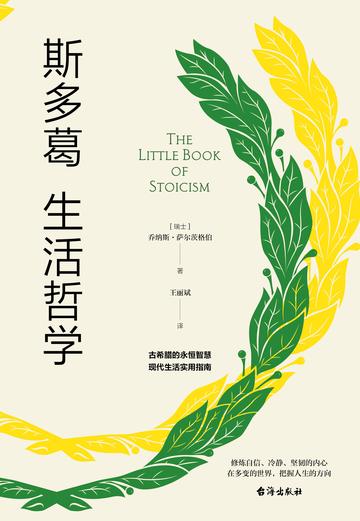
How should you deal with challenges?
How to deal with difficult people?
Where can you find joy and gain strength?
How to deal with recurring frustrating thoughts?
How to deal with changes and face life and death?
Faced with these inevitable troubles and problems in life, how to live happier?
The Stoic philosophy of more than two thousand years ago has already given the answer.
Jonas Salzgerber combined his many years of personal experience and understanding of Stoic philosophy to create this guide to happiness that is very suitable for modern people.
Starting from various interesting life details, the author introduces the historical evolution, representative figures and important views of Stoic philosophy.
At the same time, this book uses 55 daily exercises of Stoic philosophy to teach us step by step how to control emotions, how to stay sharp, how to behave in the world, and how to control life with ease like a Stoic philosopher.
Guided by the timeless wisdom of Stoic philosophy, everyone can find the path to happiness.
Reader comments
This book is not bad. It is a book about how to obtain happiness. The book also mentions that the content here has some similar views to that of Positive Psychology. I feel a little ashamed to say that. Before I read psychology books, I always read some psychological principles, behavioral psychology, etc. I thought that reading these books would be of great help to us. When I saw positive psychology, I let it go without reading it. But then I read this kind of books, which are very helpful.
We live for joy and happiness. No one pursues pain, but the happiness we understand is to read some useful books and gain the knowledge we want to learn. But what we don't know is that we will encounter a lot of setbacks and pain on the road of life. If we can overcome this setback, regulating our mood is what we need to learn most. This is why reading this book will be so helpful and important to us.
The first few chapters of this book are all about how to regulate yourself and how to obtain happiness. The later chapters are about specific training methods, and they also talk about relatively refreshing perspectives.
Things are divided into good things, bad things, and insignificant things. Good things refer to good moral character, bad things refer to all bad qualities, and insignificant things refer to things other than good and bad things. How to distinguish good things or bad things are all results we can achieve through our own actions. We can learn to be an honest person, which is a good thing, or we can be affected and become a habitual liar, which is a bad thing. In addition, many people hope to win the jackpot, which is insignificant. The result will not be what you expect because of your behavior.
To sum up, it is the things we can control and the things we cannot control. We want to achieve a goal. If there is half a probability that the goal can be achieved, we can work hard. If the probability is less than half, we will be very miserable if we cannot achieve it. So those who want happiness can choose Don't set too big goals for things that you can achieve with your own efforts. In layman's terms, this is called desire, so you have to control it instead of being controlled by it. After all, meaningless hope is the most harmful to people. I like this sentence very much. Good things must be obtained from oneself, that is, to obtain spiritual happiness, not from external things.
There is also a second point of view, reaction theory. When we encounter some unhappy things, we should first slow down and set a reaction time, consider the consequences of our actions, choose the best result, and don't be a slave to emotions. If a person says something very unpleasant, the instinctive reaction may be to fight back, use fists or verbal abuse. These are not good. You can choose to stay away to avoid affecting yourself. These previous bad behaviors will cause great harm to yourself, so by setting the reaction area, we can help us make the best choice.
This book is very good and worth reading more to gain our own happiness.
1. Imagine the ideal self, find the gap between the real self, narrow the gap, express the highest self, and use moral means to tolerate everything.
2. Focus on the things that are controlled and treat the things that are out of control as unimportant. Believe that there is only one way to happiness, which is to stop worrying about things that are beyond our control.
3. No one wants to hear about your exploits, which is annoying and selfish. Say only what needs to be said, make silence your goal most of the time, and say only what is necessary and brief.
4. Don't long for things you can't have, cherish everything you have. A wise man is content with his lot. The more and more things you don't need and the less and less you need, the freer you will be.
5. Play the "calm game", realize your inner imbalance, and see how quickly you can adjust and return to a harmonious state habitually.
Quite interesting philosophy. As a person who is naturally brilliant and extremely internally constrained, I believe this book will give me an interesting answer. However, there are still some common problems with philosophy books. I still need to be patient and read it carefully. But overall, it is indeed a very interesting answer and is worth reading.
We forget that we are mortal.
We live life as if we have immortality;
Only then did I realize that it was impossible, and then I hoped that I could start real life as soon as possible.
People are willing to give everything they have to live, but they waste time while they are alive.
They don't realize that their time will end at any time in the summer.
Stoic Philosophy
In an uncertain world, establish a certain internal order;
Clearly distinguish between controllable and uncontrollable, focus on what can be changed, and accept what cannot be changed;
Take control of your heart, practice virtue, and gain lasting peace and strength.
[Controllable and uncontrollable]
Your own thoughts, attitudes, and actions, such as whether you are focused when working, whether you are calm when facing criticism, and whether you spend time studying, are things you can control;
Other people's evaluations, boss's decisions, changes in the weather, and unexpected occurrences, such as whether colleagues are kind, whether the project will be approved, whether there will be traffic jams when going out, etc., Are all uncontrollable.
We cannot control what others think or how the outside world changes;
But being able to control whether you do things seriously and maintain a positive attitude is the key to influencing the results.
This is also a very popular topic right now.
[Ideas and Practices]
As Internet practitioners, we have to work in the 996 mode;
At the same time, he is also faced with huge work pressure and performance appraisal, which is an uncontrollable external aspect for himself.
At this moment when we have not yet escaped from such a working environment,
Abuse and disgust will only make you accept the unchangeable work intensity;
I prefer to focus on improving my work ability and efficiency;
Face difficulties and setbacks at work with a peaceful mind.
Maybe one day I will have the ability to change the environment;
Maybe, one day I will choose to leave.
Stoic in my eyes
Stoic said, take responsibility, focus on control, and pursue virtue.
When working, look for goals, clarify actions, and focus on the process.
In life, life goals, self-reconciliation, everything is experienced.
Stoic life philosophy unexpectedly fits my outlook on life and values.
Maybe it has something to do with my age, experience and work. I think this book is very good.
Although the core content has been read in other similar works and is even used in psychology books, such as rational emotive therapy, it feels like meeting an acquaintance. For people who are currently suffering from anxiety and depression, it will be helpful to read this book. Of course, the prerequisite is that you can accept the main points. If you adopt a refusal attitude, no ideas or training will be effective.
So, five stars.
I recently became obsessed with Stoicism, after reading "Living Like a Philosopher" and "Breakfast with Seneca", followed by this book. Although the core arguments are similar, it is still great for consolidating the understanding of Stoicism. Through this book, you can understand the Stoic happiness triangle: living a virtuous life, focusing on controllable things, and taking responsibility. The four Stoic virtues: wisdom, courage, justice, temperance, and many more: honesty, kindness, generosity, and more. By following correct values, learn to think rationally, make correct judgments between stimuli and responses, and then take correct actions. This philosophy can be applied to doctrines and is very practical. What's more important is to imitate it bit by bit in life, so that you can become a better person, get closer to your ideal self every moment, and live a happy and smooth life.
Seeing this, I suddenly became enlightened. Most of the things in this world are beyond our control. Only our thoughts are controlled by our being. Therefore, if we want to live a happy and smooth life, we must give up those things that we cannot control, enrich our thoughts, be kind, positive, open-minded, self-respecting, and seek knowledge, and we should hold on tight!
I discovered that it was because of my negative emotions that I put off the plans I had always made. I just wanted to be happy in time. Why did I have negative emotions? That was because I had extravagant hopes for things that I couldn't change now, which led to me not even being able to control the things I could control in front of me, and then I fell into this death spiral, dragging people down infinitely!
Thanks to the author, I found the reason!
This book is very interesting! It teaches us how to deal with difficulties and troubles. Just like I didn't do well in the exam last time and was very sad, but after reading this book, I know how to make myself happy. And there are many interesting stories and examples in this book, which is not boring at all. I think it is like a "happiness guide" that allows us to become stronger in life!
I like the acceptance and tolerance mentioned in the book: Don't take everything so seriously, don't be too harsh on yourself, these are just old things happening again. Things get messed up, people die, games are lost, things fail, it's like spring roses and summer fruits, they always come around again and again.
I also agree with Stoicism. Everyone has different beliefs and cultures, including race, and we just need to find our own path. I don't need to care about other people's thoughts or ideas, although Stoicism inspires me a lot. But the fly in the ointment is that Stoicism is overly optimistic. Of course I am not advocating a perfect Stoicism, but there are indeed few people who take this path and succeed.
Contains many life philosophies. Specific method guidance and concepts can be underlined and recorded, and it will be much more convenient to read the underlined text directly later.
Very interesting book
Stoic came at the right time [smile]
Very meaningful, recommended reading
Very good book, listen to it again
May I move towards happiness
Control your emotions, maintain inner peace, and gain happiness by controlling your desires!
On the way to self-rescue, I tried and made countless mistakes until I encountered the Stoic idea and found my destination.
Very good, actually life can become so simple
The philosophy and art of life, growing into the best version of yourself
Very good, there are some thought-provoking points in it
I don't know if it's a translation problem or it's the original version. I always feel that some parts are too talkative, but overall I feel good.







This book is not bad. It is a book about how to obtain happiness. The book also mentions that the content here has some similar views to that of Positive Psychology. I feel a little ashamed to say that. Before I read psychology books, I always read some psychological principles, behavioral psychology, etc. I thought that reading these books would be of great help to us. When I saw positive psychology, I let it go without reading it. But then I read this kind of books, which are very helpful. We live for joy and happiness. No one pursues pain, but the happiness we understand is to read some useful books and gain the knowledge we want to learn. But what we don't know is that we will encounter a lot of setbacks and pain on the road of life. If we can overcome this setback, regulating our mood is what we need to learn most. This is why reading this book will be so helpful and important to us. The first few chapters of this book are all about how to regulate yourself and how to obtain happiness. The later chapters are about specific training methods, and they also talk about relatively refreshing perspectives. Things are divided into good things, bad things, and insignificant things. Good things refer to good moral character, bad things refer to all bad qualities, and insignificant things refer to things other than good and bad things. How to distinguish good things or bad things are all results we can achieve through our own actions. We can learn to be an honest person, which is a good thing, or we can be affected and become a habitual liar, which is a bad thing. In addition, many people hope to win the jackpot, which is insignificant. The result will not be what you expect because of your behavior. To sum up, it is the things we can control and the things we cannot control. We want to achieve a goal. If there is half a probability that the goal can be achieved, we can work hard. If the probability is less than half, we will be very miserable if we cannot achieve it. So those who want happiness can choose Don't set too big goals for things that you can achieve with your own efforts. In layman's terms, this is called desire, so you have to control it instead of being controlled by it. After all, meaningless hope is the most harmful to people. I like this sentence very much. Good things must be obtained from oneself, that is, to obtain spiritual happiness, not from external things. There is also a second point of view, reaction theory. When we encounter some unhappy things, we should first slow down and set a reaction time, consider the consequences of our actions, choose the best result, and don't be a slave to emotions. If a person says something very unpleasant, the instinctive reaction may be to fight back, use fists or verbal abuse. These are not good. You can choose to stay away to avoid affecting yourself. These previous bad behaviors will cause great harm to yourself, so by setting the reaction area, we can help us make the best choice. This book is very good and worth reading more to gain our own happiness.
1. Imagine the ideal self, find the gap between the real self, narrow the gap, express the highest self, and use moral means to tolerate everything. 2. Focus on the things that are controlled and treat the things that are out of control as unimportant. Believe that there is only one way to happiness, which is to stop worrying about things that are beyond our control. 3. No one wants to hear about your exploits, which is annoying and selfish. Say only what needs to be said, make silence your goal most of the time, and say only what is necessary and brief. 4. Don't long for things you can't have, cherish everything you have. A wise man is content with his lot. The more and more things you don't need and the less and less you need, the freer you will be. 5. Play the "calm game", realize your inner imbalance, and see how quickly you can adjust and return to a harmonious state habitually.
Quite interesting philosophy. As a person who is naturally brilliant and extremely internally constrained, I believe this book will give me an interesting answer. However, there are still some common problems with philosophy books. I still need to be patient and read it carefully. But overall, it is indeed a very interesting answer and is worth reading.
We forget that we are mortal. We live life as if we have immortality; Only then did I realize that it was impossible, and then I hoped that I could start real life as soon as possible. People are willing to give everything they have to live, but they waste time while they are alive. They don't realize that their time will end at any time in the summer. Stoic Philosophy In an uncertain world, establish a certain internal order; Clearly distinguish between controllable and uncontrollable, focus on what can be changed, and accept what cannot be changed; Take control of your heart, practice virtue, and gain lasting peace and strength. [Controllable and uncontrollable] Your own thoughts, attitudes, and actions, such as whether you are focused when working, whether you are calm when facing criticism, and whether you spend time studying, are things you can control; Other people's evaluations, boss's decisions, changes in the weather, and unexpected occurrences, such as whether colleagues are kind, whether the project will be approved, whether there will be traffic jams when going out, etc., Are all uncontrollable. We cannot control what others think or how the outside world changes; But being able to control whether you do things seriously and maintain a positive attitude is the key to influencing the results. This is also a very popular topic right now. [Ideas and Practices] As Internet practitioners, we have to work in the 996 mode; At the same time, he is also faced with huge work pressure and performance appraisal, which is an uncontrollable external aspect for himself. At this moment when we have not yet escaped from such a working environment, Abuse and disgust will only make you accept the unchangeable work intensity; I prefer to focus on improving my work ability and efficiency; Face difficulties and setbacks at work with a peaceful mind. Maybe one day I will have the ability to change the environment; Maybe, one day I will choose to leave. Stoic in my eyes Stoic said, take responsibility, focus on control, and pursue virtue. When working, look for goals, clarify actions, and focus on the process. In life, life goals, self-reconciliation, everything is experienced. Stoic life philosophy unexpectedly fits my outlook on life and values.
Maybe it has something to do with my age, experience and work. I think this book is very good. Although the core content has been read in other similar works and is even used in psychology books, such as rational emotive therapy, it feels like meeting an acquaintance. For people who are currently suffering from anxiety and depression, it will be helpful to read this book. Of course, the prerequisite is that you can accept the main points. If you adopt a refusal attitude, no ideas or training will be effective. So, five stars.
I recently became obsessed with Stoicism, after reading "Living Like a Philosopher" and "Breakfast with Seneca", followed by this book. Although the core arguments are similar, it is still great for consolidating the understanding of Stoicism. Through this book, you can understand the Stoic happiness triangle: living a virtuous life, focusing on controllable things, and taking responsibility. The four Stoic virtues: wisdom, courage, justice, temperance, and many more: honesty, kindness, generosity, and more. By following correct values, learn to think rationally, make correct judgments between stimuli and responses, and then take correct actions. This philosophy can be applied to doctrines and is very practical. What's more important is to imitate it bit by bit in life, so that you can become a better person, get closer to your ideal self every moment, and live a happy and smooth life.
Seeing this, I suddenly became enlightened. Most of the things in this world are beyond our control. Only our thoughts are controlled by our being. Therefore, if we want to live a happy and smooth life, we must give up those things that we cannot control, enrich our thoughts, be kind, positive, open-minded, self-respecting, and seek knowledge, and we should hold on tight!
I discovered that it was because of my negative emotions that I put off the plans I had always made. I just wanted to be happy in time. Why did I have negative emotions? That was because I had extravagant hopes for things that I couldn't change now, which led to me not even being able to control the things I could control in front of me, and then I fell into this death spiral, dragging people down infinitely! Thanks to the author, I found the reason!
This book is very interesting! It teaches us how to deal with difficulties and troubles. Just like I didn't do well in the exam last time and was very sad, but after reading this book, I know how to make myself happy. And there are many interesting stories and examples in this book, which is not boring at all. I think it is like a "happiness guide" that allows us to become stronger in life!
I like the acceptance and tolerance mentioned in the book: Don't take everything so seriously, don't be too harsh on yourself, these are just old things happening again. Things get messed up, people die, games are lost, things fail, it's like spring roses and summer fruits, they always come around again and again.
I also agree with Stoicism. Everyone has different beliefs and cultures, including race, and we just need to find our own path. I don't need to care about other people's thoughts or ideas, although Stoicism inspires me a lot. But the fly in the ointment is that Stoicism is overly optimistic. Of course I am not advocating a perfect Stoicism, but there are indeed few people who take this path and succeed.
Contains many life philosophies. Specific method guidance and concepts can be underlined and recorded, and it will be much more convenient to read the underlined text directly later.
Very interesting book
Stoic came at the right time [smile]
Very meaningful, recommended reading
Very good book, listen to it again
May I move towards happiness
Control your emotions, maintain inner peace, and gain happiness by controlling your desires!
On the way to self-rescue, I tried and made countless mistakes until I encountered the Stoic idea and found my destination.
Very good, actually life can become so simple
The philosophy and art of life, growing into the best version of yourself
Very good, there are some thought-provoking points in it
I don't know if it's a translation problem or it's the original version. I always feel that some parts are too talkative, but overall I feel good.
Studying this book is really helpful