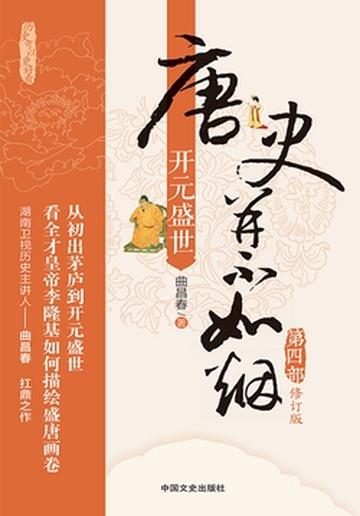
The History of the Tang Dynasty Is Not as Good as Smoke·part 4: the Prosperous Age of Kaiyuan (Revised Edition)
唐史并不如烟·第四部:开元盛世(修订版)
- Status
- Completed
- Length
- 202k Words
- Genre
- Historical
- Updated
- 3y ago
- Source
- Fanqie
Stats
54Reads
9.4Score
19Chapters
18Listens
13.1kReads · all time
Tags
Synopsis
Reader comments
In booklists 3
Traveling Through the Tang Dynasty to Become Li Longji's Son
9.2MViews84Books2moUpdated
Excellent Historical Book! Is There Any? !
There's no need to look numb at all the pretentious and cool articles!
8.5MViews366Books1dUpdated
Masterpieces, History and Culture, World Masterpieces
.
3.7MViews658Books7dUpdated
After spending more than ten days of leisure, I finally finished reading this book about the prosperous Kaiyuan era. The Kaiyuan era has a special importance in the entire history of the Tang Dynasty. It is the golden age that future generations will never forget and yearn for. However, the prosperity stopped here, and the glory of the Tang Dynasty ceased to exist from then on. From then on, the Li and Tang dynasties continued to decline. During this period, although there were several attempts to revive the empire that almost succeeded, they all failed and failed to restore the decline of the dynasty. After reading the complete book, I had many emotions in my heart. The most profound point is that the human heart and human nature are never static. We cannot judge a complete life just based on a person's behavior at a certain stage. Li Longji, Xuanzong of the Tang Dynasty, is the best example. As a young man, he could be regarded as a wise king of the previous generation. He worked hard to create a prosperous Kaiyuan era for all nations to come to the dynasty. However, as he grew older, his mentality completely changed. He gradually listened to one side and became close to treacherous villains, personally laying the foundation for the decline of the Tang Dynasty. There is also a very speculative point of view in the book that impressed me deeply: a good person with a pure heart may not be a good official; an official who is only upright and honest may not be able to properly handle government affairs and solve people's livelihood problems. There is often a contradiction between moral character and political ability. If a scholar has the world in mind and wants to be in a high position to display his ambitions and benefit the people, he will inevitably be involved in the intricate power games in the court. If you want to steadily climb the career ladder, you sometimes have to make decisions that go against your heart and conscience. This also creates the complex and multifaceted characteristics of court officials. People in high positions can never be simply classified as "good guys" or "bad guys". Standing in their own position, everyone will not think they are wrong when they act. Most of the so-called loyalty, villainy, good and evil in later generations can only be weighed and judged after the dust has settled and combined with the final historical outcome, and we can distinguish the merits and demerits of a person's life. Looking back at the famous ministers of Xuanzong, there are those who abide by morality and have noble conduct, as well as those who are well versed in the rules of the court and are proficient in power. In the final analysis, the proportion of good and evil, public and private in everyone's heart is different. The most important thing is their original intention and pursuit when they entered the officialdom. I have never denied that everyone in the court has selfish motives and is eager to display their talents; from a human perspective, everyone has the instinct to pursue a sense of superiority. But there are essential differences between people's starting points when pursuing a higher status: some people just want to be better than others, monopolize power, and satisfy their own vanity; other people climb to high positions because they hope to have more power and realize their ambition to govern the country and stabilize the people. This original intention hidden in the heart was difficult for others to discern at the time. Only by reading historical materials and looking at what they did throughout their lives can future generations infer and judge their true political intentions through the various deeds left in history. After reading the volume "The Prosperous Age of Kaiyuan", I know that I must open the next volume and face the chapter of the Anshi Rebellion. Whether you like it or not, this tragic history cannot be avoided. This is also the most important truth I have learned in the process of reading history: when reading history, we must actively jump out of the inherent judgment standards of right and wrong and put aside personal subjective preferences. Everything in the past is a fact that has happened. It will not last forever just because we prefer prosperous times, nor will it disappear just because we hate war. Our original intention of reading history books is never to choose stories that suit our own tastes, but to objectively look at all the past events that really happened. We do not define good or bad in advance, but only draw experience from historical facts and alert ourselves. This is the only meaning of reading history.
This book is very interesting. It tells the history vividly and interestingly, just like reading a story. In the book, Li Xian, Emperor Zhongzong of Tang Dynasty, and Li Dan, Emperor Ruizong of Tang Dynasty, were very aggrieved throughout their lives, which reminded me of some of my own experiences. Sometimes, we will also encounter various helplessness and difficulties, but the important thing is to persevere and find our own way out like them. This book not only gave me a deeper understanding of the history of the Tang Dynasty, but also gave me some life inspiration. Recommended to friends who like history, worth reading!
The writing is humorous and makes history vivid and interesting!
Very interesting to write. Nice.
Good-looking, good-looking, good-looking
Every word is so precious that I can't stop reading it.
Humorous language explains the truth of history.