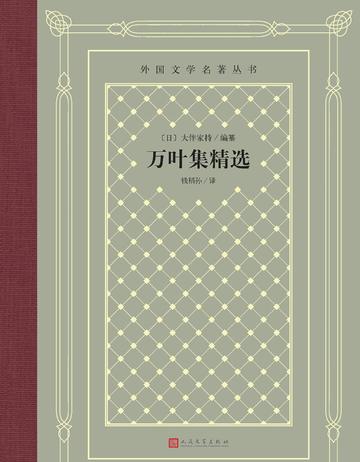
"Man'yoshu" is the oldest and largest extant collection of Japanese songs in Japan. It contains a huge collection of more than 4,500 Japanese songs from the early seventh century to the middle of the eighth century. It not only records colorful Japanese songs for future generations, but also provides future generations of readers with relevant situations and information on Japanese society, politics, culture, customs and other aspects of that period. From the perspective of literary history, it has the significance of connecting the past and the future. Waka, which was gradually separated from the ancient model of oral chanting of ballads and group creation, continued to develop under the strong influence of Han culture, and made dramatic breakthroughs in many aspects, including expression form and chanting themes. It eventually formed the unique artistic style and aesthetic characteristics of Manyo Waka, which set a model for subsequent waka creations. The translator of this book, Mr. Qian Daosun, has been engaged in the translation of Japanese classical literature for many years during his lifetime. He has profound knowledge and a good foundation in classical Chinese. He can translate Waka using different stylistic forms in different periods of creation. This book is about 700 Man'yo poems that he carefully selected and translated. Although it accounts for a small proportion of the entire Man'yo Collection, the translation is elegant and beautiful, and it is a rare example of translation of foreign classical poetry.
Reader comments
"Selected Collection of Manyoshu" is an excellent collection of Japanese songs, which gave me a deeper understanding of the essence of Japanese culture. As a father of two children, I especially appreciate the depiction of family, affection, and friendship as the most important things in our lives. At the same time, I also learned a lot about Japanese history and culture from this book. This book compiled by Otomo Kamochi collects a large number of waka, and Mr. Qian Daosun's translation is also very accurate, which allowed me to understand the meaning of each waka more deeply. In short, this is a highly recommended book. Whether you are a lover of Japanese culture or someone interested in poetry, you can get a lot from it.
There are many translations of the same poem, and I like the Shijing style the most, such as: I would rather think about it, as for this; there are rocks on the high mountains, how can it be like a pillow of death?
I like the scenery part of the poem, but have no interest in the part that praises the king's politics.
The long five-character and seven-character poems in the last few volumes have been skimmed over.
"Selected Collection of Manyoshu" is an excellent collection of Japanese songs, which gave me a deeper understanding of the essence of Japanese culture. As a father of two children, I especially appreciate the depiction of family, affection, and friendship as the most important things in our lives. At the same time, I also learned a lot about Japanese history and culture from this book. This book compiled by Otomo Kamochi collects a large number of waka, and Mr. Qian Daosun's translation is also very accurate, which allowed me to understand the meaning of each waka more deeply. In short, this is a highly recommended book. Whether you are a lover of Japanese culture or someone interested in poetry, you can get a lot from it.
There are many translations of the same poem, and I like the Shijing style the most, such as: I would rather think about it, as for this; there are rocks on the high mountains, how can it be like a pillow of death? I like the scenery part of the poem, but have no interest in the part that praises the king's politics. The long five-character and seven-character poems in the last few volumes have been skimmed over.