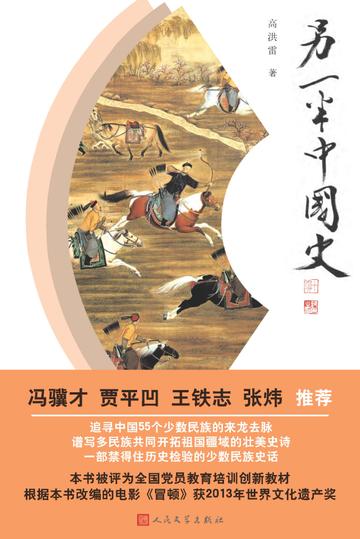
The Other Half of Chinese History
另一半中国史
- Status
- Completed
- Length
- 429k Words
- Genre
- Historical
- Updated
- 3y ago
- Source
- Fanqie
Synopsis
27Chapters
107Reads
9.0Score
25Listens
5.5kReads · all time
More by this author
In booklists 2

Books Recommended by CCTV’s Night Reading
Looking for books like "The Sustenance of Man". Why I recommend it: Just as the title says, by the time you finish reading, you feel completely nourished! A quote to remember: “What truly matters is where you look, not what lies before your eyes.”
328Books20.3MViews3dUpdated

Inner Mongolian Grasslands
Live-streaming while herding and traveling.
179Books7.7MViews1moUpdated
Reader comments 10
Translated by Google Translate
From a very interesting perspective, the author believes that the history of the Han nation has always been regarded as the mainstream by default, while the special cultural features and historical changes of the 55 ethnic minorities have only been mentioned in a few words, and have never really entered the public eye. Therefore, what we have so far called "Chinese history" can only be regarded as half of China's history. I have never interpreted Chinese history in this way before, and it can be said to be a very anti-centrist book. The book uses detailed historical materials to describe the rise, fall, replacement, development and evolution of various ethnic minorities in Chinese history. It is rich in content and has a clear historical context of each ethnic minority. It also comes with dozens of maps of the changes of ethnic minorities drawn by professional surveying and mapping departments. It is a very thoughtful book. .
Recommended. This book is a book about Chinese history. Unlike most books that focus on the rise and fall of dynasties, this book focuses on the history of ethnic minorities and the relationship between ethnic minorities and the central government. Reading this book can help me reduce my Han-centrism. When I mention Chinese history, I should not only think of the history related to the Han people. In fact, the history of ethnic minorities is also very important. As the author points out, the other half of Chinese history is the history of ethnic minorities. However, some contents in this book have not been verified and cannot be fully trusted. Please be careful when reading.
I bought this book when it was first published. After reading about half of it, I couldn't find it and didn't know where I put it. I saw this book on Tomato and finished reading the rest of it. China has always been a multi-ethnic country, and historical narratives have always recorded history from the perspective of the Han ethnic group. Due to their culture and habits, ethnic minorities have almost no historical records, and they are all passed down orally. The author of this book uses the historical origins of each nation as the benchmark, and the context is clear. It is a good book worth reading.
Some of the ethnic stories in it reminded me of the experiences of my relatives and friends, which resonated particularly well with me. However, I kind of hate characters who destroy national unity. Fortunately, the book also emphasizes the importance of national harmony. All in all, this is a book worth reading.
Different from the general talk about the history of Han culture in the Chinese Plains, this book takes a unique approach and clearly explains the changes of ethnic minorities and the historical process of integration of the Han people. It opens the page of the book and reveals another side of history.
We are fortunate to be walking on the road to national prosperity and national rejuvenation, but we still need a light to illuminate the road ahead when night falls. This light is cultural tradition and national wisdom. "The Other Half of Chinese History" uses only six Chinese characters to cover the unique temperament of Chinese civilization, because in the cultural corridor where Han culture is the mainstream, the splendid appearance of China's multi-ethnic culture will always be engraved. More importantly, when we vaguely remember the Xiongnu, Rouran, Wusun, Loulan and other ancient peoples, in "The Other Half of Chinese History", we surprisingly see their life and death, love and hatred...
It's so exciting that you can't put it down.
My favorite book on my bookshelf
Some parts are not consistent with historical facts
We can see the author's desire for survival