Leonardo da Vinci is known as a versatile genius in human history. There are about 6,000 pages of notebooks and manuscripts preserved today. Einstein once said that if Leonardo da Vinci's scientific research results had been published at that time, human science and technology would have advanced 30 to 50 years; our country's Li Shizhen traveled to the famous mountains and rivers of the motherland and wrote down tens of millions of words. The notes eventually became the "Compendium of Materia Medica", which made outstanding contributions to the development of human medicine; Marx read more than 1,500 books, left more than 100 reading notes, and completed the masterpiece that shocked the world - "Das Kapital"... As human history has developed to this day, there are countless stories about the notes left behind. Behind the jaw-dropping stories lies their diligent observation and note-taking spirit. So, can you take notes?
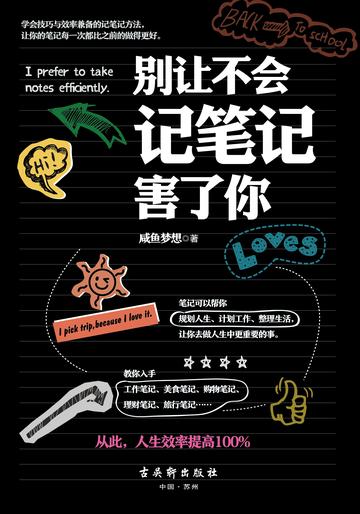
This book mainly introduces the advanced concepts and techniques of note-taking in improving study, life, work, etc., And explains the experience in note-taking, data collection, note organization, etc. In a simple and easy-to-understand manner. The content is detailed and rich, with pictures and texts, rigorous structure, and the language style is relaxed and interesting.
In addition, this book pays more attention to the development of habits, and integrates Western practical note-taking methods and Japan's popular hand accounting method into my country's long tradition of note-taking, forming advanced concepts and concise and practical note-taking techniques that are more suitable for Chinese people's recording habits. Whether you are a note-taking enthusiast or a note-taking beginner, you can benefit a lot from this book.
Reader comments
Compared with the book "Don't Tell Me You Can Take Notes", I personally feel that this book is much deeper in depth. That book was written by a Japanese.
Some of the ideas are exactly the same as Don't Tell Me You Can Take Notes, but some are very different or completely different.
The key factor of recording time for taking notes is not mentioned in this book, but it is mentioned in that one. This book introduces some tools, mostly about digital tools, but not as much about paper tools.
The key point is that you cannot record for the sake of recording, as that would be useless work. Emphasize that the purpose of note-taking is to improve efficiency and quality. This book's thoughts on note-taking are obviously much more in-depth than the book "Don't Tell Me You Can Take Notes".
A book well worth reading.
This book is quite helpful to student parties. I personally think that mastering some of the note-taking points in the book can really improve oneself. Note-taking is indeed not a simple process of copying and recording, but a burst of thinking and a collision of information.
This book mentioned the note-taking stories of many famous people, which made me deeply realize the importance of note-taking. Moreover, the content in the book is very practical, and the note-taking methods and techniques introduced are easy to understand and practice. I think whether you are studying or working, you can improve your efficiency and ability by taking notes. What I like most is the part about how to organize notes in the book, which is very enlightening. All in all, this is a book well worth reading.
Compared with the book "Don't Tell Me You Can Take Notes", I personally feel that this book is much deeper in depth. That book was written by a Japanese. Some of the ideas are exactly the same as Don't Tell Me You Can Take Notes, but some are very different or completely different. The key factor of recording time for taking notes is not mentioned in this book, but it is mentioned in that one. This book introduces some tools, mostly about digital tools, but not as much about paper tools. The key point is that you cannot record for the sake of recording, as that would be useless work. Emphasize that the purpose of note-taking is to improve efficiency and quality. This book's thoughts on note-taking are obviously much more in-depth than the book "Don't Tell Me You Can Take Notes". A book well worth reading.
This book is quite helpful to student parties. I personally think that mastering some of the note-taking points in the book can really improve oneself. Note-taking is indeed not a simple process of copying and recording, but a burst of thinking and a collision of information.
This book mentioned the note-taking stories of many famous people, which made me deeply realize the importance of note-taking. Moreover, the content in the book is very practical, and the note-taking methods and techniques introduced are easy to understand and practice. I think whether you are studying or working, you can improve your efficiency and ability by taking notes. What I like most is the part about how to organize notes in the book, which is very enlightening. All in all, this is a book well worth reading.