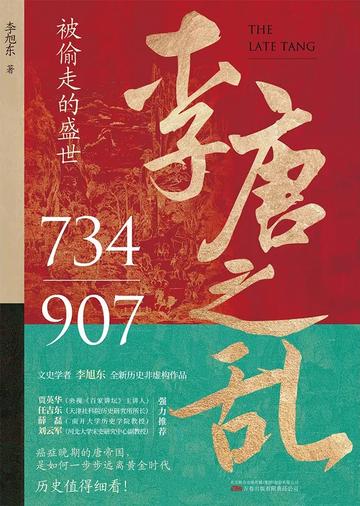
Synopsis
9Chapters
183Reads
9.4Score
24Listens
33.5kReads · all time
More by this author
In booklists 6


Looking for Novels Set During the Five Dynasties and Ten Kingdoms, the Jin Dynasty, or the Northern and Southern Dynasties
I’ve read so many stories set in the Tang, Song, and Ming dynasties that I’m tired of them. I’d like to try some less common historical periods. Preferably completed. Please recommend some~~~
395Books11.8MViews7hUpdated
Historical Novels
Please recommend some historical novels.
625Books82.2MViews1dUpdated


Any Stories Filled With Regret Between the Lines?
Any genre is fine. I've read too many sweet romances and want something different: a story with a happy ending, but where every word is tinged with regret.
571Books6MViews2dUpdated
The Chu-Han Contention, the An Lushan Rebellion, and the Five Dynasties and Ten Kingdoms
A lord-simulation game. No transmigration, but it should blend with reality. No Three Kingdoms era either. Spring and Autumn, Warring States, the end of the Qin dynasty, or mid-to-late Tang are all fine
399Books16.8MViews2dUpdated
Recommend a Transmigration Novel Set During the An Lushan Rebellion in the Tang Dynasty. No System or Brain-Dead Plot
186Books10.1MViews2dUpdated


The Complete Romance of the Three Kingdoms
178Books101MViews11dUpdated
Reader comments 9
Translated by Google Translate
The great rivers moved eastward and the waves were wiped out; the rise and fall of the Li dynasty suddenly occurred, and the dictatorship of foreign relatives; these turmoils that plagued the prosperous Tang Dynasty every few decades, from the crisis in the Tianbao period to the Anshi Rebellion; and then the foreign invasion of Tubo constantly intruded on the rule of the Tang Dynasty; this book sorts out the wars of the Li and Tang Dynasties and the dawn of life under one rule and one chaos from the history of the kingdoms in the Tang Dynasty since Longji. As the most prosperous dynasty in ancient my country, the history of Li and Tang is worthy of being remembered by future generations. The disputes in the past also tell us that history is not a peaceful age of singing and dancing, and success or failure is possible.
This book made me know: In the first month of the tenth year of the Dali calendar (AD 775), before the festive atmosphere of the Spring Festival had completely dissipated, the death of Xue Song, the military governor of Zhaoyi, triggered a bloody battle. The veteran Tian Chengsi seized Xiangzhou, Weizhou, Beizhou, and Mingzhou under the jurisdiction of Zhaoyi Jiedushi in one fell swoop. If Emperor Daizong does not intervene at this time, those greedy Jiedu envoys will become even more ignorant of the court. Emperor Daizong of the Tang Dynasty immediately mobilized soldiers and horses from nine towns to encircle and suppress the daring Tian Chengsi, but the conquest army was defeated one by one by Tian Chengsi. Emperor Daizong of the Tang Dynasty, who was unable to dismount from the tiger, had no choice but to issue an edict pardoning Tian Chengsi. Tian Chengsi successfully survived this life-threatening crisis.
"Li Tang Rebellion" is a book describing the history of the middle and late Tang Dynasty. It tells the history from Xuanzong and Li Long's Anshi Rebellion to Zhaozong and Li Ye's Guanghua Coup, the Baimayi Disaster and Zhu Wen's usurpation of the Tang Dynasty. The author discusses history based on history, limiting the readers' eyes and thoughts to the timeline of the history of the middle and late Tang Dynasty. Try to avoid using the history of other dynasties to refer to the history of the middle and late Tang Dynasty. It can be said that this book is, to a certain extent, an ideal book for those who are interested in the history of the Tang Dynasty and are not very familiar with the history of other dynasties. The author uses records from mainstream historical materials such as "Old Book of Tang", "New Book of Tang", and "Zi Zhi Tong Jian" to reflect the current social status of the Tang Dynasty society at that time as truly as possible. On some difficult issues, in addition to the views of other mathematicians on constants, the author also synthesized historical data and put forward his own analysis and opinions. It can be said that it provides us with a new perspective to understand those difficult issues of the Tang Dynasty. The history of the middle and late Tang Dynasty is a period of history that few people want to understand. It can be said that it can be said that it is a necessary condition for historians to tell this period of eunuch monopoly and separatism of vassal towns in such a detailed and rigorous way. The biggest impression on me in the whole book is this passage in the "Book of Direct Remonstrance" written by Liu Yunzhang, a Hanlin scholar during the Yizong Dynasty: "There are five ways for people to go without returning, there are eight sufferings for people but none of them are happy, nine state-owned assets have been destroyed but none has been completed, and eight officials have entered but none has come out." In just four sentences, the current situation of the society in the middle and late Tang Dynasty was summarized. The capital fell six times and the emperor moved nine times. The Tang Dynasty managed to survive for more than 100 years under such difficult social conditions. It can be said that in the late Tang Dynasty, Jiedushi had already emptied the court like the Eastern Zhou Dynasty. After more than 20 emperors, the Tang Dynasty ended its more than 200 years of history. The demise of the Tang Dynasty still serves as a warning to our descendants.
Everyone seems to know more about the An-Shi Rebellion and less about the Li-Tang Rebellion. This book makes up for this lack. After the Anshi Rebellion, faced with internal and external troubles, the Tang Empire was in decline. Li Tang went from abandonment, self-confidence, tolerance and openness to solidification, complacency, blindness and disorder, and finally to destruction. The author uncovers the historical mystery of the rise and fall of the Li and Tang dynasties, and uses a multi-dimensional and global perspective to show personal choices and struggles during the dramatic changes of the times.
This book vividly describes the Tang Dynasty after the Anshi Rebellion, which gave me a deeper understanding of that era. The author's global perspective and grasp of historical details are amazing. As a parent, I also realized from the book the close connection between the destiny of the country and personal choices. This is not only a historical work, but also an in-depth reflection on human nature and the times. It is worth reading.
The Anshi Rebellion, also known as the Tianbao Rebellion, was a war launched by the Tang Dynasty generals An Lushan and Shi Siming after they betrayed the Tang Dynasty. It was the civil war in which the Tang Dynasty fought for dominance, and was a turning point in the Tang Dynasty's rise and decline. This book begins with the Tianbao crisis, showing how the rulers of Li and Tang dealt with internal and external troubles after the Anshi Rebellion. The country reached a small peak again in chaos, known as the "Yuanhe ZTE" in history, and why the country's fortunes declined sharply. It shows the decline of a dynasty in many aspects.
Excellent literary talent and soul-stirring!
The article is very true and has historical significance
Very exciting, looking forward to the author's other masterpieces