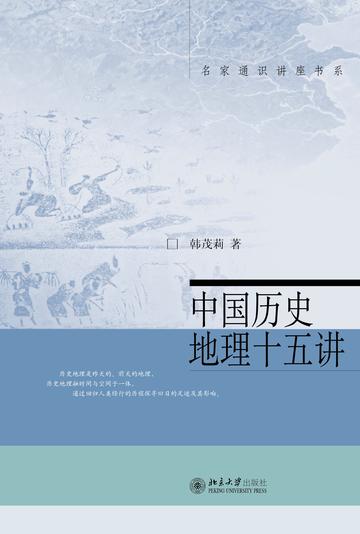
The earth is the foundation of human existence and the stage for human activities. Human beings' behavior of relying on, utilizing and transforming the earth has become various fields of geographical research. Historical geography is the study of the geography of the past. "Fifteen Lectures on Chinese Historical Geography" covers the main areas of historical geography research - territory, environment, political regions, agriculture, transportation, military, cities, etc.
Reader comments
The traditional method of studying history is usually sorting it out by time, dynasty or major events. There are too many details and the correlation is not obvious. It is easy to remember mistakes or confusion. However, Teacher Han Maoli's "Fifteen Lectures on Chinese Historical Geography" cuts into the past from territory, environment, political regions, agriculture, transportation, military, cities, etc. It is no exaggeration to say that this book completely broke through my previous understanding of ancient history. No wonder the first edition sold more than 120,000 copies. No history lover should miss this book! Geography has always been called a science subject in the liberal arts. The main reason is that the most important thing in geography is not memorization, but logical deduction. The development of everything has rules to follow. The general trend of human development in history is to shift from absolute dependence on the environment to partial dependence, and then gradually become the user and controller of the environment and embark on the road to the kingdom of freedom. For example, if you look at the development history of Beijing, you will find that from the Paleolithic Age, 700,000 years ago, the remains of Peking Man have been left in the mountains west of the small plain in Beijing. In the Western Zhou Dynasty, it was named Yan and Ji, in the Qin Dynasty it was established in Ji County, in the later Tang Dynasty it was Youzhou, in the Liao Dynasty it was Nanjing, and from the Yuan Dynasty to the Ming and Qing Dynasties it was Beijing. It gradually developed and prospered. At the same time, if we look back at the geographical level, Beijing's topography is not only conducive to settlement, production and reproduction, but the roads at the eastern foot of Taihang Mountain and the front of Yanshan Mountain are also important, providing convenience for amassing wealth and controlling military power.
The famous general lecture series "Fifteen Lectures on Chinese History and Geography", don't be deceived by the name and think that general education is relatively simple and easy to read. In fact, this is not the case. These fifteen lectures are equivalent to fifteen papers. They are not superficial or easy to read. The articles are very rigorous and cutting-edge. It tells the interactive relationship between history, geography, politics, and military affairs, and explores the impact of historical geographical environment on human activities, and the impact and consequences of human activities on the natural environment. As the book says, "Historical geography is not a prominent subject, but it has an irreplaceable status in any subject."
The earth can be said to be the most basic basis for our human survival, and it is also the center of our activities. Human beings can only walk and move on the earth. Therefore, how to transform the earth and make it bring more contributions to mankind has become a key research object in the geography discipline. Historical geography is the geography of the past, but it is extremely important for the future development of mankind. This work covers many important areas of historical geography research, and provides a detailed combing and analysis of the basic issues of these places and their historical processes. If you like geography or want to know its history, this is a very good book.
This book gave me a better understanding of the place where I live. Only by knowing its past and origins can I better understand the present and analyze the future. The geographical knowledge of this book is very comprehensive, which allows me to better make up for the deficiencies in geographical knowledge and make my geographical knowledge foundation stable. Every time I read this book, I will have a new understanding, make my geography more perfect and comprehensive, and bring my geography to a new height.
I especially liked the part about the development of ancient cities in the book, it was very interesting. The author, Professor Han Maoli, is knowledgeable and explains in simple and profound terms, so that even a person like me who doesn't know much about history and geography can understand it. Recommended to friends who are interested in Chinese history and geography!
People who understand history and geography are very charming and feel very knowledgeable. Human beings' behavior of relying on, utilizing, and transforming the earth has become various fields of geographical research. Historical geography is the study of the geography of the past. This book is very academically rational and scientific in nature, and it contains a lot of information after reading it. It introduces the geographical situation and the evolution of ancient strategic space, which is very exciting and increases your knowledge. I recommend everyone to read it, it's a very good book!
Pay attention to logic, not just a pile of details; the system is very clear, the framework is very clear, from the shallower to the deeper.



The traditional method of studying history is usually sorting it out by time, dynasty or major events. There are too many details and the correlation is not obvious. It is easy to remember mistakes or confusion. However, Teacher Han Maoli's "Fifteen Lectures on Chinese Historical Geography" cuts into the past from territory, environment, political regions, agriculture, transportation, military, cities, etc. It is no exaggeration to say that this book completely broke through my previous understanding of ancient history. No wonder the first edition sold more than 120,000 copies. No history lover should miss this book! Geography has always been called a science subject in the liberal arts. The main reason is that the most important thing in geography is not memorization, but logical deduction. The development of everything has rules to follow. The general trend of human development in history is to shift from absolute dependence on the environment to partial dependence, and then gradually become the user and controller of the environment and embark on the road to the kingdom of freedom. For example, if you look at the development history of Beijing, you will find that from the Paleolithic Age, 700,000 years ago, the remains of Peking Man have been left in the mountains west of the small plain in Beijing. In the Western Zhou Dynasty, it was named Yan and Ji, in the Qin Dynasty it was established in Ji County, in the later Tang Dynasty it was Youzhou, in the Liao Dynasty it was Nanjing, and from the Yuan Dynasty to the Ming and Qing Dynasties it was Beijing. It gradually developed and prospered. At the same time, if we look back at the geographical level, Beijing's topography is not only conducive to settlement, production and reproduction, but the roads at the eastern foot of Taihang Mountain and the front of Yanshan Mountain are also important, providing convenience for amassing wealth and controlling military power.
The famous general lecture series "Fifteen Lectures on Chinese History and Geography", don't be deceived by the name and think that general education is relatively simple and easy to read. In fact, this is not the case. These fifteen lectures are equivalent to fifteen papers. They are not superficial or easy to read. The articles are very rigorous and cutting-edge. It tells the interactive relationship between history, geography, politics, and military affairs, and explores the impact of historical geographical environment on human activities, and the impact and consequences of human activities on the natural environment. As the book says, "Historical geography is not a prominent subject, but it has an irreplaceable status in any subject."
The earth can be said to be the most basic basis for our human survival, and it is also the center of our activities. Human beings can only walk and move on the earth. Therefore, how to transform the earth and make it bring more contributions to mankind has become a key research object in the geography discipline. Historical geography is the geography of the past, but it is extremely important for the future development of mankind. This work covers many important areas of historical geography research, and provides a detailed combing and analysis of the basic issues of these places and their historical processes. If you like geography or want to know its history, this is a very good book.
This book gave me a better understanding of the place where I live. Only by knowing its past and origins can I better understand the present and analyze the future. The geographical knowledge of this book is very comprehensive, which allows me to better make up for the deficiencies in geographical knowledge and make my geographical knowledge foundation stable. Every time I read this book, I will have a new understanding, make my geography more perfect and comprehensive, and bring my geography to a new height.
I especially liked the part about the development of ancient cities in the book, it was very interesting. The author, Professor Han Maoli, is knowledgeable and explains in simple and profound terms, so that even a person like me who doesn't know much about history and geography can understand it. Recommended to friends who are interested in Chinese history and geography!
People who understand history and geography are very charming and feel very knowledgeable. Human beings' behavior of relying on, utilizing, and transforming the earth has become various fields of geographical research. Historical geography is the study of the geography of the past. This book is very academically rational and scientific in nature, and it contains a lot of information after reading it. It introduces the geographical situation and the evolution of ancient strategic space, which is very exciting and increases your knowledge. I recommend everyone to read it, it's a very good book!
Pay attention to logic, not just a pile of details; the system is very clear, the framework is very clear, from the shallower to the deeper.