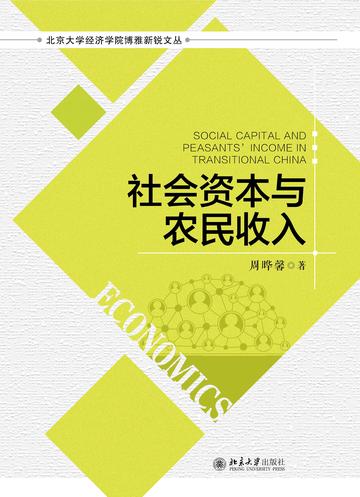
"Social Capital and Farmers' Income" is divided into two parts. It mainly discusses two major issues, namely the impact of social capital on farmers' income before and after entering the city. It also studies the investment behavior of social capital. This book is divided into two parts. It mainly discusses two major aspects of issues, namely, the impact of social capital on the income of farmers before and after entering the city. It also studies the investment behavior of social capital. Before studying this issue, the author first reviews the role of social capital in alleviating rural poverty from both static and dynamic perspectives, and believes that with the deepening of marketization, the role of social capital in anti-poverty has a tendency to weaken. Based on the literature review, the author proposes future research directions such as deepening the theoretical mechanism of social capital for poverty reduction, the anti-poverty mechanism of social capital in the process of marketization, improving social capital measurement, and strengthening the identification of causal effects.
Reader comments
This book is very interesting! It explores the impact of social capital on farmers' income, and reminds me of the experiences of many friends and relatives around me. Rural areas are developing rapidly now, and everyone is looking for ways to increase their income. The research in this book may give us some inspiration, such as how to increase income through social networks, trust relationships, etc. Moreover, the author also proposed future research directions, which feels very forward-looking. I think this book is worth reading for those who care about rural development.





This book is very interesting! It explores the impact of social capital on farmers' income, and reminds me of the experiences of many friends and relatives around me. Rural areas are developing rapidly now, and everyone is looking for ways to increase their income. The research in this book may give us some inspiration, such as how to increase income through social networks, trust relationships, etc. Moreover, the author also proposed future research directions, which feels very forward-looking. I think this book is worth reading for those who care about rural development.