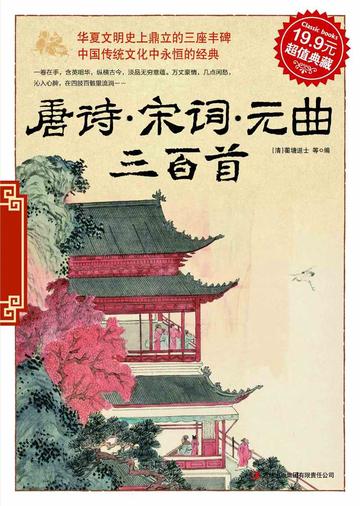
Tang poetry, Song lyrics, and Yuan opera are the three peaks in the history of Chinese literature.
The Tang Dynasty was the heyday of the development of classical poetry in my country. "Tang Poetry" was the highest symbol of Tang Dynasty literature and ushered in a new era of the development of Chinese poetry. There are many authors of Tang poetry, the most famous of which are Li Bai, Du Fu, Bai Juyi and others.
The themes of Tang poetry are very wide. Some reflect the class situation and class contradictions of the society from the side, exposing the darkness of feudal society; some praise the just war and express patriotism; some describe the beauty and beauty of the motherland's rivers and mountains, expressing the love for life. Its forms are also diverse. Ancient poetry has two types: five-character and seven-character poetry; modern poetry has two types: quatrains and rhymed poetry, which are also divided into five-character and seven-character poetry. Ancient style poetry has relatively broad requirements for rhyme and rhythm, while modern style poetry has stricter requirements. When people read Tang poetry today, they can feel the harmony of syllables, the conciseness of words, and the beauty of artistic conception, and be intoxicated by it.
Ci, a type of ancient Chinese poetry, began in the Liang Dynasty, formed in the Tang Dynasty and reached its peak in the Song Dynasty, hence the name "Song Ci". Song poetry is the dazzling gem in the crown of ancient Chinese literature, and has always been called the "double masterpiece" together with Tang poetry. The most famous poets in the Song Dynasty include Su Dongpo, Liu Yong, Xin Qiji, Li Qingzhao and others. Among them, Su and Xin are representatives of the "bold school", with their vigorous and magnificent style and broad vision; Liu and Li are representatives of the "graceful school", with their elegant, clear and expressive style.
The words are divided into small order, middle tone and long tone. Some of a word has only one paragraph, which is called monotone; some is divided into two paragraphs, which is called double tone; some is divided into three or four paragraphs, which is called triple or quadruple. The poems also have word tags, such as "Liuzhou Getou", "Xijiang Moon", "Nian Nujiao", etc. Some of them follow the titles of ancient Yuefu poems, some are based on a few words from the poems, some are based on a certain historical allusion, and some are homemade by famous writers.
Yuan opera is another literary form formed after Tang poetry and Song lyrics. It first flourished in the northern region, so it is also known as "Northern opera". Compared with poetry, its form is more flexible and it can better express its meaning. However, in comparison, its circulation is not as widespread as Tang poetry and Song poetry, so people are relatively unfamiliar with it.
Yuan opera can be roughly divided into two types, one is Yuan Zaju and the other is Yuan Sanqu. Zaju is a form that combines songs, spoken language and dance. Sanqu is poetry, including sets and Xiaoling. The sets are composed of several pieces of music, while the Xiaoling only contains one piece of music. Guan Hanqing's "The Injustice of Dou E" represents the pinnacle of the development of Yuan drama art, while Ma Zhiyuan wrote "Tian Jing Sha." "Autumn Thoughts" and other popular Sanqu.
In short, Tang poetry, Song lyrics, and Yuan opera are monuments in the history of Chinese literature and must-read for those who love Chinese literature. This book compiles "Three Hundred Tang Poems" compiled by retired scholars from Qing Hengtang, "Three Hundred Song Ci Poems" compiled by Shangjiang villagers, and "Three Hundred Yuan Operas" compiled by contemporary Mr. Ren Zhongmin, aiming to provide modern readers with a feast of classical literature.
Reader comments
This book is really good! It contains classic works of Tang poetry, Song lyrics, and Yuan operas, allowing us to appreciate the charm of Chinese classical poetry at once. I especially like the poetry of Li Bai and Su Shi. Their works are always so bold and free. Moreover, this book also has pictures by famous artists, which is a real pleasure to read. But I kind of hate those tragic stories in Yuan Qu. It makes people feel heavy after reading them. Overall, this book is a must-read for Chinese literature lovers and is worth reading again and again!
This book is really good! It contains classic works of Tang poetry, Song lyrics, and Yuan operas, allowing us to appreciate the charm of Chinese classical poetry at once. I especially like the poetry of Li Bai and Su Shi. Their works are always so bold and free. Moreover, this book also has pictures by famous artists, which is a real pleasure to read. But I kind of hate those tragic stories in Yuan Qu. It makes people feel heavy after reading them. Overall, this book is a must-read for Chinese literature lovers and is worth reading again and again!
November 28, 2023 02:34, record it and check in