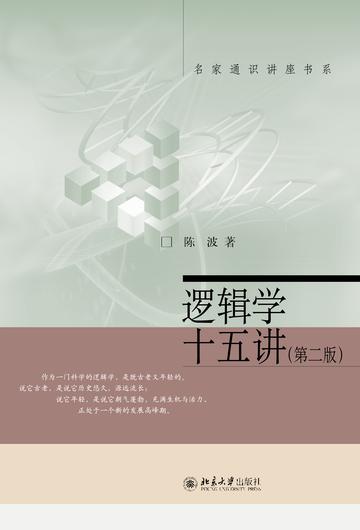
This book systematically discusses the basic theoretical categories, thinking methods and skills of logic, and introduces several important logicians in history. By reading this book, it is not difficult for readers to have a basic outline understanding of logic, have a better grasp of its most basic content, methods and skills, and more importantly, stimulate their interest in further learning.
Reader comments
If viewed as a popular science book, it has the familiar feel of a textbook, with too many formulas and symbols, and is not very friendly to readers who do not take exams or answer questions. However, this is probably a common problem with this type of book in China.
The biggest advantage is that the content is comprehensive, not only the common extensions and connotations, deductions and inductions, fallacies and paradoxes, but also introductions to people in the field of logic, modal logic, natural language and rational tenses, etc. Everything can be logicalized (forgive me for not hearing the rest), and it is all correct anyway.
There are also interesting examples. For example, our logician Jin Yuelin has long questioned that money is like dung, because if you add that friends are worth a thousand gold, it will lead to the conclusion that friends are like dung. But to fully understand his reasoning, you will need to use inverse equivalence, DeMorgan's law and when the disjunctive proposition is true, denying one of them will inevitably lead to the correctness of the other. However, this is still too complicated, so his academic achievements are far less interesting than the gossip between him and Lin Huiyin.
If you ignore the large sections of formulas in the article, the language expressions in the articles other than this part are not bad. What I like very much is the explanation of the logical theories of the pre-Qin masters at the end, such as Mozi, Gongsun Long and Xunzi, especially Mozi. This time I really felt the beauty of his logic. It is a pity that logic did not develop in ancient China, which is also a special regret.
Generally speaking, if you are interested in logic or philosophy, you can check it out.
But as Taleb mentioned in "Antifragility", "There is no evidence that playing chess helps improve your reasoning skills in other areas - even people who can play blind chess games with a group of people are no better than ordinary people when it comes to remembering things outside the chess board."
So after studying logic, you expect to be able to handle things in order in life? If you think too much, there is a high probability that it is just "field dependence" and it is just book knowledge.
This book is really good! It systematically introduces the basic concepts and methods of logic, and the content is easy to understand, so that people like me who don't know much about logic can easily understand it. Moreover, the book also introduces important logicians in history, which gave me a deeper understanding of the development of logic. The explanation given by the author, Professor Chen Bo, is very clear and makes complex logical problems simple and interesting. There is a sentence in the book that impressed me deeply: "Logic is the law of thinking." This sentence simply and profoundly reveals the importance of logic. In short, this is an introductory book on logic that is well worth reading!
I really need some theoretical foundation to read this book. I started reading it with the mentality of popularizing science. There are also easy-to-understand parts in the book. It takes effort to fully understand logic. Overall, the difficulty or positioning of this book should be entry-level, and it should be deeper than popular science, especially the mathematical logic part in the middle. Of course, it is still very rewarding after reading it. This book progressively transforms logic from literal descriptions into mathematical formulas from the shallower to the deeper levels. Then it briefly explains the classic logic schools. Finally, it introduces the simple logic theory of ancient China in a coherent manner. In the appendix, it discusses the development and application of modern and contemporary logic forums.
Learning some logic every day will help us deepen our understanding of things in life and work. This book is a textbook that introduces the basic principles and methods of logic. It first introduces the definition, history, purpose and research methods of logic, discusses logical fallacies and forms of sophistry, learns how to identify and avoid logical errors, learns how to conduct logical arguments and analyze arguments, and evaluate the rationality and logical structure of arguments. The book also explores these contents in depth and provides relevant cases, exercises and practical guidance.
Learning some logic is still useful.
It is easy to understand, but when I talk about the logic system later, there are no specific examples of reasoning about the axioms and theorems. Although it is a priori, I want to judge it. It is difficult to judge the pure symbol string.
If viewed as a popular science book, it has the familiar feel of a textbook, with too many formulas and symbols, and is not very friendly to readers who do not take exams or answer questions. However, this is probably a common problem with this type of book in China. The biggest advantage is that the content is comprehensive, not only the common extensions and connotations, deductions and inductions, fallacies and paradoxes, but also introductions to people in the field of logic, modal logic, natural language and rational tenses, etc. Everything can be logicalized (forgive me for not hearing the rest), and it is all correct anyway. There are also interesting examples. For example, our logician Jin Yuelin has long questioned that money is like dung, because if you add that friends are worth a thousand gold, it will lead to the conclusion that friends are like dung. But to fully understand his reasoning, you will need to use inverse equivalence, DeMorgan's law and when the disjunctive proposition is true, denying one of them will inevitably lead to the correctness of the other. However, this is still too complicated, so his academic achievements are far less interesting than the gossip between him and Lin Huiyin. If you ignore the large sections of formulas in the article, the language expressions in the articles other than this part are not bad. What I like very much is the explanation of the logical theories of the pre-Qin masters at the end, such as Mozi, Gongsun Long and Xunzi, especially Mozi. This time I really felt the beauty of his logic. It is a pity that logic did not develop in ancient China, which is also a special regret. Generally speaking, if you are interested in logic or philosophy, you can check it out. But as Taleb mentioned in "Antifragility", "There is no evidence that playing chess helps improve your reasoning skills in other areas - even people who can play blind chess games with a group of people are no better than ordinary people when it comes to remembering things outside the chess board." So after studying logic, you expect to be able to handle things in order in life? If you think too much, there is a high probability that it is just "field dependence" and it is just book knowledge.
This book is really good! It systematically introduces the basic concepts and methods of logic, and the content is easy to understand, so that people like me who don't know much about logic can easily understand it. Moreover, the book also introduces important logicians in history, which gave me a deeper understanding of the development of logic. The explanation given by the author, Professor Chen Bo, is very clear and makes complex logical problems simple and interesting. There is a sentence in the book that impressed me deeply: "Logic is the law of thinking." This sentence simply and profoundly reveals the importance of logic. In short, this is an introductory book on logic that is well worth reading!
I really need some theoretical foundation to read this book. I started reading it with the mentality of popularizing science. There are also easy-to-understand parts in the book. It takes effort to fully understand logic. Overall, the difficulty or positioning of this book should be entry-level, and it should be deeper than popular science, especially the mathematical logic part in the middle. Of course, it is still very rewarding after reading it. This book progressively transforms logic from literal descriptions into mathematical formulas from the shallower to the deeper levels. Then it briefly explains the classic logic schools. Finally, it introduces the simple logic theory of ancient China in a coherent manner. In the appendix, it discusses the development and application of modern and contemporary logic forums.
Learning some logic every day will help us deepen our understanding of things in life and work. This book is a textbook that introduces the basic principles and methods of logic. It first introduces the definition, history, purpose and research methods of logic, discusses logical fallacies and forms of sophistry, learns how to identify and avoid logical errors, learns how to conduct logical arguments and analyze arguments, and evaluate the rationality and logical structure of arguments. The book also explores these contents in depth and provides relevant cases, exercises and practical guidance.
Learning some logic is still useful.
It is easy to understand, but when I talk about the logic system later, there are no specific examples of reasoning about the axioms and theorems. Although it is a priori, I want to judge it. It is difficult to judge the pure symbol string.
A very good logic book