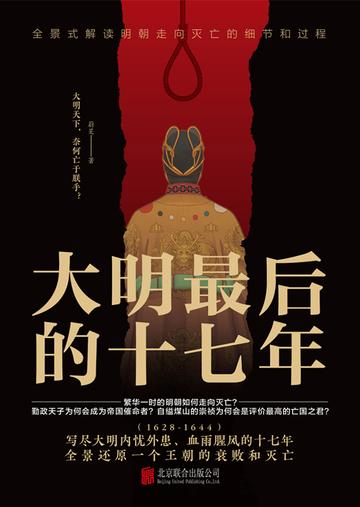
The Last Seventeen Years of the Ming Dynasty
大明最后的十七年
- Status
- Completed
- Length
- 141k Words
- Genre
- Historical
- Updated
- 3y ago
- Source
- Fanqie
Stats
Tags
Synopsis
Reader comments
In booklists 9
9.9 Points. Super Masterpiece! ! Super Pretty
I want to read a book similar to "The End of Ten Days".
The Sun, Moon, Mountains and Rivers Are Still There, and the Ming Dynasty Will Last Forever. Seeking for Ming Dynasty's Passionate Novels
I Don't Believe Anyone Who Writes History Is so Awesome.
Science and genealogy based on official history research, it's not boring!
The End of Ming Dynasty: Rise and Decline, Create Your Own Future! ! !
Late Ming Dynasty: Rise from the bottom to create your own dynasty. Highly recommended book!

Novel Completed in the Late Ming Dynasty
You Are Not an Outsider, Let Me See Your Collection of Books
The kind that can be rolled up into maggots under the quilt
Books That Reflect Real History
I want to read a book similar to "A set of books to read through the Three Kingdoms (7 volumes in total)". I want to read history books that reflect real history without excessive artistic processing. Excessive distortion of facts not only makes reading meaningless, but also distorts values.
Historical Ceiling
Come up with the best historical text in your mind, it may or may not be fantasy, let's discuss it
Looking for Top Historical Time Travel Articles! ! !
I want to read a book similar to "The First Madman of the Ming Dynasty". The protagonist's IQ is online, in line with the historical background, and does not need to be arrogant.
This book uses the simplest narrative method to make a historical picture of the Ming Dynasty from 1628 to 1644, unfolding it in front of us, allowing us to witness the entire process of Emperor Chongzhen from ascending to the throne to hanging himself. During these seventeen years, there were treacherous ministers in power, partisan disputes, famines every year, and border chaos. The whole period was characterized by internal and external troubles and turmoil. The author's language in this book is very interesting, and he expresses each event in the most direct way, which is simple, bright and extremely vivid. For children who usually don't have the patience to read lengthy texts, this book is relatively easy to read and you can find the key points from it. I really like the passage written by the author at the end: The emperor and general have high power, but in the end they are still the same regime and era. However, he transcends hell and space, transcends the world and fame and fortune, and is a person who is heading towards the future and a person who sees the world with open eyes. This is true of history, true of culture, and true of people.
The energy is about to run out, and the time is also destiny. It's a pity that the Manchus got a big deal
Starting from the fall of Wei Zhongxian, the Ming Dynasty began its last seventeen years of ups and downs, showing us the reasons for the demise of the Ming Dynasty. I really like the way this book is told. It integrates history into the story, allowing us to understand this dynasty from political, military and other aspects. At that time, there were internal and external troubles and constant wars. Became the most tragic emperor in the world.
With the end of Zhu Youxiao approaching, the Ming Dynasty ushered in its final period, with eunuch struggles and frequent wars. The emperor's indifference to political affairs made this already precarious dynasty even worse. This book talks about the emperor and the eunuchs, the court and the rebels, and more about the Central Plains and the Qiang people. It can be said that it includes the political and military affairs of the last seventeen years of the Ming Dynasty. The author focuses on the historical details and major junctures; just like the author's belief, history is immortal and will be gathered into stories to be passed down through the ages.
This book reminded me of "The Fifteen Years of Wanli". While reading, I couldn't help but want to compare the two books. In comparison, I still prefer "The Fifteen Years of Wanli". This book has less sense of story and is more suitable to be read as a history book. In the description of the content of this book, the author Wei Min takes Emperor Chongzhen of the Ming Dynasty as the starting point and ends with the Qing Dynasty's invasion of Beijing. Through detailed historical materials and complete narratives, he shows the process of the Ming Dynasty's political, military and social decline step by step.
This book is rich in content and vividly reproduces the changes in the last seventeen years of the Ming Dynasty. Among them, Zhu Youxiao's fate is regrettable, and Wei Zhongxian's character is very vividly portrayed. Although he has power over the government, he also has a certain degree of loyalty to Zhu Youxiao. The development of history is always full of drama, just like this book, which makes people think deeply.
The text is humorous, the writing is smooth, and the historical materials are detailed.
It is factual, humorous, and the metaphor is appropriate. A rare good book!
The writing style of this book "The Last Seventeen Years of the Ming Dynasty" is really interesting. I even laughed at some parts of the author's descriptions. You can see the satire of the officials at the time throughout the article. For example, in order to refuse the eunuchs to join the cabinet, Zhu Youjian described the cabinet as a "flowing table", which is really interesting and absurd. It is great to read this book to understand the situation in the late Ming Dynasty for more than ten years. It is indeed a popular history book of the Ming Dynasty that cannot be missed, and it opens up a new perspective on the Ming Dynasty.
A good book, you can read it It looks so desperate
Very humorous and fascinating
The content is very rich and good.
The author writes well and has a sense of humor. I personally think it's quite good.
Close to historical facts and well written!