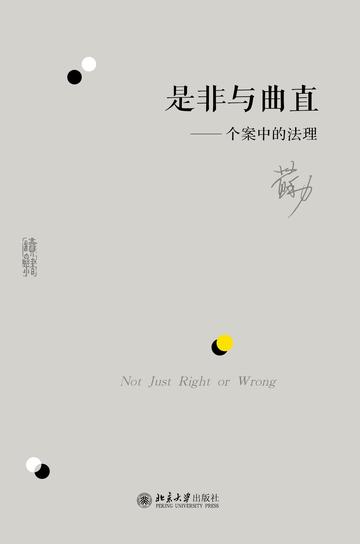
This book uses the "Yao Jiaxin Case", "Xu Ting Case" and "Yellow Disk Case" as research "specimens", and uses the rationality, acumen and insight of legal scholars to start from those crucial but crucial plots and facts that people, even legal professionals, have intentionally forgotten, actively omitted or are too lazy to verify, and puts forward unique thinking and conclusions, which is extremely enlightening.
The author believes that the approach that Chinese legal research should adhere to is: presenting facts, reasoning (legal principles), and distinguishing right from wrong. The order of the three cannot be messed up. Only by focusing on facts that ordinary people can actually experience and perceive can we develop sharable reasoning. Although due to different evaluations of relevant factors, or even driven by self-interest, the judgments reached by each are inconsistent. This is what this book is about.
This is a more lively and open case analysis. Although these cases have been settled, they still leave a lot of room for people to think. The questions raised by the author and the relevant discussions themselves are still interesting and worthy of our deep thought.
This revision has made some adjustments, modifications and additions to the text of the book.
Reader comments
With the help of a specific legal incident, the so-called "Yellow Disc Case" (since it did not ultimately enter into litigation, it is not strictly a "case"), and the legal discourse surrounding this incident, this article attempts to sort out the knowledge actually used by legal scholars in relevant departments when thinking and analyzing this incident. The conclusion is that the mainstream legal discourse in contemporary China generally belongs to the academic liberal tradition, which increasingly emphasizes the protection of citizens' lives, freedoms and property, including personal privacy and value preferences.
This book is very interesting. Teacher Su Li allows us to see the multifaceted nature of legal principles through the analysis of some cases. His perspective is unique and thought-provoking. Just like the "Chinese legal principles" mentioned in the book, it gave me a deeper understanding of the law. Moreover, some classic quotes in the book are also very inspiring, such as "But I have never been confused, never, like a river, knows where tomorrow will go in the deepest night." This sentence made me feel the power of persistence and reason. I recommend you read this book, I believe you will gain a lot.
On the one hand, legal analysis must comprehensively balance the interests of all aspects of the design, including the social interests of specific people that are easily overlooked and cannot be implemented in practice. We must analyze the laws of nature and conscience with extreme candor, and try our best to inquire into the knowledge possibilities in the case and its significance to law and jurisprudence. Even if it is never pursued deliberately, the practical analysis of such cases often has to involve related disciplines and science. In order to make use of strengths and weaknesses, and fully develop controversial points that are beneficial to oneself and easy to play.
The author starts from the important facts and plots and puts forward a unique conclusion that is contrary to the inertial cognition. The author believes that Chinese legal principles should be to present facts, reason and legal principles, and then decide right from wrong. This order cannot be disrupted. Only by focusing on facts that ordinary people can really perceive can we develop and share the reasoning. Although due to different evaluations of relevant factors, or even the trend of self-interest, the judgments drawn by each cannot be unified. This is exactly what this book is about
Chinese jurisprudence is now in a prosperous stage. The book studies some widely controversial cases, such as Yao Jiaxin case, Xu Ting case and Huang Die case. These cases that have been widely controversial in society are all subjects that Chinese legal science needs to study, the right and wrong and the merits. Shuzhong obtained some conclusions by rewriting the development process of these cases and focusing on details. Unique thinking makes these conclusions of great significance to China's development.


With the help of a specific legal incident, the so-called "Yellow Disc Case" (since it did not ultimately enter into litigation, it is not strictly a "case"), and the legal discourse surrounding this incident, this article attempts to sort out the knowledge actually used by legal scholars in relevant departments when thinking and analyzing this incident. The conclusion is that the mainstream legal discourse in contemporary China generally belongs to the academic liberal tradition, which increasingly emphasizes the protection of citizens' lives, freedoms and property, including personal privacy and value preferences.
This book is very interesting. Teacher Su Li allows us to see the multifaceted nature of legal principles through the analysis of some cases. His perspective is unique and thought-provoking. Just like the "Chinese legal principles" mentioned in the book, it gave me a deeper understanding of the law. Moreover, some classic quotes in the book are also very inspiring, such as "But I have never been confused, never, like a river, knows where tomorrow will go in the deepest night." This sentence made me feel the power of persistence and reason. I recommend you read this book, I believe you will gain a lot.
On the one hand, legal analysis must comprehensively balance the interests of all aspects of the design, including the social interests of specific people that are easily overlooked and cannot be implemented in practice. We must analyze the laws of nature and conscience with extreme candor, and try our best to inquire into the knowledge possibilities in the case and its significance to law and jurisprudence. Even if it is never pursued deliberately, the practical analysis of such cases often has to involve related disciplines and science. In order to make use of strengths and weaknesses, and fully develop controversial points that are beneficial to oneself and easy to play.
The author starts from the important facts and plots and puts forward a unique conclusion that is contrary to the inertial cognition. The author believes that Chinese legal principles should be to present facts, reason and legal principles, and then decide right from wrong. This order cannot be disrupted. Only by focusing on facts that ordinary people can really perceive can we develop and share the reasoning. Although due to different evaluations of relevant factors, or even the trend of self-interest, the judgments drawn by each cannot be unified. This is exactly what this book is about
Chinese jurisprudence is now in a prosperous stage. The book studies some widely controversial cases, such as Yao Jiaxin case, Xu Ting case and Huang Die case. These cases that have been widely controversial in society are all subjects that Chinese legal science needs to study, the right and wrong and the merits. Shuzhong obtained some conclusions by rewriting the development process of these cases and focusing on details. Unique thinking makes these conclusions of great significance to China's development.
Very simple and easy to read book