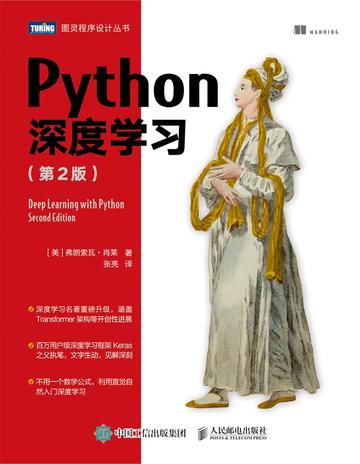
This book is written by François Cholet, the father of the popular deep learning framework Keras, and helps you build a deep learning knowledge system through intuitive explanations and rich examples. The author avoids the use of mathematical notation and instead uses Python code to explain the core ideas of deep learning. The book has a total of 14 chapters, which not only covers the basic principles of deep learning, but also reflects the important progress made in this rapidly developing field in recent years, including the principles and examples of the Transformer architecture. After reading this book, you will be able to use Keras to solve many real-world problems from computer vision to natural language processing, including image classification, image segmentation, time series prediction, text classification, machine translation, text generation, and more.
Reader comments
I came here because of the reputation. I have to write my graduation thesis and start studying hard.
This book is very good! For people like me who have no deep learning foundation, its content is very easy to understand, and there are no complicated mathematical formulas. It is all explained in Python code. I especially like the explanation of the Transformer architecture in the book, which gave me a deeper understanding of natural language processing. I think of my friend who does NLP, he will definitely like this part. However, I kind of hate those people who always argue on technical forums about which framework is best. Deep learning is an evolving field and the most appropriate tool should be chosen based on the specific problem. Overall, this book is well worth reading.



I came here because of the reputation. I have to write my graduation thesis and start studying hard.
This book is very good! For people like me who have no deep learning foundation, its content is very easy to understand, and there are no complicated mathematical formulas. It is all explained in Python code. I especially like the explanation of the Transformer architecture in the book, which gave me a deeper understanding of natural language processing. I think of my friend who does NLP, he will definitely like this part. However, I kind of hate those people who always argue on technical forums about which framework is best. Deep learning is an evolving field and the most appropriate tool should be chosen based on the specific problem. Overall, this book is well worth reading.