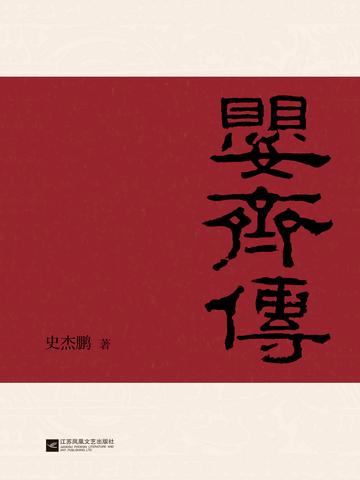
Read the tale of an ordinary man amid the tides of history, and behold a panoramic view of the Western Han.
A lifetime like a stirring, sorrowful song, a heart of earnest devotion, and the promise of youth.
One of the three novels in Liang Huiwang's Western Han trilogy, and a sequel to Little Wu the Pavilion Chief. A classic historical tale rated 7.8 on Douban. Revised and republished eleven years later, with a new afterword by the author.
The protagonist, Ying Qi, was once Little Wu's attendant. After Little Wu's death, a chance opportunity brought him promotion and drew him into turbulent political struggles. After many twists and turns, he eventually retired from public life. In the fourth year of the Zhenghe era, Emperor Wu, believing that the Crown Prince was plotting a rebellion, ordered his forces to attack the prince's army. The Crown Prince killed himself. Shen Wu, the Governor of the Capital District who had helped him, leapt from a cliff to his death. Shen Wu's attendants, including Ying Qi, were arrested and later pardoned. Ying Qi returned to his home in Yuzhang County. He and Yan Changnian, son of the wealthy Yan Lecheng, both sought the affection of E Jun, the county magistrate's sister. After being humiliated in public, Yan Changnian killed himself. Yan Lecheng grew jealous and resentful of Ying Qi, swearing to avenge his son. He bribed Zhao Guangguo, the governor of Yuzhang, manipulated the law, and used legal statutes to drive Ying Qi's uncle, Ying Qingji, to his death. He then confiscated Ying Qi's property, leaving him destitute and homeless.
With artistic passion and a rich imagination, the author brings familiar Han dynasty texts to life, using elegant yet unadorned language to create a compelling portrait of a quintessential figure and his life in the Han dynasty. The twists and turns of Ying Qi's struggles reflect every facet of Han society.
There is the hardship of forced labor in “A gentleman is away on service, and none knows when he will return,” and the simple pleasures of farming in “They marked out the borders, they measured the fields, they opened the furrows.” There is the joy of marriage in “In the south, the crooked tree is entwined with kudzu,” and the lofty sentiments of the court in “The decree of Heaven, how majestic and unending.” It was an age when people recited the Book of Songs at weddings and funerals. Join Ying Qi as he rises and falls upon the waves of fate.
From the Peach Blossom Spring to the imperial court, the strings of zithers play in harmony. From the quiet city of Nanchang to the court at Chang'an, then to disappointment amid the foreign tunes of the frontier at Zhangye, the proud young man's eyes gradually fill with corpses. The strange encounters, loves, and schemes of hate along the way wear down his youthful spirit.
The plot twists and turns, and the characters are etched with striking depth. The many shades of love and hate, joy and sorrow that we all know come together in the story of Ying Qi's remarkable life.


This book touched me deeply. It shows a real and complex society of the Western Han Dynasty. Yingqi's story made me understand that life is impermanent and we need to cherish the present moment. Just like what is said in the book, "A gentleman is in battle and does not know his future." We must seize every opportunity and strive to pursue our dreams. At the same time, this book also made me feel the weight of history, as if I could see the lives of people of that era in and outside the palace. The author's writing skills are very deep, and the plot has ups and downs, which is endlessly memorable.
I like Shi Jiepeng's novels very much. His narration makes readers feel as if they are in a real scene, especially the expression of language and the accumulation of historical knowledge. While reading the novel, people can imagine the scenes in front of them and present them one by one. Like it 👍🏻
Good-looking, good-looking, good-looking