Stats
5.8Score
Synopsis
No synopsis yet.
We haven’t got an English blurb for this one. It appears once the source description has been translated.
We haven’t got an English blurb for this one. It appears once the source description has been translated.
The narrative is concise, the background is appropriately supplemented, the relationships between the characters found out from historical data are complex but clear, and the appropriate use of metaphors and modern popular terms makes the reading process not too boring. Overall, this is a good book that helps people get started and understand history.
There is no need to hesitate about the book written by Bohai Xiaoli. There is also a book written by an author named Guo Jianlong that is also very perfect and worth recommending.
People who read history are happy. People who understand history are more than happy.
Every popular history book about Bohai Officials is really worth reading. I came to read Two Han Dynasties after reading Three Kingdoms. I didn't expect that reading in this order would make people sincerely sigh, "It turned out that I became what I became after going through these experiences." The most profound impression in this book on the events of the two Han Dynasties is the reign of Emperor Wu of the Han Dynasty, the resurgence of Guangwu, and the final overthrow of the Han family. There are so many shining stars in the four-hundred-year dynasty. After reading this book, I finally understand why they can be called great.
The first part is very exciting, but the second part, starting from Liu Xiu, is a bit complicated, but it accounts for less than 10% of the whole book. It is still a good book!
It was a little difficult for me to read this book: on the one hand, I don't know anything about the history of the Eastern Han Dynasty; on the other hand, I don't like reading about wars, but this book is not only full of wars, but also has many wars on multiple fronts. But fortunately, I've finished reading it. I also had a preliminary understanding of the history of the Eastern Han Dynasty, which filled in the blanks I had about this period of history. The one I am most interested in is Wang Mang. I take a moment and hope to study him more. Because I always feel that Confucius's thoughts are correct, but no one can truly reach the state he said and achieve the unity of knowledge and action. Maybe Wang Mang has achieved it? Want to see it again.
History is wonderfully written like this. The author's analysis of historical events is very logical and thorough. However, the author's pen name is "Bohai Xiaoli", which shows that the author also knows that he has limitations. Utilitarianism accounts for too much, but it is also in line with today's aesthetics. All in all, it's a good book and I look forward to the follow-up.
After reading this book, I know: the era of Emperor Wu was an era of action for the entire bureaucracy. The military generals first ushered in a once-in-a-lifetime era of achievement, which was very rare in the period of great unification. Then, the ministers of gathering who had a poor reputation in the past dynasties also got their own exclusive stage to show off their long-sleeved skills in the name of the imperial court. Needless to say, cruel officials are as cruel as they can be. At this time, the traditional literati and bureaucrats seemed a little lonely.
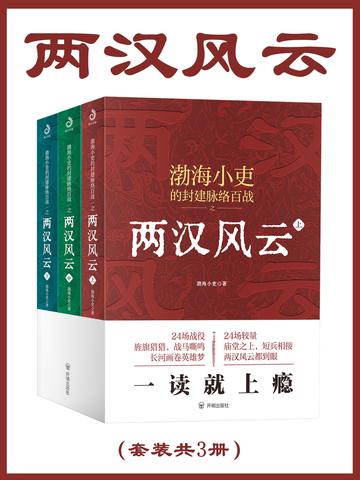
Based on the context of 24 battles, this book tells the story of the changes of the Han Dynasty over more than 400 years, and reveals the truth in the temples on the battlefield that has been obscured by the fog of history. Why was Liu Bang, who had obvious advantages, trapped in Baishan Mountain? What was the magic weapon used by the Han cavalry to sweep away the Xiongnu during the period of Emperor Wu of the Han Dynasty? Why did Huo Guang dare to risk deposing the emperor? Why did Emperor Huan of the Han Dynasty, who killed powerful ministers when he was young, allow eunuchs to take power later? Each story has ups and downs. After reading this set of books, you will not only learn history, but also learn the experiences and lessons of successful kings and defeated bandits.
Wonderful, easy to understand, and tells history vividly
Good book, rewarding, recommended
Good looking, organized and reasonable. I have read half of it, and what I remember most is the three steps of a coup, and why silk is sold on the trade road. Good books should be recommended!
There are no cool dramas like Chinese history. It's so fun to listen to! ! !
After reading this book, I know: The era of Emperor Wu was an era of action for the entire bureaucracy. The military generals first ushered in a once-in-a-lifetime era of achievement, which was very rare in the period of great unification. Then, the ministers of gathering who had a poor reputation in the past dynasties also got their own exclusive stage to show off their long-sleeved skills in the name of the imperial court. Needless to say, cruel officials are as cruel as they can be. At this time, the traditional literati and bureaucrats seemed a little lonely.
The history books are full of vicissitudes of life. The saying "When people are hungry every year, people eat each other" means that our ancestors continued their lives by eating other people's flesh and blood. The seeds have gone through thousands of years of games with the world until they are passed on to us thousands of years later.
This is a relatively wonderful literary work about the history of the Han Dynasty. It is easy to read and does not have a boring sense of history. The author also has his own dimensional analysis and comprehensive judgment on important historical figures and historical events, which benefits readers a lot. [Praise]
It can be seen that the author is very familiar with the history of the Han Dynasty. He really broke the history into pieces and presented it to the readers through the most common words. This is how we understand history. Historical textbooks let us know the historical phenomena. This book allows us to understand the historical background and some things behind the history. I recommend everyone to read it. It will help us understand the 300-year history of the Han Dynasty.
The author's writing style is humorous and not boring to read. Regarding history, the author's logic is clear and his analysis is thorough. It is a good book.
Just like what is said in the book, "Xiang Yu, as Liu Bang's lifelong enemy, still disgusted Liu Bang after his death." Although Liu Bang defeated Xiang Yu, he still had many headaches! However, my favorite is the heroes in the book, they are all so awesome! I want to be a brave person like them!
Anyone who offends a strong man will definitely be killed no matter how far away he is; anyone who reads this book will definitely praise him no matter how far he reads it [praise]
Xiaoli's books make people gain insights and make them think deeply.
A history book written by a grassroots worker. 24 Battles are used to describe the four hundred years of changes in the two Han Dynasties. It explains the difficult-to-understand founding of the Eastern Han Dynasty clearly in humorous language, although the latter part is a bit complicated and redundant. But the shortcomings outweigh the good points. The two parts of the Han Dynasty and the founding of the Eastern Han Dynasty are particularly well written. It is a history book worth reading. War is a continuation of politics and a tool to seize interests. Some people add fuel to the flames, while others suffer from it. If you think about it carefully, you will find that the truth is actually so ugly.
I like it very much. The author uses figurative language and appropriate metaphors to let us understand the characters and events in the historical background of that time. When reading, we feel like we understand what happened and why. It is easy to understand.
Super pretty! You can learn a lot! Nice! Super exciting!
Unique and wonderful, the classic is reproduced, the picture is close to reality, the gray line of grass and snakes stretches for thousands of miles, and it is soul-stirring! After reading the complete book of the Han Dynasty, I am still quite shocked. The role of the Great Wall, sending troops to fight the Huns in spring, rainfall of 400 millimeters and so on, Zhang Qian, Wei Qing, Huo Qubing, Ban Chao, Li Guang Nanfeng, Huo Guang deposed the emperor, Wang Mang usurped power, Yuan Shao and Dong Zhuo are all vivid characters, party struggles, nobles, and eunuchs. , Emperor Wu struggled all his life and killed the prince. The last Luntai crime was so many that he could not let go. The Liaodong Corridor, the Hexi Corridor, Monan and Mobei, the Nine Bends of the Yellow River were only rich. Wang Jing governed the Yellow River. He managed it in one year and eliminated floods for 600 years. The Han Dynasty was famous far and wide! Shock all over the world!
A good book. There is no nonsense throughout. Every word is exquisite. After reading it, I couldn't read other historical books for a short time.
Great book, popular history.
The affairs of the world do not belong to me. I want to do it. Who dares to disobey? Do you want to test whether my sword is sharp?
Humorous explanation of real history, full of positive energy
He has a deep study of the history of the Han Dynasty, especially the relationship between the characters and their personality characteristics. He is logical and well-organized, and can analyze the background and causes of events in depth. Although some opinions are subjective, they are over two thousand years old, and the history books themselves have limitations and subjectivity. He can draw on hundreds of opinions, use relatively easy-to-understand and humorous language descriptions, and let more people understand reading and history. It is very good. I like it here 👍🏻