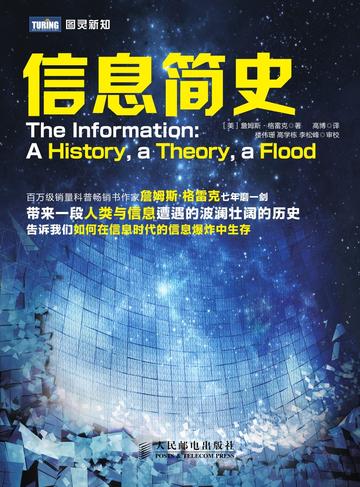
The history of humanity’s encounters with information goes back a long way. James Gleick tells this history in an unexpected way, beginning with African drum languages (Chapter 1). Indigenous African tribes once used drums with only two pitches, high and low, to transmit complex messages. But how did they do it? The chapters that follow explore several pivotal events that shaped this history, including the invention of writing (Chapter 2), Robert Cawdrey’s English dictionary (Chapter 3), Charles Babbage’s Difference Engine and Ada Byron’s program (Chapter 4), the Chappe brothers’ semaphore towers and Morse code (Chapter 5).
But humanity began to consciously understand and use information with Claude Shannon’s founding of information theory in 1948 (Chapters 6 and 7). Shannon’s information theory not only greatly advanced information technology, but also sparked an information turn in many other disciplines (Chapter 8), changing how people understood subjects such as Maxwell’s demon (Chapter 9), the code of life (Chapter 10), memes (Chapter 11), randomness (Chapter 12), and quantum information theory (Chapter 13). Some scientists even believe that the foundations of the world are neither matter nor energy, but information. As physicist John Wheeler put it, “It from bit.”
Today, information floods over us, leaving us struggling with information anxiety, overload, and fatigue. But looking back through history, this is nothing new, and people have always found ways to cope. Wikipedia (Chapter 14) and Google (Chapter 15) are among our solutions. Whatever our attitude toward the future of information, one thing is certain: we humans are creatures of information.
As the author of such bestsellers as Chaos, Genius, Faster, and Isaac Newton, Gleick not only reconstructs historical details with care and explains complex theories in accessible terms, but also vividly portrays several figures unfamiliar to the wider public: Charles Babbage, a pioneer of programmable computers far ahead of his time; Ada Byron, daughter of the poet Byron; Alan Turing, the brilliant, ill-fated father of computer science; and the book’s central figure, Claude Shannon, the father of information theory.







A very profound book that is close to the truth. It reveals the relationship between information and energy. This is an area that is rarely covered in other cognitive improvement books (because it is approached from the perspective of physics). It is subversive and inspiring at the first level.
This book is rich in content and tells the history of information from a unique perspective. Not only does it introduce important historical events and figures, it also explains some complex theories in a simple and easy-to-understand manner. The author's descriptions are vivid and gave me a deeper understanding of the development of the information. It's a great read for people like me who are interested in technology and history.
The breadth is good, but the depth is still a bit lacking. When compared to a popular science book, it scores 8 to 9 points.
Recommended by the teacher, very beautiful.