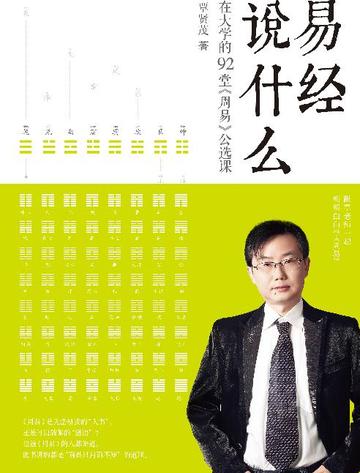
Only by knowing the answer to the riddle can you truly understand the "Zhouyi". It seems that everyone can understand the common vernacular "Zhouyi" version on the market. But as soon as I closed the book and thought about it, I didn't understand it. We cannot say that there is anything wrong with most of these books, but we can say that they are not suitable for ordinary readers to study on their own. Because "The Book of Changes" is like a riddle, its hexagrams and lines are like riddles. Most books only teach you to read mysterious words, so that you only know what they are but don't know why. The intelligence of readers cannot be underestimated! Readers always have to ask more questions in their hearts after reading the vernacular explanation. When you ask this question, you often get confused and cannot learn anymore! The "Book of Changes", the "heavenly book", has a very complicated logical structure. There are numerous books to interpret, each insisting on its own words and criticizing each other, and hesitating to speak and being secretive, which makes people feel like they are in a cloud. The author of "What Does the Book of Changes Say" has been studying the Book of Changes for 20 years since he was about 30 years old. In "What the Book of Changes Says", from the perspective of a teacher, he compiled his notes on the "Book of Changes" course he taught at Sichuan University into a book, which is very suitable for young people to study on their own. By opening "What Does the Book of Changes Say", you can bypass the trap and go straight to the "main entrance" of "The Book of Changes".
Reader comments
The so-called Three Yis in history, "Lianshan", "Gui Zang" and "Zhou Yi" are all based on certain inherent mathematical and logical structural principles, and then use the principles of symbolism to write hexagrams. The "Lianshan" and "Gui Zang" Yi Jing have been lost. It is necessary to take a look at the "Zhou Yi" to understand the classical Tibetan scriptures. However, Zhouyi is too difficult to understand. For many people, it is just a book from heaven. If you want to understand the book from heaven, you naturally need the guidance of an expert. The author of this book is an expert who studies the Book of Changes. This book "What the Book of Changes Says" is an effective guide to help you understand the book from heaven. This book is already easier to understand than most other interpretations on the market. Friends who are new to the I Ching can read it.
If you like the I Ching and mystical culture, this book is worth recommending. The author once taught the "I Ching" and naturally understands what the "I Ching" says. We see that in order to understand the "I Ching", it is necessary to have an original book of the "I Ching", but it is even more necessary to have a book explaining the "I Ching". This book is to explain the "I Ching". Different from those vernacular "I Ching", this book goes deeper. It tells you the origin of the "I Ching" first, to understand what knowledge you need to know and what speculations you have, and then starts to decompose the "I Ching". Most interpretations of "The Book of Changes" on the market are not very suitable for beginners such as college students. I recommend this one here.
The author of this book, Qin Xianmao, has studied Yi Xue for 20 years and compiled his own lecture notes into a book, which is very suitable for young people like us to study on their own. He interprets "The Book of Changes" in a simple and profound way from a teacher's perspective, allowing us to bypass the complex logical structures and various controversies and directly understand the mystery of this "heavenly book". Moreover, the author's explanation is very interesting. It feels like chatting with a sunny and cheerful boy, which makes people full of interest in "The Book of Changes". I think this is a good introductory book and recommend it to everyone!
It was created in ancient China thousands of years ago and has been passed down to this day. There must be no one who has not heard of the great name of the Book of Changes. But the I Ching is also notoriously obscure and abstruse. This book uniquely makes the contents of the I Ching more practical, so that even a person like me who is not very savvy can understand it very clearly. And you can really apply them to real life. I can only say that everyone will benefit a lot after reading it.
The core idea of the Book of Changes is that "Yi has Tai Chi, which generates two rituals, two rituals generate four images, four images generate Bagua, Bagua determines good and bad luck, and good and bad luck generates great causes." This means that there is an eternal change and balance in the universe, and different states and changes are described through the eight hexagrams. The hexagram emphasizes that "Tao follows nature", that is, the operation of the universe and human society should follow the laws of nature. By observing and understanding changes and patterns in nature, insights and wisdom can be gained to help people cope with the challenges and changes in life.
The Chinese Book of Changes is ancient and full of mysteries. This is a book introducing the I Ching. Through the interpretation and analysis of the I Ching, the author shows readers the ideas and applications of the I Ching. This book explains the basic concepts of the I Ching, the meanings of the hexagrams and hexagrams, and provides examples to illustrate the application of the I Ching in life, career, and decision-making. For readers who are interested in the I Ching or want to understand traditional Chinese culture, this book is a good introduction.
Simple, clear and easy to understand!
This book can be read by self-study. Where can I buy it? I really want to buy a copy.
The so-called Three Yis in history, "Lianshan", "Gui Zang" and "Zhou Yi" are all based on certain inherent mathematical and logical structural principles, and then use the principles of symbolism to write hexagrams. The "Lianshan" and "Gui Zang" Yi Jing have been lost. It is necessary to take a look at the "Zhou Yi" to understand the classical Tibetan scriptures. However, Zhouyi is too difficult to understand. For many people, it is just a book from heaven. If you want to understand the book from heaven, you naturally need the guidance of an expert. The author of this book is an expert who studies the Book of Changes. This book "What the Book of Changes Says" is an effective guide to help you understand the book from heaven. This book is already easier to understand than most other interpretations on the market. Friends who are new to the I Ching can read it.
If you like the I Ching and mystical culture, this book is worth recommending. The author once taught the "I Ching" and naturally understands what the "I Ching" says. We see that in order to understand the "I Ching", it is necessary to have an original book of the "I Ching", but it is even more necessary to have a book explaining the "I Ching". This book is to explain the "I Ching". Different from those vernacular "I Ching", this book goes deeper. It tells you the origin of the "I Ching" first, to understand what knowledge you need to know and what speculations you have, and then starts to decompose the "I Ching". Most interpretations of "The Book of Changes" on the market are not very suitable for beginners such as college students. I recommend this one here.
The author of this book, Qin Xianmao, has studied Yi Xue for 20 years and compiled his own lecture notes into a book, which is very suitable for young people like us to study on their own. He interprets "The Book of Changes" in a simple and profound way from a teacher's perspective, allowing us to bypass the complex logical structures and various controversies and directly understand the mystery of this "heavenly book". Moreover, the author's explanation is very interesting. It feels like chatting with a sunny and cheerful boy, which makes people full of interest in "The Book of Changes". I think this is a good introductory book and recommend it to everyone!
It was created in ancient China thousands of years ago and has been passed down to this day. There must be no one who has not heard of the great name of the Book of Changes. But the I Ching is also notoriously obscure and abstruse. This book uniquely makes the contents of the I Ching more practical, so that even a person like me who is not very savvy can understand it very clearly. And you can really apply them to real life. I can only say that everyone will benefit a lot after reading it.
The core idea of the Book of Changes is that "Yi has Tai Chi, which generates two rituals, two rituals generate four images, four images generate Bagua, Bagua determines good and bad luck, and good and bad luck generates great causes." This means that there is an eternal change and balance in the universe, and different states and changes are described through the eight hexagrams. The hexagram emphasizes that "Tao follows nature", that is, the operation of the universe and human society should follow the laws of nature. By observing and understanding changes and patterns in nature, insights and wisdom can be gained to help people cope with the challenges and changes in life.
The Chinese Book of Changes is ancient and full of mysteries. This is a book introducing the I Ching. Through the interpretation and analysis of the I Ching, the author shows readers the ideas and applications of the I Ching. This book explains the basic concepts of the I Ching, the meanings of the hexagrams and hexagrams, and provides examples to illustrate the application of the I Ching in life, career, and decision-making. For readers who are interested in the I Ching or want to understand traditional Chinese culture, this book is a good introduction.
Simple, clear and easy to understand!
This book can be read by self-study. Where can I buy it? I really want to buy a copy.