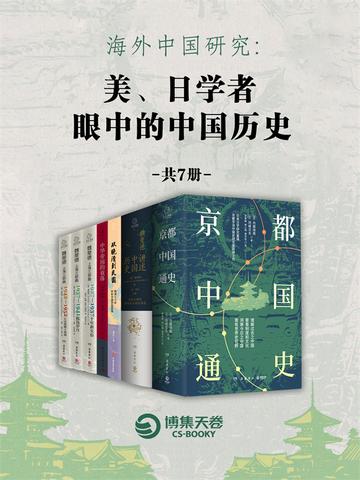
"Kyoto General History of China": This book is a general history of China written by Japanese historian Naito Konan and his disciple Okazaki Fumio.
The development of Chinese history is essentially the development of culture.
According to the different contents and forms of cultural development in each era, the author divides Chinese history into three periods: ancient times, medieval times, and modern times. In addition to comprehensively introducing the important events and typical figures of each period, he also focuses on elucidating the profound impact of the institutions and culture of each period on the process of Chinese history.
"Telling the History of China": This is a work by the American historian Wei Feide that analyzes Chinese history from a global perspective. It can be regarded as the culmination of 40 years of research on Chinese history!
The content covers many key issues in Chinese history, especially modern history, such as the evolution of Sino-Western relations, political changes in the Ming and Qing dynasties, modern China's understanding of the world, local history of Shanghai during the Republic of China, Chinese revolution and modernization, etc.
"From the Late Qing Dynasty to the Republic of China": The twists and turns of the Three Gorges of the Yangtze River are the pride of the Chinese people and a trendy area in China's natural history.
The Opium War opened the prelude to China's once-in-two-thousand-year "social and cultural transformation" phenomenon that began in the 19th century.
In the wise eyes of historian Tang Degang, the "humanistic view of history" is just like the "natural view of history." A war in 1840 not only set off a major change in China's social and political form, but also made the long history of history have to go through a hundred years of treacherous turbulence before it can enter the magnificent Pacific Ocean through the Three Gorges.
Tang Degang combines the historical perspective of the Three Gorges and humanistic exploration in this book, creating an objective and in-depth history of modern China.
"The Decline of the Chinese Empire": starting from the three groups of farmers, gentry, and merchants that constitute the main structure of traditional society;
A detailed analysis of how the Chinese Empire achieved order step by step;
Towards strength;
Getting into trouble; the process of establishing order again.
In terms of historical periodization of modern Chinese history;
Wakefield adopts the views of North American sinologists;
The narrative content not only includes the history after the Opium War, but also goes back to the late Ming Dynasty, making the work very characteristic of a "family story".
"Wilfield's Shanghai Trilogy (3 volumes in total)": Shanghai is a "Far Eastern metropolis", the place where many major historical events took place and where various contradictions gathered in modern China.
It reflects the modern history of China from the local history of Shanghai with a novel perspective.
From the turmoil in Shanghai in the first half of the 20th century, you can get a glimpse of the political ups and downs and social changes in modern China!
References were made to a large number of Shanghai municipal and police archives during the Republic of China, as well as archives in the Shanghai Municipal Archives and Library.
Reader comments
The writing style of this book is rigorous and the writing style is smooth. I like the division and explanation of Chinese history in the book, which gave me a clearer understanding of the development of Chinese history. Moreover, the book studies Chinese history from the perspectives of scholars from different countries, which gives people a lot of inspiration. I particularly like Naito Honan's perspective. He has a deep understanding of the development of Chinese culture. All in all, this is a great book worth reading!
We have basically no idea of the local history that is close at hand, but we are shaped by the impression of the distant empire.
The writing style of this book is rigorous and the writing style is smooth. I like the division and explanation of Chinese history in the book, which gave me a clearer understanding of the development of Chinese history. Moreover, the book studies Chinese history from the perspectives of scholars from different countries, which gives people a lot of inspiration. I particularly like Naito Honan's perspective. He has a deep understanding of the development of Chinese culture. All in all, this is a great book worth reading!
We have basically no idea of the local history that is close at hand, but we are shaped by the impression of the distant empire.