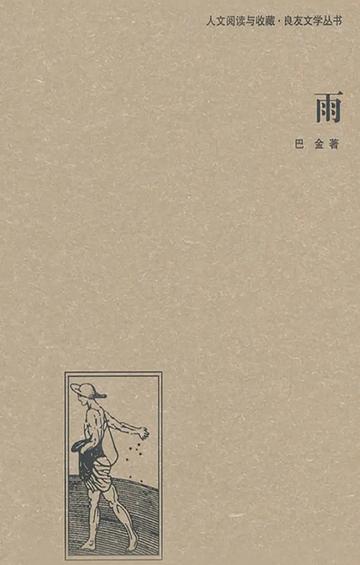
"Rain" is the second novel in Ba Jin's "Love Trilogy". It mainly tells the experience of Wu Renming, the friend of Zhou Ruyun, the protagonist in "Fog". He is full of revolutionary enthusiasm, but in the eyes of people around him, he is reckless and frivolous. Unable to be understood by everyone, he felt extremely lonely and had to turn to women for help, so he indulged in love. Ultimately, the self-sacrifice of women cheers him up and recommits himself to the revolution.
Reader comments
This book is based on the characters of the previous chapter "Thunder". Zhou Rushui is still tormented by the pain caused by his cowardice and indecision, so he has the idea of suicide; Wu Renmin enjoyed a short-term happy love, but it also shattered soon after, causing Wu Renmin to be greatly hit. At the same time, he was able to quickly realize that all this is a social system As a result, she re-invested in the revolutionary cause and became a perseverant character who would not be easily defeated by the setbacks of life. In the article, Li Peizhu is a brave and decisive career-oriented woman with independent thoughts and independent personality. The article shows various characters and reflects the different directions of life under various characters. Among them, I personally really like Wu Renmin's perseverance and independent thinking and brave women like Li Peizhu...
Compared with the previous film "Fog", which made people lament Zhou Rushui's cowardice and timidity in his treatment of love, the plot in "Rain" is more gloomy and makes people hate the social system at that time.
While describing the tragedy and comedy of love, the author also satirized the social environment at that time. Through Wu Renmin's perspective, he saw a lot of the prevailing customs and the thoughts of teenagers who were in desperate need of rescue.
After reading this book, I reflected on many shortcomings in my treatment of love, and taught me to face the conflict between love and career.
Maybe it's because I'm not old enough, but I feel that the ideas conveyed in "The Fog" are easier to discover. However, I did feel the melancholy that Balao mentioned in the preface. Chen Zhen, who cherished life, died earlier than his destined short life. Ruoshui, who was indecisive, ended his life with the only determination, and it was unknown. In fact, the reason why I read "Love Trilogy" is to extract some of Balao's views on love, so as to correct my own view of love. Therefore, I also ask book friends to give me some advice.
Benevolent people like Shui are brave and decisive, and they are also relatively clear-headed.
This book resonates with me very much, especially the character Wu Renming. He is full of passion but not understood. Just like when I am in love, there are times when I am not understood by others. But he finally cheers up in the self-sacrifice of women, which also reminds me of the sacrifice and growth in love. The descriptions in the book are very delicate, which made me feel the atmosphere of that era and the inner world of the characters. I like this book very much and recommend it to you!
Alas, the ending was unexpected. Mr. Xiong sacrificed himself and the protagonist paralyzed himself. In exchange for today's situation, someone still needs to hold the whip. Hats off to you, sir.
This book is based on the characters of the previous chapter "Thunder". Zhou Rushui is still tormented by the pain caused by his cowardice and indecision, so he has the idea of suicide; Wu Renmin enjoyed a short-term happy love, but it also shattered soon after, causing Wu Renmin to be greatly hit. At the same time, he was able to quickly realize that all this is a social system As a result, she re-invested in the revolutionary cause and became a perseverant character who would not be easily defeated by the setbacks of life. In the article, Li Peizhu is a brave and decisive career-oriented woman with independent thoughts and independent personality. The article shows various characters and reflects the different directions of life under various characters. Among them, I personally really like Wu Renmin's perseverance and independent thinking and brave women like Li Peizhu...
Compared with the previous film "Fog", which made people lament Zhou Rushui's cowardice and timidity in his treatment of love, the plot in "Rain" is more gloomy and makes people hate the social system at that time. While describing the tragedy and comedy of love, the author also satirized the social environment at that time. Through Wu Renmin's perspective, he saw a lot of the prevailing customs and the thoughts of teenagers who were in desperate need of rescue. After reading this book, I reflected on many shortcomings in my treatment of love, and taught me to face the conflict between love and career.
Maybe it's because I'm not old enough, but I feel that the ideas conveyed in "The Fog" are easier to discover. However, I did feel the melancholy that Balao mentioned in the preface. Chen Zhen, who cherished life, died earlier than his destined short life. Ruoshui, who was indecisive, ended his life with the only determination, and it was unknown. In fact, the reason why I read "Love Trilogy" is to extract some of Balao's views on love, so as to correct my own view of love. Therefore, I also ask book friends to give me some advice.
Benevolent people like Shui are brave and decisive, and they are also relatively clear-headed.
This book resonates with me very much, especially the character Wu Renming. He is full of passion but not understood. Just like when I am in love, there are times when I am not understood by others. But he finally cheers up in the self-sacrifice of women, which also reminds me of the sacrifice and growth in love. The descriptions in the book are very delicate, which made me feel the atmosphere of that era and the inner world of the characters. I like this book very much and recommend it to you!
Alas, the ending was unexpected. Mr. Xiong sacrificed himself and the protagonist paralyzed himself. In exchange for today's situation, someone still needs to hold the whip. Hats off to you, sir.