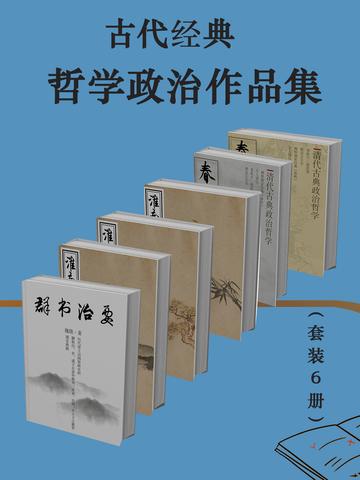
This is a collection of ancient classic philosophical and political works, including 6 volumes such as "Spring and Autumn Fan Lu", "Huainanzi" and "Qunshu Zhiyao".
"Spring and Autumn Fan Lu" is a political philosophy work written by Chinese Han Dynasty philosopher Dong Zhongshu.
"Huainanzi" is a philosophical work collectively compiled by the Western Han Dynasty royal family Huainan King Liu An and his disciples who collected historical materials. It contains rich historical research value and spiritual wisdom.
"Qunshu Zhiyao" is a classic compiled by Emperor Taizong of the Tang Dynasty in the early years of Zhenguan. It brings together the essence of thoughts on self-cultivation, family order, country governance, and world peace among classics, histories, and scholars before the Tang Dynasty.
For readers who are interested in this kind of subject matter, this set of books is worth reading carefully.
"Huainanzi" takes Taoism as its sect, synthesizes the thoughts of various schools of thought, and builds a philosophical system of thought with Taoism as the main body.
The book provides a new interpretation of governance by doing nothing, advocates proactiveness and enterprising, and makes useful explorations into the ways of governing the country.
It made extensive and in-depth discussions on astronomy, geography, and seasons, and used Taoism as its basis to explain various natural phenomena, making important contributions to the development of science and technology in ancient my country.
On the basis of inheriting the Taoist thoughts of the pre-Qin Dynasty, this book synthesizes the best parts of the theories of various schools of thought, and plays an irreplaceable role in the study of the culture of the Qin and Han Dynasties in later generations.
On the basis of inheriting the Taoist thoughts of the pre-Qin Dynasty, "Huainanzi" combines Yin-Yang, Mohism, Dharma and part of Confucianism, but its main purpose belongs to Taoism.
The author believes that this book contains broad and bright principles like Tao.
"Spring and Autumn Fanlu" advocated Gongyang Studies and carried out the purpose of "unification of the Spring and Autumn Period". It expounded the philosophical-theological theory centered on Yin-Yang and the Five Elements, and the interaction between heaven and man. It promoted the theory of human nature of "three qualities of nature", the ethical thought of "the three cardinal principles of the king's way can be sought from heaven" and the historical view of the cycle of the three unifications of red, black and white. It laid the theoretical foundation for the centralized feudal governance system of the Han Dynasty.
In the middle of the Western Han Dynasty, the separation of vassal kingdoms with frequent wars basically ended, production was restored and developed, centralization of power was consolidated and strengthened, and a situation of economic prosperity and political unification emerged.
In order to meet the needs of unified centralization, Dong Zhongshu's theological idealistic philosophy came into being. His philosophical thoughts are mainly reflected in his "Spring and Autumn Fanlu".
"Qunshu Zhiyao" is a collection of the most essential wisdom on state governance from sixty-six classics selected by Wei Zheng and other officials from the vast pre-Tang Dynasty. Its content covers the "Five Classics" (Poems, Books, Rites, Yi, Yi, etc.). Spring and Autumn Period), the "First Four Histories" ("Historical Records", "Hanshu", "Later Hanshu", "Three Kingdoms") and "Jin Shu", as well as hundreds of schools of thought, such as Mohism, Taoism, Legalism, Agriculture, Military, etc., Are considered to be the essence of China's excellent traditional culture.