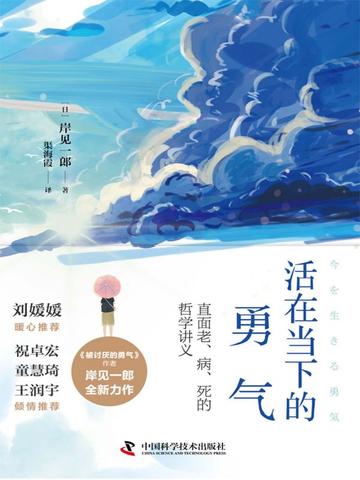
How to correctly face uneasiness and fear, let yourself go through the thorny and dangerous roads in life, and live out your own meaning of life is a major topic that has attracted much attention at present.
If you don't feel happy, it's largely because your understanding of "aging, disease, and death" is biased.
This book is another new work by the Japanese writer Ichiro Kishimi following the "Courage Series" such as "The Courage to Be Disliked" and "The Courage to Be Happy".
The book is divided into 6 lectures, starting from "What philosophy can do", "How to obtain happiness", "Interpersonal relationships are the source of troubles", "Learning from aging and illness", "Death is not the end", and "Living in the present".
Reader comments
Living in the present requires courage!
The past cannot be changed and the future is full of variables.
Don't always be bound by the past, and don't worry too much about the future.
Focus on the present moment, the only moment we can truly grasp.
Anxiety often stems from fear of the future, while regret stems from obsession with the past.
Only by bravely standing on the present moment and devoting yourself wholeheartedly to this moment can you truly feel the beauty of life.
No matter what setbacks you have experienced, now is the best time to start over.
No matter how uncertain the future is, every step taken now determines the direction of the future.
[Three core questions]
1. How can we truly live in the present?
: Abandon regrets about the past and anxiety about the future, devote yourself to every moment of the present, and face current experiences with a positive attitude.
(It is meaningless to always be immersed in the failure experience of past work; focus on the current work tasks, have no distracting thoughts, pay attention to the current operation, and the work results will naturally be significant)
2. Does living in the present make people short-sighted?
: No, living in the present means focusing on the things in front of you, not without considering the future, but planning for the future based on the present.
(When reviewing in the classroom, just focus on the current knowledge points and don't think about the test results; when making study plans, make arrangements based on your own abilities and test goals)
3. How to cultivate the courage to live in the present?
: Through self-awareness, accepting one's imperfections, letting go of past baggage and excessive expectations for the future.
(The reason for escaping from the present is very important and varies from person to person; only by self-reflection and accepting your current situation can you gradually have the courage to face the present)
Content Sharing
1. "The role of philosophy is not to possess knowledge, but to enable people to understand how to live."
2. "There is no universal meaning in life. The meaning is given by oneself."
3. "We often suffer not because of the 'trauma' in our own experiences, but because we want to escape the pain caused by the 'trauma'."
4. "Not being afraid of being disliked but moving forward courageously, not following the crowd but marching forward bravely, this is freedom for people."
5. "What determines us is not our past experiences, but the meaning we give to our experiences."
This book touched on the correct attitude when facing aging, illness and death. Some of the ideas in the book are thought-provoking, such as "Death is not the end", which gave me a new understanding of life. However, I kind of hated the character in the book who was always complaining, his negative attitude was irritating. Overall, this is a courageous and inspiring book worth reading.







Living in the present requires courage! The past cannot be changed and the future is full of variables. Don't always be bound by the past, and don't worry too much about the future. Focus on the present moment, the only moment we can truly grasp. Anxiety often stems from fear of the future, while regret stems from obsession with the past. Only by bravely standing on the present moment and devoting yourself wholeheartedly to this moment can you truly feel the beauty of life. No matter what setbacks you have experienced, now is the best time to start over. No matter how uncertain the future is, every step taken now determines the direction of the future. [Three core questions] 1. How can we truly live in the present? : Abandon regrets about the past and anxiety about the future, devote yourself to every moment of the present, and face current experiences with a positive attitude. (It is meaningless to always be immersed in the failure experience of past work; focus on the current work tasks, have no distracting thoughts, pay attention to the current operation, and the work results will naturally be significant) 2. Does living in the present make people short-sighted? : No, living in the present means focusing on the things in front of you, not without considering the future, but planning for the future based on the present. (When reviewing in the classroom, just focus on the current knowledge points and don't think about the test results; when making study plans, make arrangements based on your own abilities and test goals) 3. How to cultivate the courage to live in the present? : Through self-awareness, accepting one's imperfections, letting go of past baggage and excessive expectations for the future. (The reason for escaping from the present is very important and varies from person to person; only by self-reflection and accepting your current situation can you gradually have the courage to face the present) Content Sharing 1. "The role of philosophy is not to possess knowledge, but to enable people to understand how to live." 2. "There is no universal meaning in life. The meaning is given by oneself." 3. "We often suffer not because of the 'trauma' in our own experiences, but because we want to escape the pain caused by the 'trauma'." 4. "Not being afraid of being disliked but moving forward courageously, not following the crowd but marching forward bravely, this is freedom for people." 5. "What determines us is not our past experiences, but the meaning we give to our experiences."
This book touched on the correct attitude when facing aging, illness and death. Some of the ideas in the book are thought-provoking, such as "Death is not the end", which gave me a new understanding of life. However, I kind of hated the character in the book who was always complaining, his negative attitude was irritating. Overall, this is a courageous and inspiring book worth reading.