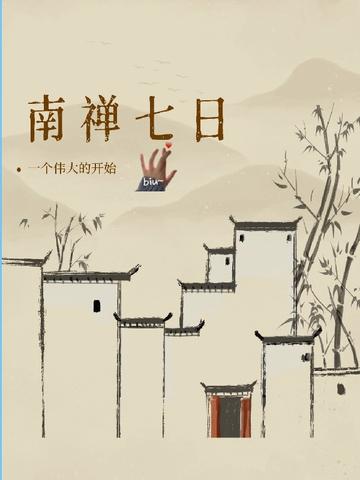
Seven Days of Meditation, also known as A Study of Life Sciences and the Practice of Chan, features lectures by Mr. Nan Huaijin, a renowned scholar celebrated both in China and abroad. Born in 1918 into a scholarly family in Yueqing County, Wenzhou, Zhejiang, he is now 85 years old. He received his earliest instruction at home and studied the works of the ancient masters from a young age. When the War of Resistance Against Japan broke out, the young Nan Huaijin put down his writing brush, joined the military, and rode across the southwestern frontier. He later returned to Sichuan and taught at the Central Military Academy and Jinling University. Blessed with an independent spirit and unwilling to be constrained by worldly things, he would spend his holidays and spare time traveling through famous mountains and rivers in straw sandals, carrying a bamboo staff, seeking out eminent monks and extraordinary people. He once withdrew to Daping Temple on Mount Emei, where he spent three years in retreat and read the vast collection of the Buddhist canon. He then traveled through Kang and Tibet, visiting eminent masters of Esoteric Buddhism and studying the different schools of Tibetan Buddhism in depth. After leaving Tibet, he went to Kunming, where he first lectured at Yunnan University and later taught at Sichuan University. After the victory in the War of Resistance, he returned to his hometown. Before long, he withdrew from public life to Mount Tianzhu in Hangzhou and Mount Lu in Jiangxi, devoting himself to scholarship. After moving to Taiwan, he was successively appointed to positions at Chinese Culture University, Fu Jen Catholic University, and other universities and research institutes. He also taught in Japan, the United States, and countries in Central America. In recent years, he has moved to Hong Kong, where he has done extensive work to foster cultural exchange across the Taiwan Strait. Mr. Nan Huaijin is well versed in the classics, history, philosophy, and literature, and has a profound understanding of both Eastern and Western cultures. His knowledge is vast, and his publications are numerous. In particular, his method of drawing on the classics and historical texts together to explain famous works of Confucianism, Buddhism, and Daoism, supported by extensive references and insights spanning ancient and modern times, is profound, lively, and humorous. His achievements in popularizing traditional Chinese culture have been remarkable, and his works are beloved by readers of all backgrounds on both sides of the Taiwan Strait.


I have to say that the key points of meditation knowledge and skills in general and detailed terms are explained very well. After reading it, I feel very calm and open-minded. I read it three times and still need to read it carefully.
After reading this book, people have become much more enlightened, and their belief in daily meditation has become firmer! It is highly recommended. Nanshi has a simple and concise introduction to many Buddhist scriptures, clarifying the direction and choice of reading!
Deep and simple, easy to pick up, everything becomes interesting. He is really a master.
Good book, worth reading several times
Interesting, informative and inspiring
The so-called "reading a good book" after getting the secret is like telling the truth to thousands of words in one sentence. Nan Lao just put the finishing touches on it and brought out the wisdom eye. Whether he can do it or not is entirely up to the individual.
Use plain language to describe profound truths.
The meaning is endless
Wish you all the best to Mr. Nan Huaijin!
Words to busy beings in this noisy world!